








What is to be done with Iran's nuclear material? US & Israel should remove it militarily, says former DM Gallant
Trump reiterates: Nuclear material will be removed in a deal or a military operation
The nuclear material remaining in Iran can and should have been removed via military means, Israel’s former defense minister, Yoav Gallant, told Army Radio on Monday, as the nuclear issue once again appears to be a central bone of contention in the peace talks between Washington and Tehran.
While U.S. President Donald Trump has recently presented the reopening of the Strait of Hormuz as a given in any agreement, the nuclear issue remains undecided.
Three weeks ago, two senior Iranian sources told Reuters that Iranian Supreme Leader Mojtaba Khamenei forbade sending the material outside the country under any deal, while Israeli officials have told the outlet that Trump has assured Israel that the peace deal would include the removal of the material.
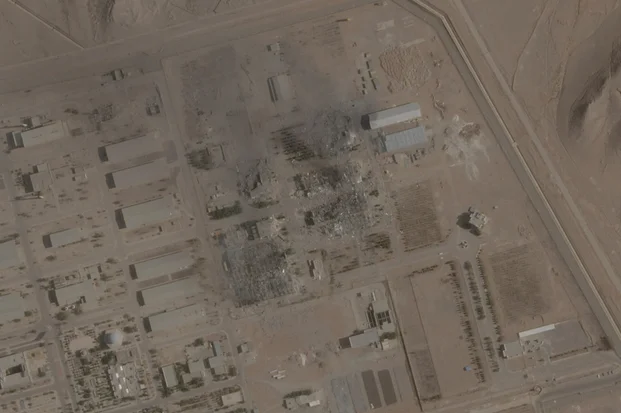
This, ostensibly, leaves only the military route, through a highly complicated and risky operation to retrieve the dangerous material that is buried deep under the rubble of the nuclear sites in Natanz and Fordow, which were bombed by the U.S. last year.
Gallant, a former commander of the elite naval commando Shayetet 13 unit, acknowledged that it would be dangerous, but “worth paying the price to avoid an existential risk. I never sent people on more dangerous operations than what I did myself.”
“The IDF and US military had the capability to physically extract the enriched uranium from Iran,” Gallant told the radio station, “in the situation we’ve come to, that was the only option to achieve the necessary goal. That’s what the campaign was for – to stop the nuclear program.”
“The uranium enriched to high and medium levels represents 30 years of Iran’s nuclear efforts. If you bring it to you, you’ve set them 30 years back,” he argued.
Trump has talked about the removal of what he calls the “nuclear dust” several times in recent days. The estimated more than 900 pounds of up to 60% enriched uranium are stored in gaseous form in tank-like cylinders, which could be packaged into large containers.
Speaking to NBC News’ “Meet the Press” on Sunday, Trump said that a deal was “very close” while stressing he wants “airtight language” to decisively end the regime’s pursuit of nuclear weapons.
Despite reports of Khamenei’s order, he said he would cooperate with the regime to remove the material under a potential deal, but threatened that a military option is on the table as well.
“If we make a deal that now we’re friendly, we’ll all go together. It’ll be our equipment. We’ll take it out and destroy [the material], whether it’s on-site or whether we take it off-site.”
“If we don’t make a deal, then we’re going to take them out militarily, very harshly. And we’ll wait ’till we do that before we go, in which case we’ll have safety either way,” he said.
Trump also told reporters last Thursday that he weighed ordering a military retrieval operation at the start of the war but decided against it due to the risks.
“Getting there [Iran] is not like Venezuela. You have to be there for two weeks. You need a lot of equipment,“ Trump said.
Meanwhile, UN nuclear watchdog chief Rafael Grossi urged the Iranian regime on Monday to “re-engage” with the International Atomic Energy Agency and allow inspections at its nuclear sites.
At the same time, the U.S., with the support of Great Britain, France and Germany, is pushing for another resolution ordering the regime to provide “precise information” on the bombed sites and the enriched uranium.
Popular article:
interview Easter message of resurrection hope amid war at Jerusalem's Garden Tomb
biblical commentary Let my people go: a Passover message for today
4 IDF soldiers killed, 2 wounded in fighting in southern Lebanon, as Israel eliminates dozens of Hezbollah terrorists

Receive latest news & updates
A message from All Israel News
Help us educate Christians on a daily basis about what is happening in Israel & the Middle East and why it matters.
For as little as $10, you can support ALL ISRAEL NEWS, a non-profit media organization that is supported by readers like you.
Latest articles:
North American Jewish organizations to recruit 100 professionals to combat antisemitism
‘No need’ for pre-election Iran strike, IDF chief says as gov’t, opposition trade blame for potential escalation – report
terror attack 2 Israeli soldiers killed, 2 terrorists eliminated in Hebron shooting; IDF says much larger attack was prevented
analysis A people dwelling securely? Israel’s strategic standing, 3 years after Oct 7
Hamas on wheels: What I found in Dearborn reveals a troubling history and a battle over Israel