Christian Israeli leader says government should grant a separate status to Christians; will run for Knesset
Christian voices in Israel
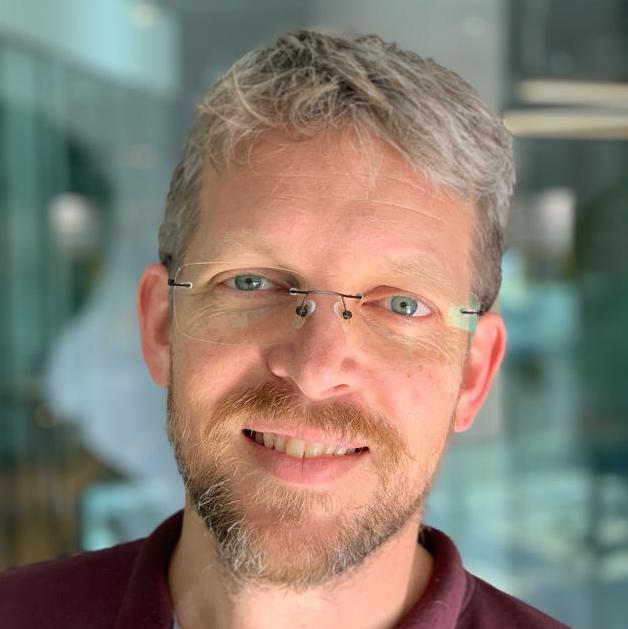



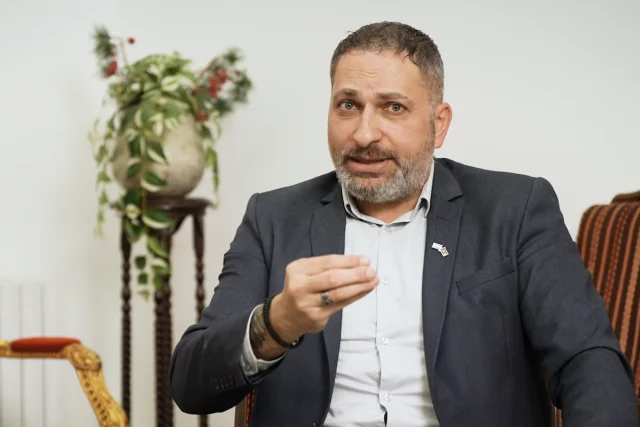
Amid several incidents of disrespect or outright violence, one Israeli Christian leader is pushing for the government to recognize a separate status for Christians.
Ihab Shlayan, a rising leader in the Israeli Christian community, said the lack of government recognition and representation is a serious problem for the Christian community.
“If I need something from the Knesset or from the government or from the president, who can I call?” Shlayan asked. “I don't want something for me. I want for my community. Who can I call? Why for all the other communities here, they have a proper politicization, a representation in the Israeli institution.”
Because of this, Shlayan recently decided to run for a seat in the Knesset – a controversial decision within his community, which has traditionally avoided politics. However, Shlayan sees it as a necessary task.
ALL ISRAEL NEWS interviewed Shlayan as part of a series exploring Christian voices in the Holy Land.
Shlayan recently began campaigning for support among Israeli Christians, in an effort to raise awareness for his community in Israeli politics. Although he didn’t elaborate on his political ambitions, his organization, Israeli Christian Voice, posted a statement on Facebook announcing that he was joining the Democrats party, headed by Yair Golan.
“We are with Ihab Shlayan and see maintaining our identity as Christians as something fundamental that cannot be compromised,” the statement read. “As Jesus Christ said, we do not hide the light and we do not hide our cross or our faith.”
The statement reflects the complicated position in which indigenous Christians frequently find themselves.
“We are not with the extreme right that does not want us, that sees us as foreigners and does not accept our true existence because from their perspective, we are considered messianics (Christians) and this is unacceptable to them. And we are not with the communists or the Arab parties that do not see us and do not give room for our identity,” the statement continued.
“We chose our path as Israeli Christians with our identity in our roots and our faith while striving for security, stability and a strong government. The time has come for the state to recognize us as a Christian community like the other communities.”
Shlayan was a career officer in the military, serving 24 years. In the Oct. 7 war, he served as a reservist. He actively encourages young Israeli Christians to enlist in the IDF, an unpopular stance among the Arabic-speaking population in Israel.
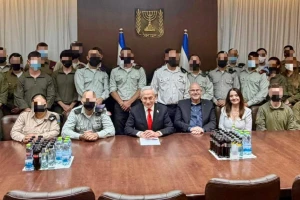
In recent months, Shlayan participated in Israeli President Isaac Herzog’s annual reception for Christian leaders. He also joined Prime Minister Benjamin Netanyahu's meeting with Christian soldiers, and has met multiple times with U.S. Ambassador to Israel Mike Huckabee to speak about the situation of Christians in Israel.
It was during Shlayan’s time in the military that he first began to understand the importance of his Christian identity, which eventually led him to partner with another Israeli Christian with significant IDF experience, Shadi Khalloul, to petition the Israeli government to recognize Aramean Christians as a distinct group in Israeli society. They succeeded in 2014.
While in the military, Shlayan was first placed with a Bedouin unit, but due to cultural differences, he never fit in. He was later transferred to a Jewish unit, but because of his poor Hebrew at the time, and the misunderstanding of many Israeli Jews over differences between Muslims and Christians, he found that the label Arab Christian still caused problems.
“At the beginning, when I enlisted to the army, I called myself Arab,” Shlayan said. He only later came to understand that his choice to identify as an Arab Christian was part of the friction with the Jewish soldiers, who associated the label “Arab” with Islam and Israel’s political enemies.
In Israel, the majority of the Christian community speak Arabic as their mother tongue. However, most do not fit into the broader Israeli Arab society, due to their Christian culture and faith. Most of the approximately 2.1 million Arabs living in Israel are Muslims. Only around 185,000 people in Israel define themselves as Christian, with most of those, about 79%, coming from the Arab Christian community.
The Israeli government treats all of these as one community, which Shlayan said is problematic for the Christians.
“We learn about the Arabs and the Muslim religion,” Shlayan explained. “We didn’t learn about our history.”
In contrast, other minorities, such as Druze and Circassians, have their own status, and their own educational tracks within the public education system.
Many Israeli Christians, both from the Arabic speaking community and the Armenian community, describe feeling like “a minority within a minority.” They do not belong to the Jewish majority, but they also do not identify with the large Arab Muslim minority.
However, in the IDF Shlayan’s knowledge of the Arabic language proved useful, and led to him being transferred to the Communications Division, and eventually being accepted into officer’s training.
During that service, Shlayan and Khalloul, began to encourage enlistment among the Israeli Christian community, which has traditionally avoided military service.
While Arabic remains a crucial part of Shlayan’s life, he said that use of the language is not enough to define a person’s identity in Israel, pointing to the large Mizrachi (Middle Eastern) Jewish population in Israel, many of whom also speak Arabic.
Shlayan also explained that after living among the Muslim Arab community for hundreds of years, many Christians are afraid to speak out against Muslim harassment. He pointed out that while many Christians in Israel call themselves Arabs, they do not want to live in the surrounding Arab countries.
“But the majority of the Christian community, do you think they want to live In the Arab countries?” Shlayan asked, “I'm telling you, no.”
He said that the ongoing persecution of Christians in Muslim countries, which has led to a dramatic decline in the Christian populations of almost every Middle Eastern nation, is the reason.
Shlayan said some in the Christian community are beginning to understand that things in the Middle East are changing.
“We thought that to be a sheep next to the wolf is better for you,” Shlayan said, explaining why Christians have been willing to criticize Israeli harassment of Christians, but remain largely quiet about Muslim harassment and persecution. “But now to be a sheep next to the wolf [means you] will be eaten.”
Although he is adamant about establishing a national Christian identity, Shlayan believes in separation of church and state. He said that having a Christian representative in the government will free the religious leaders to focus on their spiritual duties.
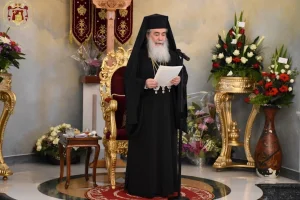
However, his political actions have led to opposition from some church leaders, with the Jerusalem Patriarchate recently issuing a statement attacking Christian Zionism and claiming to be the only legitimate voices to represent the Christian community in the Holy Land.
Shlayan, who calls himself a Christian Zionist despite his Greek Orthodox Church membership, said some Christian leaders have privately supported him.
He related that one church leader recently told him, “Ihab, I cannot say that I'm supporting you because you know where I live…But, we are just waiting for one leader to take the ship and help us.”
His message to the clergy is to not attack Israel publicly.
“I'm asking them, ‘Don't use the propaganda against Israeli Christians,’” Shlayan said, “because in the end, the Christians will suffer from this issue.”
You might also like to read this: