Arabic news outlet under fire for interviewing IDF about Hezbollah tunnel in Lebanon
Al-Hurra journalist argues he only wants to show facts on the ground






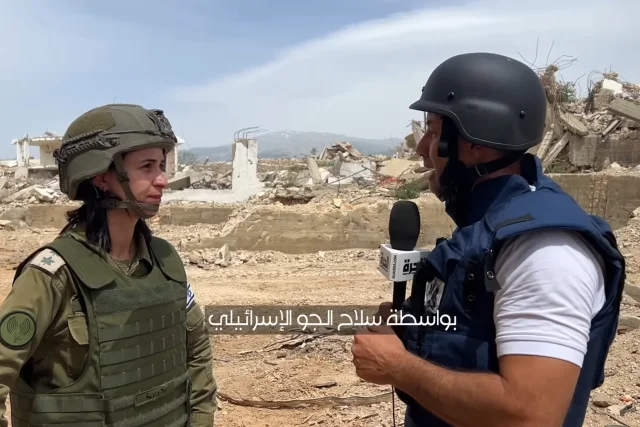
An Arabic-language news outlet recently drew strong criticism as a journalist was sent to see Hezbollah’s terror tunnels with his own eyes, and then interviewed the IDF’s new Arabic Spokeswoman, Lt.-Col. Ella Waweya.
Al-Hurra is an Arabic-language news outlet based in the U.S. and funded by the American government, but employs mostly native Arab speakers. The journalist, Yahya Qassem, recently dared to ignore the overwhelming stigma against direct contact with Israelis, let alone with the Israeli military, across the Arab world.
“The camera of Al-Hurra enters one of Hezbollah's tunnels in the town of al-Khiam in southern Lebanon, at a depth of 25 meters underground, and documents what the confrontations have left behind in one of the most tense border areas,” the outlet wrote on 𝕏, alongside the video showing Qassem accompanying IDF soldiers into a tunnel hidden under a clothes shop.
كاميرا "الحرة" تدخل أحد أنفاق حزب الله في بلدة الخيام جنوبي لبنان، على عمق 25 مترًا تحت الأرض، وتوثّق ما خلّفته المواجهات في واحدة من أكثر المناطق الحدودية توترًا. pic.twitter.com/EN0We8NTeQ
— قناة الحرة (@alhurranews) May 15, 2026
Waweya, widely known as "Captain Ella," had exposed the innocent-looking shop belonging to a charitable organization in a previous video, showing the entrance to a 25-meter deep tunnel that was hidden under the floors.
As part of the report, Qassem spoke with Waweya directly, asking her whether it was Israel that had ignored the ceasefire in Lebanon, where the IDF and Hezbollah have been trading fire for weeks.
Unusual for Arabic-language media, Qassem also presented the Israeli side when mentioning the number of Lebanese killed in recent fighting, by noting that the IDF has said that the overwhelming majority of those killed were linked to Hezbollah.
🔎LOCATED: A 25-meter-deep underground Hezbollah command center inside a clothing store in Al-Khiyam.
— Israel Defense Forces (@IDF) April 23, 2026
Inside it were weapons and rooms used for managing terror operations by the terrorist organization’s operatives. pic.twitter.com/J7zg6G5qzO
Most of the reactions to the report in the comments were hostile, and the Qatari state-owned outlet Al-Araby Al-Jadeed even published an article accusing al-Hurra of speaking “on behalf of the Israeli army.”
The report “has nothing to do with journalism, but is merely a blatant propaganda presentation for the Israeli army, formulated entirely with the eye of the occupation and its language and vocabulary,” the article claimed.
“This is not journalistic coverage from the heart of the war, but rather a literal translation of the Israeli military narrative into Arabic, with all its justifications for the invasion and its reshaping of reality according to the perspective of the occupation itself,” it concluded.
Speaking to Ynet News about the report and the reactions he received, Qassem explained that all he wanted to do was expose the facts as he saw them.
#مشاهد خاصة من داخل بلدة الخيام جنوب لبنان، تحت دكان ملابس يُعرف باسم “مشروع بقية الله الخيري” ويبدو كمكان مدني عادي، عثرت قوات جيش الدفاع الإسرائيلي على مقر قيادة تابع لحزب الله على عمق نحو 25 مترًا تحت الأرض. pic.twitter.com/BkVsN7PkXy
— Lieutenant Colonel Ella Waweya | إيلا واوية (@CaptainElla1) May 10, 2026
“There is a tunnel beneath a clothing store intended to allow Hezbollah operatives to stay there for a certain period before carrying out attacks,” he said. “When the IDF enters southern Lebanon and says, ‘I’m entering because of Hezbollah,’ in the Arab world it is perceived as propaganda, as something untrue. I came and showed that it is true, that the IDF entered because there is a specific threat.”
“What matters to me is the truth. I saw with my own eyes that there is a tunnel. I saw that money and resources were invested in it, and I understand that ultimately it also harms the Lebanese,” he added.
He also noted that he tried to expose all sides of the issue, highlighting that he reported on “the total destruction in Khiam. I raised questions such as whether the residents of Khiam can return there or not. At the same time, I talked about it being a Hezbollah stronghold. The next day, I did another report from inside the tunnel and exposed things that many Arabic-language media outlets are unable to show because they know they will receive reactions like the ones I got.”
Al-Araby Al-Jadeed has specifically claimed that the report didn’t “remind viewers that Khiam is a Lebanese city that suffered massive bombardment and destruction at the hands of the occupation.”
For Waweya and the IDF, the report from al-Hurra was a rare coup that enabled parts of the Arab world to see things from the Israeli perspective.
The work of her unit is intended to “allow the public in the Arab world to see reality directly,” Waweya told Ynet.
“Ultimately, when Arab reporters enter the field together with IDF forces and see with their own eyes tunnels, weapons and Hezbollah terror infrastructure embedded within civilian areas, they are not required to rely on videos or claims from one side or another, but instead report what they themselves witness on the ground,” she said.
“I think that once reporters see from the field where Hezbollah places its terror infrastructure, they understand that it uses Lebanese civilians as human shields and that the attacks and destruction it brings upon them are outrageous.”
You might also like to read this: