After killing Hamas leader in Gaza, Israel ready to begin dismantling terror group 'one way or another’
Failure to disarm could lead to imminent resumption of military operations in Gaza Strip





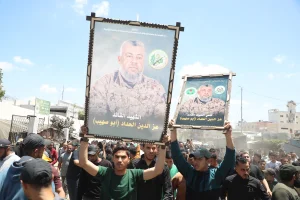
Following the killing of top Hamas military commander, Izz al-Din al-Haddad, on Friday, Israel assesses that it may have another opportunity to disarm the terror group.
A senior official involved in efforts to implement the U.S. peace plan in Gaza told Ynet News that al-Haddad’s killing proves Hamas can be disarmed, “one way or another.”
While the U.S. plan calls for Hamas to disarm willingly, “the killing of Hamas military wing chief Izz al-Din al-Haddad proves that dismantling Hamas is possible the hard way, too,” the official told Ynet.
The official also said that al-Haddad’s assassination “may move them to agree to disarm voluntarily, but it also may not.”
“"Hamas will disarm, one way or another,” the official said. “The more they do so voluntarily, the better it will be for them. The longer this is delayed, the worse it is for everyone, including them. It is a win-win or a lose-lose — but in the end, they will disarm.”
The U.S. plan for the rebuilding of Gaza has been stuck for several months, largely due to Hamas’ unwillingness to disarm. Upset with the lack of progress, the U.S. proposed a disarmament in stages, which was also rejected by the terror group.
Just last week, the Gaza envoy for the Board of Peace, Nickolay Mladenov, said that while there have been ceasefire violations by both sides, Hamas’ unwillingness to disarm is the principle sticking point, preventing the Gaza Peace deal from advancing.
“You cannot build a future with armed groups running the streets, hiding in tunnels and stockpiling weapons. You cannot deliver reconstruction with militias on every corner,” Mladenov told reporters in Jerusalem.
Mladenov also accused Hamas of “consolidating” its power in the Gaza Strip, while refusing to adhere to the terms of the October 2025 ceasefire agreement.
“Hamas is consolidating its grip on the population. It is taxing people in the street who have nothing left to give,” Mladenov said.
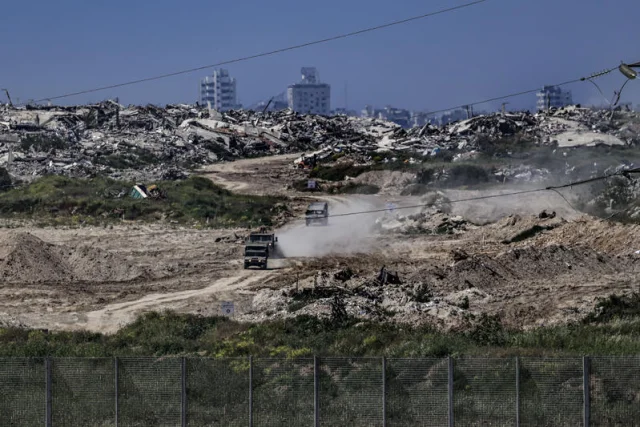
While the administration of U.S. President Donald Trump is reportedly in favor of shifting the focus of reconstruction efforts to the territory controlled by Israel, Hamas appears to be resisting such efforts, which would undermine its control over the Gaza population.
Last week, Hamas prevented a group of Palestinian contractors from the territory it controls in Gaza from entering the Israeli-controlled area behind the Yellow Line. According to a report in public broadcaster Kan News, armed Hamas operatives threatened the contractors, preventing them from entering the Israeli-controlled area where they were to start work on a construction project funded by the United Arab Emirates. The project is being overseen by the U.S.-run Civil-Military Coordination Center in Kiryat Gat.
On Sunday morning, Kan reported that Mladenov has continued discussions with Hamas over the entry of the Palestinian technocrat leaders from the National Committee for the Administration of Gaza (NCAG).
The Israeli leadership is weighing resuming military operations in the Gaza Strip, and the killing of al-Haddad appears to be a signal of intent on the part of the Israeli government. Shortly before the start of Operation Roaring Lion, Kan News reported that Israel was strengthening anti-Hamas militias in Gaza ahead of a plan to resume military operations against the terror group.
The killing of al-Haddad, Hamas' top military commander in Gaza, could lead to a softening of Hamas’ position. While a number of Qassam Brigade commanders are believed to remain in Gaza, it is unclear if they would be willing to make concessions.
Among these is Hussein Fayyad, also known as Abu Hamza, the commander of the Beit Hanoun Battalion in the Qassam Brigades. Fayyad survived an assassination attempt in Jabaliya in May 2024.
He was initially declared to have been eliminated by the IDF, but following his reappearance in early 2025, the military acknowledged that “the intelligence information relied upon by military intelligence and the Shin Bet was not sufficiently accurate.”
Another military commander is Mohammed Odeh, the head of Hamas’ intelligence division. Odeh is considered one of the few remaining senior commanders in Gaza.
A third commander, still believed to be living, is Haitham al-Hawajri. Al-Hawajri is the commander of the Shati Camp Battalion. He led invasion operations on Oct. 7, 2023, and oversaw Hamas activity in the vicinity of al-Shifa Hospital. He was also unsuccessfully targeted by Israel in the first few months of the war. However, in January 2025, he was seen during the release of American-Israeli hostage Keith Siegel.
Like al-Haddad, each of these commanders is believed to be committed to Hamas’ ideology, and their willingness to compromise remains unknown.
If they also prove to be unwilling to compromise, a resumption of fighting in Gaza could take place in the near future.
“Hamas has been in violation of the agreement for several weeks, with all the implications," the official who spoke with Ynet stated. “As President Trump said, ‘Hamas will disarm the easy way or the hard way.’”
“They put themselves in this situation, and the dismantling will happen in any case,” the official concluded, stating, “We are not telling Israel whether to resume fighting. That is Israel’s decision.”
You might also like to read this: