How Tel Lachish testifies to ancient battles of Israel





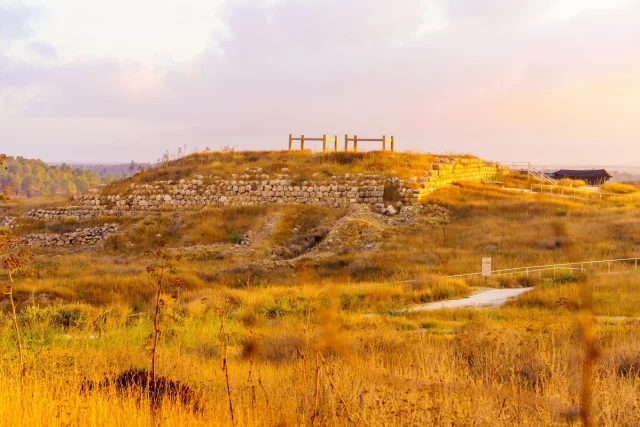
The remains of the ancient city at Tel Lachish provide some of the best-preserved archaeological evidence of battles described in the Bible. The hilltop fortress at Mount Lachish was once the second most important city in the Iron Age kingdom of Judah, after Jerusalem.
Situated between the port cities of Ashkelon and Gaza and the hills of Hebron, Lachish was a strategic and important trade hub. It was at the intersection between the road of Via Maris and the road on the way to Jerusalem, according to tour guide Levi Simon.
Lachish had previously been a Canaanite city led by King Japhia, but was conquered by the Israelites under Joshua, along with five other Canaanite cities, when the sun famously stood still for an hour. But in 701 BC, it would be Hezekiah, king of Judah, who would be in trouble.
Simon described Hezekiah as “a mighty king of Judea” who accomplished radical reforms and “brings the worship back to Jerusalem.”
However, it was while Hezekiah was ruling from Jerusalem that King Sennacherib of Assyria came with his army and overtook the city of Lachish.
“What I'm looking at behind me is the oldest military ramp that we have in the world, and we can see the military strategies of Sennacherib right here,” Simon tells ALL ISRAEL NEWS correspondent, Oriel Moran. “He had some of the most brutal military strategies that we have ever heard of.”
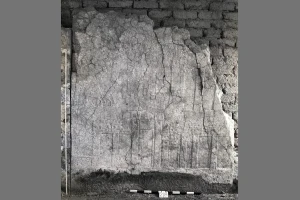
The grim details of those battle strategies were portrayed in graphic form on what are known as the Lachish Reliefs, a series of stone carvings displaying the Assyrian conquests in all their gory glory.
“These are all depicted in reliefs found in Nineveh in the 19th century by a British archaeologist,” Simon continues. “The battles are mentioned in the book of Kings and in the book of Chronicles… but most of these battles were recorded in these ancient reliefs and cuneiform letters.”
The siege and conquest of the heavily fortified city are mentioned in the Bible in 2 Kings 18–19, 2 Chronicles 32, and Isaiah 36–37, and are well-attested by archaeology, including the Lachish reliefs.
“Even before this discovery, perhaps no event in biblical history was more corroborated than Assyrian King Sennacherib’s military campaign into Judah,” writes Brent Nagtegaal of the Armstrong Institute of Biblical Archaeology.
Seeing the enormous siege ramp makes it easy to imagine the Assyrian army swarming around Lachish, preventing food and water from entering the city, and preparing to breach the walls.
“Now, Hezekiah thought this would happen since they had already heard about the total destruction of all the other 43 cities inside of Judea,” Simon told Moran, painting the picture of the historical events. “This was a disaster.”
“From here, you could actually see the hilltop of Azakah, which was also a major city in Judea, which was completely destroyed. They saw the pillars of black smoke already coming from there… So the people were getting worried,” he explained.
“The Assyrian kingdom were masters at psychological warfare, and they did pretty horrible things that we can see on the reliefs,” he continued. “They would chop the heads off of the prisoners of war and then with a big spear kind of circle around where we're standing now so the people inside of the city could see it.”
Simon described the fear that would build as they saw the Assyrians constructing the siege ramp up to their city walls.
“This is the original ramp,” he pointed out. “It hasn't been tampered with. They just took stones from all around, about 20,000 tons worth of rocks and rubble, which they then collected here and accumulated to then create this ramp going up. This really started a huge fear factor inside the city.”
To visually represent all the kings of Judah, the site at Tel Lachish features a series of chairs with backs of different heights, one for each king. As far as the kings of Judah go, Hezekiah was a good one, trusting God for help in the face of extreme threat.
“Incline your ear, O Lord, and hear; open your eyes, O Lord, and see; and hear the words of Sennacherib, which he has sent to mock the living God. Truly, O Lord, the kings of Assyria have laid waste the nations and their lands and have cast their gods into the fire, for they were not gods, but the work of men's hands, wood and stone. Therefore, they were destroyed. So now, O Lord our God, save us, please, from his hand, that all the kingdoms of the earth may know that you, O Lord, are God alone” (2 Kings 19:16-19).
Isaiah the prophet reassured Hezekiah that God had heard his prayer:
“Therefore, thus says the Lord concerning the king of Assyria: He shall not come into this city or shoot an arrow there, or come before it with a shield or cast up a siege mound against it. By the way that he came, by the same he shall return, and he shall not come into this city, declares the Lord. For I will defend this city to save it, for my own sake and for the sake of my servant David” (2 Kings 19:32-34).
While Lachish fell to the Assyrians after a 25-day siege in 701 BC, Jerusalem was miraculously preserved. God dealt with the Assyrian army himself and sent Sennacharib packing.
“That night the angel of the Lord went out and struck down 185,000 in the camp of the Assyrians. And when people arose early in the morning, behold, these were all dead bodies” (2 Kings 19:35).
There are “massive destruction layers at Judean sites like Lachish and Azekah from the late 8th century BC” along with “evidence of the siege preparations in Jerusalem enacted by King Hezekiah of Judah, most notably, a 550-meter (1,800-foot) water tunnel running underneath the city,” according to Nagtegaal. These are mentioned three times in the Bible and are still accessible today.
The Lachish wall reliefs, chiseled into stone slabs more than 2,700 years old and depicting the Assyrian siege, capture, and destruction of Lachish, are on display at the British Museum in London.
You might also like to read this: