1919: The forgotten moment Jewish–Arab cooperation was within reach




Arabs and Jews are not mortal enemies. On the contrary, throughout history, Jews were often treated better by Muslim rulers than by Christians. What changed in the 20th century?
A couple of years ago, I created a timeline of the wars in the Land of Israel from 1882 to 2023. What stood out were the many forks in the road – moments that could have led to very different outcomes. The current situation in the Middle East was not inevitable; it grew out of decisions made at critical junctures. One of the most dramatic ones came immediately after World War I.
Today, I want to revisit a time when Jewish-Arab cooperation seemed within reach.
We often hear that the British “promised Palestine to both the Jews and the Arabs at the same time.” That’s inaccurate. Their promises to all sides were vague on purpose, and expectations overlapped. But if they wanted, they really could have satisfied both national ambitions if they had established an independent “Kingdom of Arabia” after World War I, in which the Zionists would have had Hebrew-speaking autonomy in Palestine.
And in 1919, it looked like that was going to happen.
Emir Faisal, a direct descendant of Muhammad, had sided with the British and fought side-by-side with Lawrence of Arabia to expel the Ottomans. He expected the British to give him this kingdom. The Zionists had recently received the Balfour Declaration in which the British Empire viewed “with favour, the establishment in Palestine of a national home for the Jewish people.”
No promises of an independent state, but a “national home.”
Before the World Wars, we need to remember that the world was still largely ruled by multi-ethnic and multi-lingual empires. My great-great-grandfather, when writing about Zionism from London in a book published in 1911, envisioned a Jewish homeland anywhere in the world which would be ruled as a Jewish autonomy under the authority of an empire “to which we will always be its faithful servants.”
I am not going to go into detail on how Saudi Arabia emerged at this time under the House of Saud, or the mess with the short-lived Kingdom of Hejaz, but the other Arab royal house, the Hashemites, who were descendants of Muhammad, were working closely with the British, and Emir Faisal expected to be crowned king over Arabia.
It might have encompassed the modern countries of Kuwait, Iraq, Syria, Lebanon, Jordan, Israel, and Palestine. Its capital would have been Damascus, and its name Syria, Great Syria, or Arabia. At the specific point in time when this was about to happen, the local Arabs in Palestine hailed Faisal as their king, and many refused to be called Palestinians. They wanted to be southern Syria, part of the kingdom of Arabia.
People claim Zionism sprung out of European nationalism of the 19th century, but pan-Arab nationalism came from there too.
Would Faisal have allowed Jewish autonomy in Palestine? Probably. He was not a huge Zionist, but he was pragmatic and realized what a benefit it would be to have a large group of European-educated Jewish thinkers and inventors coming to Palestine. In a correspondence from 1919 (which he denied having any recollection of later in life), he said things like this:
“The Arabs, especially the educated among us, look with the deepest sympathy on the Zionist movement. … we will wish the Jews a most hearty welcome home … We are working together for a reformed and revived Near East, and our two movements complete one another. The Jewish movement is national and not imperialist. Our movement is national and not imperialist, and there is room in Syria for us both. Indeed, I think that neither can be a real success without the other.”
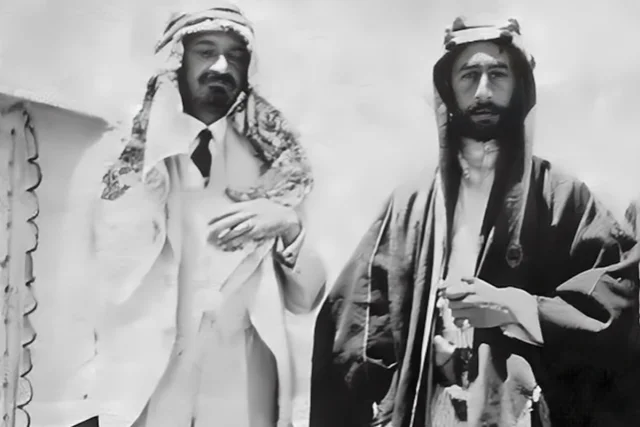
He wrote this nearly a year after he had signed a famous agreement with the leader of the Zionist movement, Chaim Weizmann, in January 1919, where they agreed on cooperation and mutual support.
Imagine the scene: Weizmann was a European chemist, very cosmopolitan. Emir Faisal was the “Desert Prince.” And they actually sat down and signed a formal document pledging cooperation.
Why did Faisal do this? He was far from being a Zionist, but he realized that the Zionist movement could be an asset rather than a threat to the Arab world.
The empire he was about to receive had been neglected for centuries. It was poor and underdeveloped. He likely saw in Weizmann a global network of European-educated scientists, engineers, doctors, financiers, all wanting to become a part of his kingdom.
To him, the Jews were a modernization engine that would come in handy if he wanted his kingdom to become modern, powerful, and able to stand up against the European powers. That’s likely what he meant when he said that the movements complete one another.
So yes, this could have happened. Faisal’s religious legitimacy would enable him to sideline any nationalist or religious opposition to Zionism, and it could have enabled the Hebrew-speaking Jewish society to thrive and develop as an autonomous part of his larger Arab kingdom. The Arabs get their kingdom, the Jews get their national home, and the whole region benefits from economic development.
I know many of you are probably screaming right now, “Why aren’t we living in that timeline?”
There were many reasons why none of this occurred, and we will get to that. I’m not sure it would have been the utopia it initially sounded like at first glance.
Now, imagine the 1930s. After Hitler’s rise to power, European Jews were in mortal danger, and the Jewish community in Palestine would have pressed urgently to open the gates. Local Arab leaders in Jerusalem and Jaffa, however, had already shown deep opposition to large-scale Jewish immigration. The idea that they would have welcomed it unconditionally is a myth.
How would Faisal have responded?
In our timeline, the Arab Revolt broke out and the British government limited immigration through the White Papers. A Hashemite ruler would likely have faced similar pressures. Faisal was pragmatic; if his Arab subjects were enraged by what they perceived as uncontrolled immigration, he would almost certainly have imposed restrictions of some kind. And since he died in 1933, the crisis might well have fallen to his successor at the very moment he was consolidating power.
The result would hardly have been peaceful. Jewish underground organizations would likely have emerged anyway. Refugees might still have been smuggled in, despite official limits. Whether they bore the names Haganah and Irgun or something entirely different, resistance movements would almost certainly have formed. Even in this alternate timeline, the 1930s would have been tense, volatile, and morally agonizing.
And then World War II hits.
The British-aligned Hashemites would probably side with the British231z\. The Italian airstrikes against Tel Aviv and Haifa would have been brutal—they happened in reality too, but in this timeline, they might have been worse.
With the war over and the huge number of Jewish refugees, the demands to open the borders for them would have increased. Maybe Israel would get independence anyway around 1948? By force or by diplomacy? Both options are possible.
The Palestinian naqba refugees might still have had to flee, only they wouldn’t be Palestinians. They would be Arabs, citizens of Arabia, fleeing from one part of the country to a different part of the country. They wouldn’t be stateless refugees, but internally displaced, passport-holding subjects of the Arab kingdom.
The multi-generational refugee crisis that fuels so much of the conflict today would not have formed. It doesn’t mean that there wouldn’t have been any suffering but the legal and political reality would have been different.
Israel would also look different in this scenario. Its bureaucracy and institutions, and big parts of democracy itself, are things Israelis have inherited from British rule.
Would an Israel emerging from this scenario be democratic, or would we have had a “King Ben Gurion” scenario? Or at least a much more authoritarian Prime Minister or President.
A state’s political culture tends to absorb some of the character of the empire it’s in. If the whole region was a monarchy, the Jewish state might have leaned in that direction too.
How about the internal Israeli racism against Jews from Arab countries?
If significant numbers of Iraqi and other Middle Eastern Jews had migrated earlier under stable conditions, rather than arriving with nothing in the 1950s, they might have managed the Jewish autonomy’s relations with the royal court during the 1920s and 1930s. They would have risen to positions of power in Israeli society, and the dynamic between Ashkenazi and Mizrachi Jews, which shook the country in the 1960s and 70s, would have looked very different.
People look at the Faisal–Weizmann Agreement and imagine a lost utopia. I am more skeptical. Yes, the region would have developed very differently, but I still suspect that some form of Jewish independence would eventually have emerged.
Would Faisal have allowed it? That is difficult to know. He died in 1933, just as Europe was beginning to unravel under Hitler. Any long-term arrangement would, therefore, have depended on his successor. If his son Ghazi had inherited both his throne and his pragmatism, he might have concluded that granting Jewish statehood through negotiation was wiser than suppressing it by force.
In a vast Arabian kingdom stretching from Kuwait to Palestine, the Jews would not have been the only minority pressing for greater autonomy. The Kurds in northern Syria and Iraq would likely have posed an even larger and more persistent challenge. Faced with multiple nationalist pressures, a pragmatic ruler might have chosen compromise in one arena to preserve stability in others. Perhaps securing guarantees over Jerusalem and Muslim holy sites while recognizing Jewish sovereignty elsewhere.
So why did this not occur? Two words: Sykes-Picot. The French and British had a secret agreement from 1916 – in the midst of World War I – in which they had carved up the Ottoman Empire between them. Weizmann and Faisal had not been aware of this agreement.
They met and made decisions on cooperation and the future of the Middle East, unaware that their fate had already been shaped by European diplomats carving up the Ottoman map in 1916. I said that the British could have satisfied the national ambitions of both the Jews and the Arabs, but had they done that, they would have had to break their promise to France. And France had fought with them on the front lines.
In this agreement, Britain took control over Palestine, Transjordan, Iraq, and Kuwait (they already had Egypt), while France took Syria and Lebanon. Faisal had already established his capital in Damascus when the French army arrived and expelled him in 1920, crushing his army. Britain gave him a consolation prize of becoming king of Iraq, while they gave Transjordan to his brother, Abdullah.
Abdullah’s descendants are still on the Jordanian throne, while Faisal’s descendants were killed in a bloody revolution in the 1950s.
In the agreement with Weizmann, Faisal had added a caveat: that he was not obliged to the agreement if the Arabs did not obtain their independence from Britain, which essentially made the agreement null and void after 1920.
The pragmatic Arabs like Faisal, and in Jerusalem, the Nashashibi clan, lost their credibility. They appeared naïve for having trusted European promises and ended up with nothing. Instead, the radical elements, like the grand mufti of Jerusalem, took over the narrative, changing it from “we can work together in a shared space” to a zero-sum “winner takes all” conflict.
In 1919, there was real and honest cooperation between Jews and Arabs on the future of Palestine. It collapsed, not because Jews and Arabs are eternal enemies, but because empires calculated differently, leaders made choices, and fragile agreements were overridden.
Hatred is not genetic. History is not destiny. It is the accumulation of decisions. And the future depends on the decisions we make today. If an Arab prince over 100 years ago could realize that Zionism is an asset and not a threat to the Middle East, then perhaps that possibility still exists today. In fact, the Abraham Accords suggest that it does.
You might also like to read this: