Knesset advances controversial bill to appoint political commission to investigate Oct 7 events
Opposition MKs boycott vote, call for state commission of inquiry



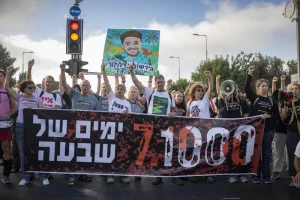
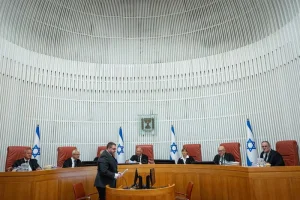
The Knesset approved the first reading of a bill on Monday night to establish a political investigation committee into the Oct. 7 massacre.
The bill passed 59-0 on its first reading, with the opposition parties boycotting the vote. The opposition, along with a large number of Israelis, have called for a state commission of inquiry, as was done following the initial failures in the Yom Kippur War.
The bill was approved for its first reading in the Knesset Constitution, Law and Justice Committee in early June.
However, it was not immediately put to a vote in the Knesset plenum at the time due to an ultimatum from the ultra-Orthodox parties. They said they would only allow the bill to advance if legislation regulating the status of yeshiva students also moved forward.
Two Likud MKs, Dan Illouz and Yuli Edelstein, also did not participate in the vote in protest of the attempt to appoint a political inquiry rather than a state commission.
After passing the first reading, the bill will now be sent back to the Constitution, Law and Justice Committee in preparation for the final two votes in the Knesset plenum.
The coalition will attempt to pass the bill before the pre-election dissolution of the Knesset on July 17. If the bill is not passed before then, the legislation will only continue in the next Knesset if the next government returns the bill to the agenda.
The bill establishes a commission to investigate the events and factors that led to the massacre and the resulting war and will submit its conclusions to the Speaker of the Knesset and the Israeli government. The committee will receive full investigative powers, including the ability to summon witnesses, as well as collect testimonies and documents.
The initiator of the bill, Likud MK Ariel Kellner, is calling for a supermajority (80 out of 120) to appoint the six-member committee and chairman.
If there is no agreement on the committee members after two weeks, both the coalition and the opposition will be allowed to appoint three members to the committee, with another four supervisory members chosen to represent the families of hostages and victims.
However, according to the wording of the bill, the committee can begin working with as few as three members, which would allow the coalition to conduct an inquiry even if the opposition continues to boycott the process.
Kellner has claimed he was willing to compromise on the committee's composition, accusing the opposition of refusing to cooperate. However, he rejected a compromise proposal that called for a committee composed of Knesset members, government representatives and members of the judiciary.
"Neither ministers, nor prime ministers, nor chiefs of staff, nor judges will investigate the debacle," Kellner said in the Knesset.
Kellner repeated a common coalition criticism of the judiciary, arguing that public trust in the courts is low and that the judiciary shares responsibility for the Oct. 7 disaster.
He also echoed the coalition's claim that a judicially appointed commission would blame only the government while shielding the military leadership.
“Trust in the Supreme Court is at an all-time low,” Kellner said. “The bereaved families who do not trust the holy church of the High Court of Justice have become second-class families. Only the proposal that is being put forward here today provides a response to trust. Only those who do not want the truth or pre-written conclusions will agree to a committee appointed by Yitzhak Amit.”
The opposition claims the move to appoint a political inquiry, instead of a state commission of inquiry, is an attempt to deflect blame from the government, especially from Prime Minister Benjamin Netanyahu, who has been in office since 2009, except for 18 months in 2021-2022.
The bill bars current or former Supreme Court judges; IDF officers with the rank of colonel or higher; former Shin Bet chiefs; government and military legal advisers; and ministers who have served on the Ministerial Committee for National Security Affairs or the Political-Security Cabinet since 2005 from serving on the investigative committee.
Opposition Leader Yair Lapid explained the decision to boycott the vote on the bill: “The opposition will not be part of a false representation whose sole purpose is to whitewash and prevent the investigation of the greatest disaster that has befallen the Jewish people since the Holocaust. In the first month of the next government, we will establish a state investigation committee to investigate the October 7 massacre.”
However, Likud MK Tally Gotliv, who participated in the committee's deliberations on the bill, accused the security establishment of hiding findings from the public.
“7,000 terrorists infiltrated unhindered and they are trying to prevent us from finding out who is guilty,” Gotliv claimed.
She also accused the Shin Bet and the security establishment of covering up details of the massacres.
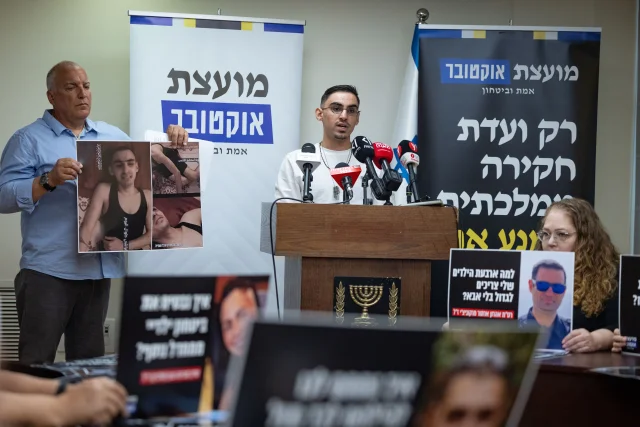
The October Council, which represents many of the hostages and bereaved families, called the bill a “political cover-up,” saying, “This government, which led the State of Israel with closed eyes into the most terrible massacre in its history since the Holocaust, has lost all legitimacy.”
The council called for a state commission of inquiry.
Prime minister hopefuls Naftali Bennett and Gadi Eisenkot joined the call for a state commission of inquiry, saying the next government would establish such a commission as one of its first acts.
Yisrael Beiteinu Chairman Avigdor Lieberman said, “The political investigation committee is a cover-up committee designed to disrupt and torpedo the investigation of the truth.”
Lieberman was Defense Minister under Netanyahu in 2016-2018. He resigned after warnings of Hamas strengthening and a possible plan to invade Israel were ignored.
Please take a moment to join believers worldwide praying for Israel right now. Add your light to the live prayer map—and show the world one more watchman praying for the peace of Jerusalem.

You might also like to read this: