








Israel's High Court gives gov't two months to decide how to investigate Hamas' Oct 7 massacres
Families of victims slam court decision as aiding gov't to shirk responsibility for Israel’s worst disaster
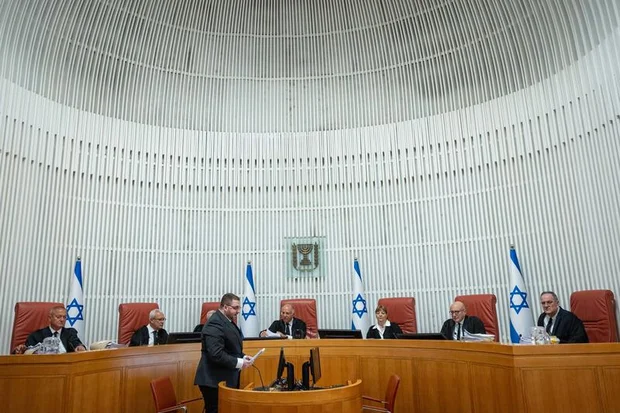
Israel's High Court of Justice ruled Monday that the government must formulate an outline for the investigation of Hamas' Oct. 7 massacres by July 1, as part of a ruling on a petition for the establishment of a state commission of inquiry.
In its ruling, the court expressed frustration with the government for failing to establish an official inquiry into the events of Oct. 7, 2023: “There is no dispute that the events of the October 7 attacks must be investigated – and thoroughly and in depth,” the court wrote in its opening remark.
“Despite this, we are now more than two and a half years after the severe disaster that struck the entire country on October 7, 2023, and the government has not yet established an appropriate mechanism to investigate the catastrophic events and draw the necessary lessons to prevent their recurrence.”
“This state of affairs is unacceptable, and it raises considerable legal difficulties,” the court noted.
The government has refused calls for a state commission of inquiry, as its members would be nominated by Supreme Court President Isaac Amit, who some coalition members see as illegitimate and who supporters of the right-wing coalition broadly see as an opponent.
Prime Minister Benjamin Netanyahu has instead proposed an alternative committee of inquiry, with coalition and opposition nominating half of the members, respectively. This has been roundly rejected by the opposition as a politically motivated attempt to evade responsibility.
The court also acknowledged the frustration of those who had petitioned the High Court of Justice to force the government to act, noting that “the Legal Advisor to the Government shares their position.”
The court also stated that it understood the government’s preference for establishing “an investigative committee that will be established by virtue of a special legal arrangement, based on broad consensus.”
The coalition government argues that, due to deep distrust in certain state institutions among its own voting bloc, as well as distrust of the coalition government among the opposition voting bloc, a special investigative committee should be established with input and agreement by both sides.
The court cited the government’s position that “the establishment of a committee that will be independent and have full investigative powers and will enjoy as broad public consent as possible,” but also noted its failure to act to establish such a committee.
Additionally, the court expressed its legal opinion that the High Court of Justice does, in fact, possess “the authority to hear petitions concerning the establishment or non-establishment of an investigative committee,” citing several previous judicial precedents.
However, despite the fact that the court expressed an opinion that such an investigation should happen soon, it decided to grant the government an extension of approximately two months “in the hope that it will soon find a suitable outline for investigating the events, which will receive broad public approval.”
“Therefore, we instruct the government to submit an update notice regarding the outline formulated for investigating the events – this, by July 1, 2026,” the court wrote.
The decision follows a stormy hearing last week, in which pro-government activists attempted to force their way into the courtroom to protest the High Court. That hearing was interrupted when the activists, who oppose the establishment of a state investigation, tried to break into the courtroom, and the justices were instructed to leave. After around half an hour, the hearing resumed.
The coalition government and the judicial branch have engaged in a series of clashes over the past two and a half years, starting with Prime Minister Benjamin Netanyahu's attempt to appoint Shas leader Aryeh Deri to a government minister position, despite previous convictions of tax fraud and bribery. The court ruled his appointment was unreasonable.
Bereaved families of the "October Council" expressed outrage at the court’s decision.
“The High Court justices today awarded a prize for violence against bereaved families, incitement, failure to take responsibility and attempts to bury the truth," the organization said in a statement. “The judges ruled today that the blood of over 2,000 murdered people is innocent under the auspices of the court.”
The “October Council” represents about 1,500 families who support the establishment of a state investigation committee, along with other responses.
“Instead of being on the right side of history, the Supreme Court chose today to give the Israeli government another two months of leeway,” the organization said.
“Today's High Court decision sends a dangerous message: You can postpone, you can delay, you can continue without giving an account.”
Popular article:
interview Easter message of resurrection hope amid war at Jerusalem's Garden Tomb

biblical commentary Let my people go: a Passover message for today
4 IDF soldiers killed, 2 wounded in fighting in southern Lebanon, as Israel eliminates dozens of Hezbollah terrorists

Receive latest news & updates
A message from All Israel News
Help us educate Christians on a daily basis about what is happening in Israel & the Middle East and why it matters.
For as little as $10, you can support ALL ISRAEL NEWS, a non-profit media organization that is supported by readers like you.
Latest articles:
North American Jewish organizations to recruit 100 professionals to combat antisemitism

‘No need’ for pre-election Iran strike, IDF chief says as gov’t, opposition trade blame for potential escalation – report
terror attack 2 Israeli soldiers killed, 2 terrorists eliminated in Hebron shooting; IDF says much larger attack was prevented
analysis A people dwelling securely? Israel’s strategic standing, 3 years after Oct 7

Hamas on wheels: What I found in Dearborn reveals a troubling history and a battle over Israel