Turkey seizes rare ancient Hebrew manuscript in major antiquities smuggling crackdown



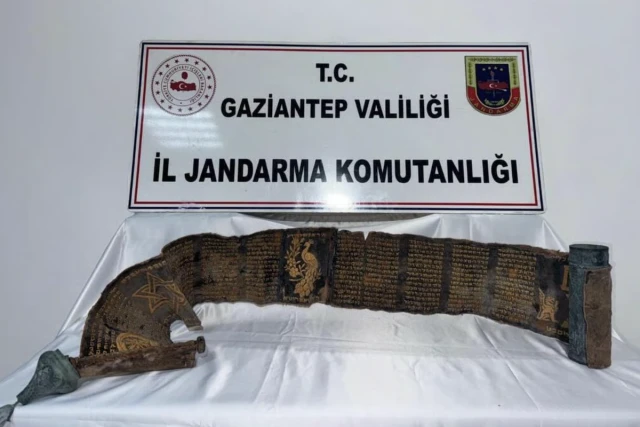
The Turkish media portal Türkiye Today published a report on Monday about the ongoing efforts to combat the illegal trade in antiquities that are often looted from legitimate archaeological digs throughout the region.
The report included details about an archaeological artifact recently seized by police, along with other contraband that smugglers were attempting to sell on the black market. The item is a two-meter manuscript inscribed on python skin with gold Hebrew script, which is of particular interest to the Israel Antiquities Authority (IAA). It had been rolled up and stored inside a copper case with an “ornate, embossed lid,” according to the report.
This particular artifact sheds light on the ancient Jewish community in Türkiye, although the origins of the artifact will be studied further before conclusions can be drawn.
For now, Türkiye’s Gendarmerie (Jandarma), a paramilitary law enforcement agency similar to Israel’s Border Police and responsible for public order, internal security, and law enforcement, has announced that the suspected smuggler was captured and arrested in Gaziantep province. The area, near the Syrian border, is a hub for cross-border smuggling of various commodities, including narcotics, people, gold, oil, and antiquities.
The Anatolian Peninsula, which makes up most of modern Turkey, is home to hundreds of archaeological sites aiming to catalogue the remnants of the many civilizations that have come and gone in the region over the millennia. For most of the past 3,000 years, Jews have been part of the social, political, economic and cultural milieu of nearly all those civilizations, with extensive trade ties and diaspora communities.
“Asia Minor,” as the peninsula was known 2,000 years ago, played a role in the Roman Empire and was a center of tourism, commerce, and agriculture, and home to many large cities with institutions of higher learning and sophisticated economies. Many of the cities visited by the Apostle Paul during his missionary journeys, and where he established churches as chronicled in the New Testament, were located in this region.
In recent years, the black market for antiquities has exploded all over the world and Turkey has been the source of many of these looted artifacts, resulting in the formation of special police units tasked with combating the phenomenon.
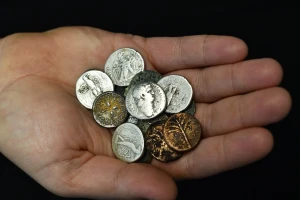
In 2017, police seized a rare 1,500-year-old Torah scroll along with 200 coins, some silver, some bronze, as well as other artifacts from the Hellenistic and Seljuk periods. In 2019, an 800-year-old Hebrew book, or “Diyarbakır,” was recovered. It was 22 pages and inscribed on leather. In 2021, a gold-embossed Torah manuscript was seized, which archaeologists believe could be as old as 2,500 years.
Archaeologists have also uncovered significant ruins of Jewish synagogues and other signs of communal life in ancient cities, including Sardis, Limyra, Andriake, and Priene. The IAA is in regular communication with its Turkish counterparts to help explore, catalogue, and develop these sites, which often become tourist attractions that generate economic activity, jobs, and academic research opportunities.
You might also like to read this: