Israel exposes Hamas terror funding network funneling millions, jails key operatives





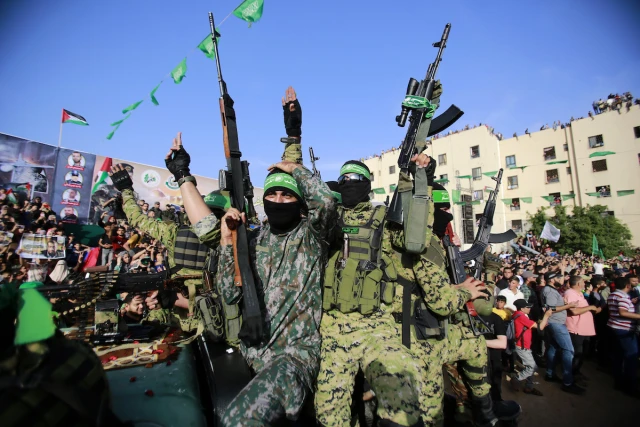
The Israeli Central District Court revealed in a recent ruling that a covert Hamas-linked funding network transferred millions of shekels to support terrorism, including NIS 2.2 million (about $730,000) sent in seven transactions. The court identified Fadi Arabi – whose brother is a Hamas operative in Turkey – as a key figure in the network, which operated through intermediaries inside Israel.
Arabi ran the network with several associates. The court sentenced operative Adem Dolani to five years in prison and fined him NIS 270,000 (about $90,000). Another operative, Muhammad Alziz, was identified as having recruited Dolani, who allegedly tried to cover his tracks by deleting communications with his Turkish contact and local associates.
Dolani’s legal defense asked the Israeli court for leniency due to his alleged strained financial situation and his family’s dependence on welfare and housing aid. While not denying that Dolani has a criminal history involving property crimes, the defense emphasized that he had previously not been linked to Hamas-affiliated terrorism funding networks.
Judge Michael Karshan responded by partially accepting the plea agreement, which he assessed as "appropriate and balanced" given Dolani’s confession and no previous history of terrorism-related crimes.
However, the judge also noted that Dolani had nevertheless chosen to get involved in Hamas-linked terrorism funding after the Oct. 7 massacre of 1,200 Israelis and kidnapping of 251 people from southern Israeli border communities.
"Although the defendant was not the leader or initiator of the financial transfers, he carried out seven transfers to Hamas after the October 7 attack," Karshan stated.
Hamas, which openly calls for Israel’s destruction and the murder of all Jews, is required to disarm according to the American-brokered Gaza ceasefire agreement reached in October 2025.
However, senior Hamas officials have repeatedly refused to disarm and vowed to keep at least some of the Jihadist group’s arms.
Hamas recently rejected a U.S.-backed Board of Peace disarmament plan that would require the group to lay down its weapons as part of a broader Gaza reconstruction framework. Hamas has reportedly framed ongoing regional tensions, including those involving Iran and the Tehran-backed Hezbollah in Lebanon, as an opportunity to strengthen its hold on the Gaza Strip.
Israel has demanded that Hamas immediately surrender all of its weapons. By contrast, the Board of Peace and mediating countries last month proposed a phased disarmament plan, beginning with the handover of heavy weapons within 90 days and allowing the group to retain lighter arms temporarily. Hamas rejected the proposal, as international attention has increasingly shifted from Gaza to Iran, the Strait of Hormuz, and the conflict with Hezbollah in Lebanon.
A senior Hamas official recently told the BBC that the Jihadist group would not participate in the next phase of the Gaza ceasefire until Israel reportedly carries out its obligations.
“We are waiting for Mladenov to provide a clear timetable for Israel to fulfill the remaining obligations of Phase I,” the Hamas official said, accusing the Board of Peace’s High Representative for Gaza, Nickolay Mladenov, of being biased in Israel’s favor.
However, Mladenov and other Board of Peace officials have told Hamas that no reconstruction in Gaza or withdrawal of Israeli troops can be expected as long as the group refuses to disarm in accordance with the ceasefire agreement.
You might also like to read this: