Former IDF chief Eisenkot urges opposition to unify to beat Netanyahu & reach ‘Zionist majority’
Polls show neck-and-neck race for largest party between Together and Likud



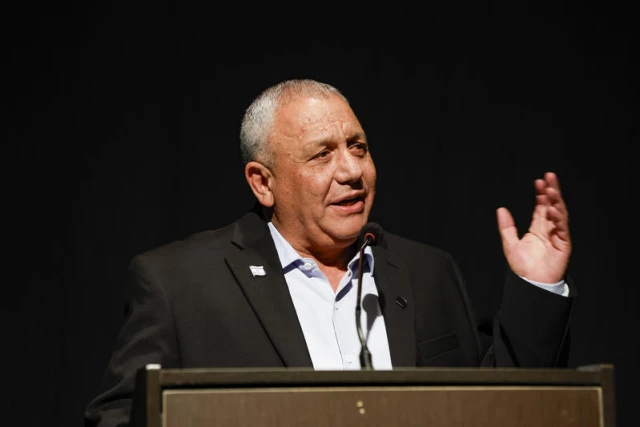
Former IDF chief Gadi Eisenkot, chairman of the Yashar! Party, issued a call to most opposition leaders to meet and coordinate their actions toward the upcoming elections, with the goal being to defeat the current government and establish a “Zionist majority.”
The invitation is the latest in a series of attempts by opposition leaders to adopt a coordinated strategy to finally defeat Prime Minister Benjamin Netanyahu. In this context, the phrase “Zionist majority” highlights the goal of reaching the necessary 61 Knesset seats without either the Arab parties or the ultra-Orthodox parties.
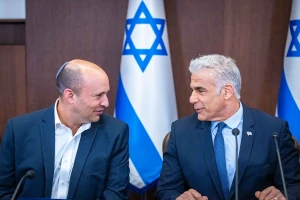
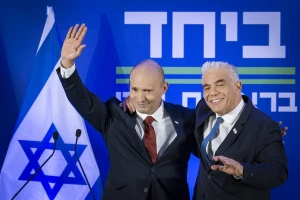
Eisenkot said he invited former prime minister Naftali Bennett and Opposition Leader Yair Lapid, who announced their joint “Together” Party earlier this week and offered Eisenkot to join as well.
He has reportedly indicated he won’t join the new party, as his own popularity has been steadily rising, and in some polls, even rivaled Bennett as the most popular opposition leader.
Also invited were Avigdor Liberman of the right-wing Yisrael Beitenu party and Yair Golan of the far-left Democrats, but not Blue and White’s Benny Gantz, Eisenkot’s former party colleague, who in the most recent polls has not crossed the electoral threshold of four seats.
Channel 12 poll this evening shows little change after the Bennett-Lapid unification:
— Amit Segal (@AmitSegal) April 27, 2026
26 – Together (Bennett and Lapid)
25 – Likud
15 – Eisenkot
10 – The Democrats
9 – Shas
9 – Yisrael Beiteinu
9 – Otzma Yehudit
7 – United Torah Judaism
5 – Hadash–Ta’al
5 –…
Contrary to the aforementioned leaders, Gantz has also rejected their openly anti-Netanyahu stance, stressing that the country needs “a broad Zionist government” where “it almost doesn’t matter who the prime minister is. It matters what this government looks like,” he told Channel 12 on Monday.
Several TV channels on Monday published their latest election polls, the first that included the new Together Party.
The polls generally showed that the merger didn’t significantly shift the bigger picture, but cemented Bennett as Netanyahu’s most important challenger among the opposition.
The situation between the blocs is expected to be further influenced by additional mergers and potential new parties that will be announced closer to the elections, currently slated for the end of October at the latest.
“Bennett is creating all sorts of advantages for himself in this move. He is getting Lapid, a politician experienced in election campaigns, and the field organization of Yesh Atid,” commented Moran Azoulay, Ynet News’ political correspondent.
Lazar’s poll is dramatic. It suggests that the merger:
— Israel Elects (@israel_elects) April 27, 2026
· Cost Opp. Bloc crucial seats
· Didn't help Bennett pull away from Eisenkot
· Boosted Likud more than Bennett, propelling it ahead (they were tied in Lazar’s previous poll)
Will be interesting to see whether other… https://t.co/ecDU0YPUsl
“At the strategic level, the question arises whether Bennett knows how to provide a response to those swinging votes that may be the decisive mandates – the soft, moderate right, which is looking for a home. It is not yet clear whether he has given up on them, and it seems that Bennett himself is also examining these questions. The upcoming polls will have a decisive impact on things.”
According to Channel 12’s poll, Together would immediately become the largest party with 26 seats, narrowly beating the Likud with 25. The opposition bloc would receive 60 seats, while Netanyahu was projected to only receive 50 mandates.
However, Kan News’ poll showed the Likud leading Together with 27 to 24 seats, while the opposition bloc fell short of a majority with 58 seats, and the current coalition garnered 52 seats.
Channel 13 projected a tie at 26 seats for Together and Likud, while the coalition bloc leads the opposition with 57 to 52 mandates.
Commenting on the new party, Channel 12’s political commentator Amnon Abramovich noted that Bennett and Lapid received “two seats fewer than the sum they held separately – a reminder that political mergers do not always succeed.”
Eisenkot’s Yashar Party received between 15 and 12 mandates in most recent polls.
“The most striking figure in the poll is the broad support among opposition voters for Gadi Eisenkot joining ‘Together’: 65% in favor, with only a negligible share opposed,” said Abramovich.
The channel’s chief political analyst and Abramovich’s frequent sparring partner, Amit Segal, pointed out the significance of the poll projecting five seats for a hypothetical party dubbed "Likud-B" that could be formed by former Likud stalwarts Yuli Edelstein, Moshe Kahlon, and Gilad Erdan – the “soft, moderate right” that was also mentioned by Azoulay.
“Usually, a hypothetical party that receives five seats in a poll is not seen as a realistic basis for running. However, in this case the picture is more complex: it’s 5 seats for a completely theoretical party, along with about 3% more below the electoral threshold – voters signaling that they do not want to belong to the existing blocs.”
Segal referred to Gantz’s Blue and White, as well as the “Reservists’ Party” led by Yoaz Hendel, which together represent around 3% of the votes but don’t yet cross the threshold.
“Altogether, this represents a potential of 8–9 seats even before the move gets underway – a figure that illustrates how significant such a development could be. There appears to be public appetite for such a move, and the remaining question is who will know how to capitalize on it,” Segal explained.
You might also like to read this: