Former IDF Chief Eisenkot proposes joint list with Bennett & Lapid to topple Netanyahu gov’t in next elections
New party leader to be named after election date is finalized




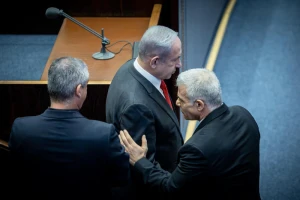
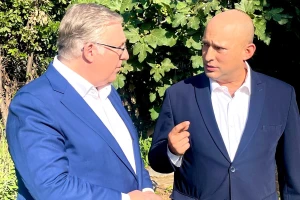
Former IDF Chief and Knesset Minister Gadi Eisenkot proposed to create a unified platform with former Prime Minister Naftali Bennett and the current opposition leader, Yair Lapid, Israeli media reported on Tuesday.
The report, first published by Channel 12 News, was later confirmed by Eisenkot’s office to The Jerusalem Post.
Prominent leaders in the anti-Netanyahu camp have been negotiating over potential party mergers and joint platforms for months, while jockeying for position to lead a large party that could defeat the prime minister in the coming elections, which will be held no later than this October.
Last year, Eisenkot created his Yashar party after leaving Benny Gantz’s National Unity party. However, he has since been in constant contact with other leading politicians of the Israeli opposition, attempting to unify several parties in an effort to create a platform big enough to challenge the Likud as the largest party.
After an election, the party chairman with the most votes traditionally receives the first presidential mandate to attempt to build a governing coalition.
Eisenkot’s Yashar party has been projected to receive between seven and nine seats in the coming elections, which are scheduled for October but could be held earlier if the coalition collapses before then.
Former Prime Minister Bennett also founded a new party last year, which has been widely projected to become the second-largest party with around 22 seats – still not enough to topple the Likud.
According to Eisenkot’s proposal, a unified platform has the potential to beat the Likud. His idea envisions the bloc to take a central, rather than an outright left-wing position, while its leader would be announced after the date for the next elections is finalized.
Eisenkot further proposed the establishment of joint guidelines for the new party, which would also be coordinated with, and endorsed by, the leaders of the broader anti-Netanyahu camp, like the hawkish Yisrael Beitenu and the far-left Democrats.
There was no immediate official response by Lapid or Bennett to Eisenkot’s proposal.
On Tuesday evening, Bennett published a new statement reiterating his ambition to replace Netanyahu as prime minister.
“I'm not looking to humiliate Netanyahu; I intend to replace him. I need to bring everyone in, and I don't want to trample anyone. Just win,” he said at an activists' conference in the northern city of Karmiel.
Lapid has also been claiming that only his Yesh Atid party would be able to successfully form a new government, despite polling at roughly the same level as Eisenkot. In the last elections, he garnered 23 seats in the Knesset.
A first response to Eisenkot’s proposal came from Yoaz Hendel, chairman of the new Reservists party. Hendel served as communications minister under Netanyahu as well as in the Bennett-Lapid government.
“In my view, what’s happening in the center, center-left, is less important for our purposes. The decisive point in Israeli politics is to the right of the center,” Hendel said at a conference.
Hendel has been positioning himself as an alternative to the current right-wing government, advocating for centrist social positions – including drafting the ultra-Orthodox – while being staunchly right-wing on security issues.
“From deep familiarity, I can tell you that right-wing voters who look at this government and say it’s a catastrophe, and religious Zionist voters who oppose the draft-evasion law – they will not vote for such a group. That’s why the reservists are so vital in the upcoming elections,” he argued.
You might also like to read this: