Protests mark 1,000 days since Oct 7, accusing government of failure to take responsibility
Survivors and hostage families continue demand for state commission of inquiry into the massacre



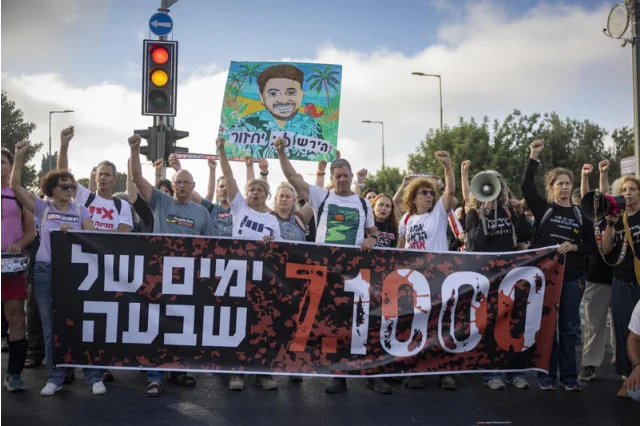
Protests and memorial events are occurring across Israel on Thursday, as the nation marks 1,000 days since the Hamas massacres of Oct. 7, 2023.
The events, many organized by the October Council, a group of over 1,500 survivors and bereaved families from Oct. 7, as well as some former hostages, started at 6:29 a.m., marking the exact hour that the first missiles were fired at Israel that day.
One of the first events was a demonstration in front of the Prime Minister’s Residence in Jerusalem, which the protesters called a “wake-up call” to the government, which has still not voted to conduct a state commission of inquiry.
Commemorations for the day of remembrance began on Wednesday evening, with a rally at Sha’ar HaNegev Junction, where many of the Hamas terrorists arrived after breaching the security barrier, before entering the town of Sderot on Oct. 7.
Several bereaved families and survivors of the massacre were present at the gathering.
Other protests demanding a state commission of inquiry began in the early morning hours in several locations. Near the Knesset in Jerusalem, protesters set up a large coffin, while in Paris Square in the city, demonstrators conducted a mock funeral procession, with some wearing orange jumpsuits to signify that government ministers deserve prison sentences for the failures of that day.
Demonstrators waved signs criticizing the "moral, leadership and strategic failure" of the coalition government.
At the Tel Aviv beach, a large sand display was created, which read, “Their blood cries out from the ground…Days of failure, abandonment, and bereavement.”
Families of victims of the Nova rave party held a memorial at the Re’im parking lot, marking the occasion with a minute of silence at 10:00 am. The ceremony was held at the site where the party was held, which witnessed some of the worst of that day's atrocities.
Protest vigils were also held near Prime Minister Benjamin Netanyahu's private residence in Caesarea, as well as at the homes of ministers Miki Zohar and Yoav Kish.
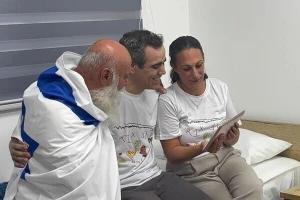
During a demonstration at Amiad Junction in the Upper Galilee, Danny Miran, father of former hostage Omri Miran, attacked the government for changing the name of the war and refusing to recognize the event as a massacre.
“This was not a war of revival; this was a war of bloodshed,” Miran stated.
“Smotrich did not return the hostages - 50 more hostages could have returned alive,” Miran claimed, referring to reports that Finance Minister Bezalel Smotrich and National Security Minister Itamar Ben Gvir pressured Netanyahu not to agree to certain hostage release deal offers.
Earlier this week, Smotrich claimed the hostages returned home thanks to his efforts. “I think that if it were not for me, the war in Gaza would have ended even before Rafah. Thanks to me, all the hostages are here,” Smotrich said on Monday.
Former hostage pointman Maj.-Gen. (res.) Nitzan Alon said on Wednesday night that the Gaza War could have ended one year earlier, and more hostages returned home alive, if not for cabinet decisions.
“In certain cases, with different conduct and decisions, or different negotiations, we might have been able to bring them back alive,” Alon said during comments at the Herzliya Conference at Reichman University on Wednesday.
Danny Elgarat, brother of murdered hostage Itzik Elgarat, said the government should not even claim all the hostages returned.
“For a thousand days I’ve heard over and over again people saying, ‘The hostages have returned.’ Not all of them have returned,” Elgarat said.
“Those who came back alive returned. Those who were kidnapped alive, abandoned in captivity, murdered, and brought back in a coffin — did not return,” Elgarat emphasized. “My brother Itzik did not return. Itzik was kidnapped alive and could have come back alive, but he was abandoned to die.”
Esther Buchshtab, the mother of Yagev who was killed in Hamas captivity, accused the government of failing to take responsibility for the massacre.
“251 hostages, including my son Yagev and his wife, were kidnapped from their home,” Esther said. “1,000 days since the abandonment began. Military pressure did not save the kidnapped, but harmed them. But the government continued its course and did not see the people who were there.”
Omri Miran told public broadcaster Kan News that he sees a difference between how the military and the government are handling the Oct. 7 events.
“On the national level we don’t see any change in how things are being handled. We haven’t learned that lesson,” Miran stated. “Military officers tell me first and foremost, ‘We’re sorry, and we’re ashamed.’ I don’t see that from our leadership.”
Miran sharply criticized Netanyahu, urging him to “take responsibility and start dealing with what taking responsibility actually means, instead of focusing on the draft exemption law for Torah scholars just to buy yourself another two weeks in power.”
Sharon Sharabi, whose brother Yossi was killed in Hamas captivity, and whose brother, Eli Sharabi, was released in a severely emaciated condition only to discover that his wife Lian and their two daughters Noya and Yahel had been killed in the Oct. 7 massacre, spoke of the difficult feelings he has after so many days.
“A thousand days in which a state investigation committee has not yet been established. How is it that after 1,000 days, Hamas is still standing on its feet?” Sharabi asked.
“In this place, a thousand days ago, I lost four members of my family: Yossi, Lian, Noya and Yahel, may their memory be blessed, alongside the fighters and civilians who fell here for the heroism of Israel. A thousand days in which a state investigation committee has not yet been established,” Sharabi continued.
“The questions still resonate. How did this happen? How did the State of Israel fail to protect its citizens? How are the terrorist organizations, Hamas and Jihad, which are in Gaza and Judea and Samaria, still standing on their feet? All citizens of Israel deserve the answers.”
With upcoming elections, several public figures chose to mark the occasion with political messages. Yisrael Beiteinu Chairman, MK Avigdor Liberman, visited Kibbutz Kfar Aza and claimed that the writing was on the wall before the massacre took place.
“This should never have happened,” Liberman stated. “The writing was on the wall. I personally laid out all the alerts and warnings on the decision-makers' table. Ever since, they've been trying to do everything to make us forget it so they can evade responsibility.”
Liberman served as Defense Minister under Netanyahu from 2016-2018. He resigned the position after the cabinet voted at that time to agree to a ceasefire with Hamas and had called for increased military operations in Gaza to remove Hamas from power, warning the terror organization was strengthening.
As part of the memorial, an organization called Testimony 710, which archives video testimonies of survivors of the Oct. 7 massacre, uploaded a new online video to mark the 1,000th day since the massacre.
The group said that it will also be screening a new video of survivor testimonies at the Tel Aviv Museum of Art on Thursday.
In the evening, the final rally is planned to take place at Hostages Square, near the Kirya IDF headquarters. Formerly named Museum Square, it was renamed Hostages Square due to the numerous protests on behalf of the hostages during the Gaza War.
You might also like to read this: