Hamas claims to 'dissolve' its Gaza gov't ahead of entry of US-backed technocratic committee
Gaza residents fear for the future, say Hamas hides from Israel, targets ‘collaborators’ at night



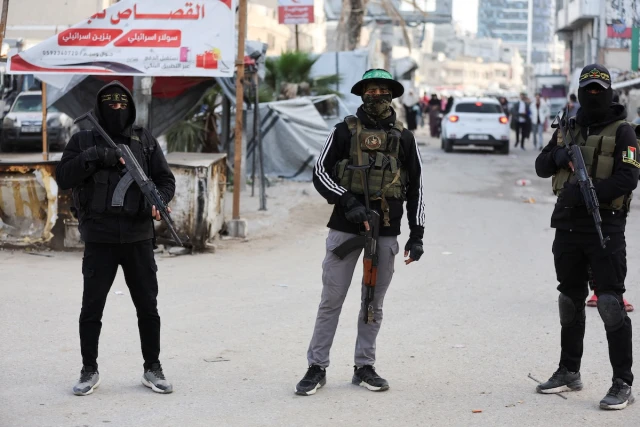
Hamas announced the resignation of the head of its “Emergency Committee,” the body that effectively governs the Gaza Strip at the moment, ostensibly in preparation for the transfer of authority to the technocratic National Committee for the Administration of Gaza (NCAG).
“The head of the government’s emergency committee Mohammed al-Farra has officially submitted his resignation,” Hamas media office spokesman Ismail al-Thawabta told AFP on Monday.
Hamas said the move should allow the NCAG, headed by former Palestinian government official Dr. Ali Shaath, to enter the Strip and assume administrative responsibility.
However, Hamas also said that “technical and professional staff” would remain in their positions, in order to smooth the transition and maintain service to the Gaza population.
"The Hamas government's purported resignation, in which all of its ministers remain in their positions, is a spin with no significance whatsoever," a senior Israeli official told Kan News in response. "Hamas fears it will be declared the party violating the agreement, so it is stalling for time and engaging in spin."
According to Hamas' announcement, until the entry of the technocratic committee, a temporary transitional government will operate in the Gaza Strip, headed by Abdul Hadi Al-Agha, former director general of Hamas' Ministry of Waqf and Holy Places, and a Hamas military wing member.
The NCAG was created by the U.S.-backed Gaza Board of Peace to be the local administrative authority, with the Board of Peace itself staying outside of Gaza and overseeing both the NCAG and the reconstruction efforts.
The move by Hamas appears to be intended to signal its willingness to move ahead with parts of the peace plan, while still resisting any efforts to disarm, as called for in the peace plan developed by U.S. President Donald Trump.
In a note to social media, the Board of Peace said it has “taken note of the announcement today regarding the dissolution of the ‘Emergency Committee’ in Gaza,” while stating that its “assessment will be guided by actions, not promises, to meet the critical needs of the people of Gaza.”
“Decisions must be comprehensive with respect to the requirements as set out in the Roadmap for advancing governance, security, and transition in Gaza,” the statement continued.
“We look forward to the successful conclusion of discussions on this Roadmap, including on the implementation mechanisms necessary to enable the National Committee for the Administration of Gaza to assume full governing authority,” it said.
We have taken note of the announcement today regarding the dissolution of the “Emergency Committee” in Gaza. Ultimately, our assessment will be guided by actions, not promises, to meet the critical needs of the people of Gaza. Decisions must be comprehensive with respect to the…
— Board of Peace (@BoardOfPeace) July 6, 2026
Moreover, the Board of Peace noted that the agreement calls for the surrendering of all weapons.
“The core principle remains one authority, one law and one weapon,” it stated. “This means the consolidation of all weapons under the control of the NCAG as provided for in the Comprehensive Gaza Peace Plan and United Nations Security Council Resolution 2803.”
Hamas has consistently refused to disarm before the establishment of a Palestinian state, despite agreeing to do so as part of the October 2025 ceasefire negotiations. It is also exploiting the negotiations and the delay of any peace process to rebuild its power.
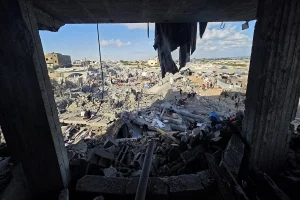
Meanwhile, a report from Channel 12 News indicates that Gazan residents are afraid of renewed fighting due to Hamas' refusal to disarm.
One resident, who went only by the initial M. to protect his identity, told Channel 12, “Hamas is reorganizing in a situation that is natural for them. That is, there is a ceasefire, they are in control, they have command and control rooms, there are places that they control, they arrest people, they interrogate people, and no one is allowed to speak... This is the natural situation for them.”
M. said the real question for many Gazans is, “What steps is Israel taking?”
“After all, it controls more than 70% of the territory of the Gaza Strip. Why not separate the civilians from Hamas?", M. asked, referring to plans to create a Hamas-free zone centered on Rafah. “Why not transfer the civilians to an area that constitutes that 70% of the territory, so that this area will be the safe area where the civilians will live?”
M. also said that Israel’s current strategy makes it easy for Hamas to hide among civilians.
“I hope there will be real plans to separate the civilians from Hamas,” he said, “because the way Israel is operating today, the war will last ten years. It cannot be ended this way, because it is very easy to hide among the civilians, in the camps and in civilian areas.”
Another civilian, A., told Channel 12 that everyone is afraid the war will return.
“There is a fear on the street here that the war will return, because Hamas refuses to hand over its weapons,” A. said. “Everyone is tense, everyone is tired and worn out. In general, there is no optimism at all in Gaza. We are just waiting, because we don't know what to do. There is nothing we can do.”
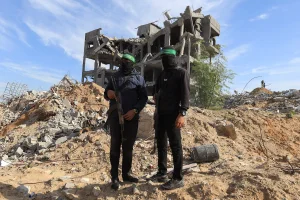
She said that Hamas dresses as civilians during the day, but carries out repressive actions at night, targeting people accused of “collaborating” with Israel.
“They still control the area,” she said. “I mean, when they want to hurt someone, beat someone or shoot someone - they do it. They murdered a poor young man and accused him of collaboration.”
Meanwhile, Israeli authorities assesses that Hamas is biding its time, waiting to see the outcome of the Iran negotiations and the upcoming Israeli elections, before committing to any course of action.
You might also like to read this: