With support from Turkey and Egypt, Hamas seeks new ceasefire deal without surrendering weapons
Hamas continues to refuse calls for disarmament, blames Israel for ‘ceasefire violations’




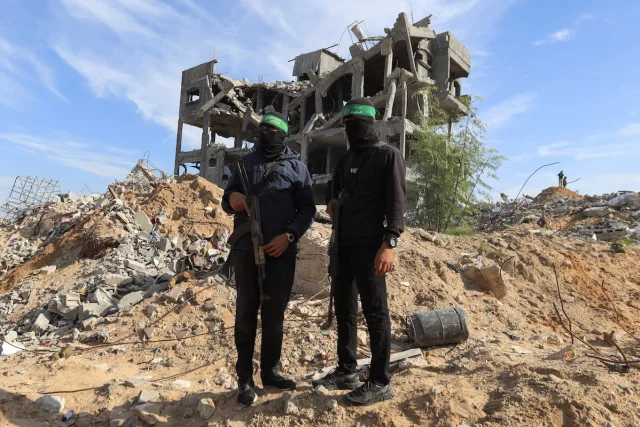
Hamas is attempting to formulate a new ceasefire outline, with help from Turkey and Egypt, which is intended to revive mediation efforts between the terror group and Israel, Saudi news organization Asharq Al-Awsat reported.
The talks have been suspended for months, with both sides accusing the other of ceasefire violations. The IDF has continued to target Hamas leaders, and has taken additional territory inside the Gaza Strip, beyond the 53% it was allowed to keep as a temporary security buffer in the October 2025 ceasefire agreement.
Hamas, for its part, accuses Israel of a failure to withdraw its troops from Gaza, failing to respect the ceasefire through its repeated strikes, and of not allowing sufficient humanitarian aid into the Strip.
Israel, meanwhile, points to several attempts by armed Palestinians to cross the Yellow Line into Israeli-controlled territory, along with Hamas’ refusal to disarm, as proof that the terror organization is failing to uphold its obligations under the agreement.
The IDF's Office for Coordination of Government Activities in the Territories (COGAT) denies claims of insufficient aid, saying the amount of food aid entering Gaza daily is more than enough to support the population.
The humanitarian situation in Gaza is stable, supported by a continuous and consistent flow of aid.
— COGAT (@cogatonline) June 2, 2026
Working alongside the CMCC, the UN, and authorized international partners, we ensure a steady supply of food, water, sanitation, and medical services. pic.twitter.com/dCriwjiibt
The Asharq Al-Awsat report cited two “Hamas sources” who said the group is expected to send a delegation to Cairo this weekend to discuss preliminary proposals to resolve the existing disagreements, following discussions with Turkish officials in Ankara earlier this week.
The Hamas sources did not indicate what the proposals entail, however, a statement released after the meeting with Turkish intelligence head Ibrahim Kalin, blamed Israel for failing to honor the Sharm al-Sheikh agreement, for escalating strikes in Gaza and for a “failure to complete the implementation of the first phase of the agreement.”
Hamas has repeatedly insisted that Israel fully withdraw from the Gaza Strip at the conclusion of the first phase of a ceasefire agreement, while Israel maintains that any withdrawal is contingent on Hamas beginning to disarm. The terror organization has consistently rejected disarmament proposals that involve surrendering its weapons to an external party.
Hamas has also expressed sharp criticism of UN Special Coordinator for the Middle East Peace Process Nikolay Mladenov, who has insisted that the deal agreed to by Hamas includes disarmament as part of the process of installing the National Committee for the Administration of Gaza (NCAG).
A report in Asharq Al-Awsat earlier this year stated that “several prominent political and military leaders” from Hamas could leave the Gaza Strip as part of the transition to the second phase of the peace deal. However, in recent weeks, Israel has eliminated most of Hamas’ senior military leaders.
With Hamas increasingly appearing intent on remaining in Gaza, and even incorporating itself into the incoming Palestinian governance of the Strip, and its continued refusal to disarm, Israel has returned to the idea of resuming military operations to destroy the last elements of the terror organization.
Last week, Prime Minister Benjamin Netanyahu ordered the IDF to seize as much as 70% of the Gaza Strip in an apparent bid to pressure Hamas to return to the negotiating table.
You might also like to read this: