Back in the 1930s? German hotel tells Israelis, ‘no Jews allowed,’ triggering discussion about ongoing antisemitism
‘The realm of what is normal shrinks more and more,’ says Holocaust survivor




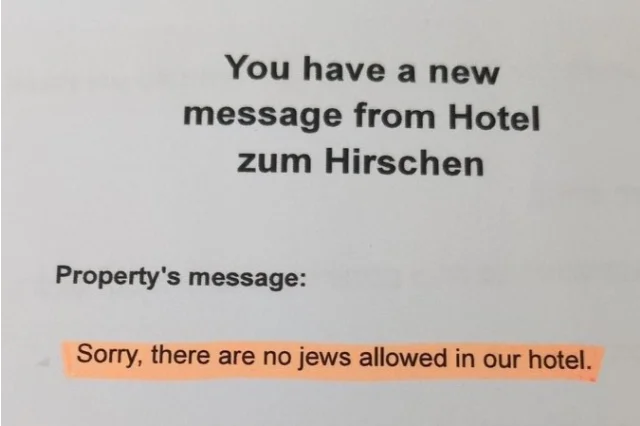
A German hotel told an Israeli family requesting a reservation that there are “no Jews allowed,” triggering intense discussions about the presence of antisemitism in Germany, almost 100 years after the Nazi Party came to power.
The striking case was highlighted by Israel’s consul general to Southern Germany, Talya Lador-Fresher, this week.
“Are we back in the 1930s? A hotel responded to an Israeli as follows: ‘Sorry, there are no Jews allowed in our hotel.’ I'm glad that booking.com has banned this hotel from its website,” she wrote on 𝕏.
The case was widely covered by the German press, and the Upper Palatinate Police Headquarters said that the Regensburg Criminal Police opened an investigation.
Sind wir wieder in den 1930er Jahren? Ein Hotel hat einem Israeli folgendes geantwortet: „sorry, there are no Jews allowed in our hotel“.
— Talya Lador (@TalyaLador) June 2, 2026
Ich bin froh darüber, dass @bookingcom dieses Hotel von seiner Homepage verbannt hat. pic.twitter.com/3hiBEK1dse
It is also somewhat unusual among recent cases of antisemitic incidents toward Israelis, which often cite Israel’s alleged genocide or other actions as ostensible reasons. In this case, the hotel quickly apologized, claiming that the statement was made out of frustration and a lack of care, rather than antisemitism or any anti-Israel sentiment.
Responding to several media outlets, a representative of the family that has owned the hotel on the Czech border for over 100 years has apologized for the statement, arguing that the family doesn’t hold hostile beliefs toward Jews or Israelis and blaming recent fake bookings and phishing attempts for causing frustration to boil over.
The hotel's junior manager said that they thought the unusual request from Israel was fake as well. “Very, very stupid on our part. But it in no way reflects our beliefs or our worldview,” he said, adding the antisemitic message was made “in passing” amid a busy workday.
Lador-Fresher criticized this explanation: “In passing? Then maybe that's exactly what he thinks. He didn't give it any thought. That's pretty shocking, I think,” she told the public broadcaster Bayerischer Rundfunk.
“Antisemitism is not an Israeli problem; it is not a Jewish problem. It is a threat to democracy,” she added.
On its website, the hotel further tried to explain its position, stating “unequivocally … we condemn all forms of discrimination. Claims that certain groups are not welcome here are untrue and do not reflect the facts,” while adding, “Normal operations are not affected.”
German journalist Tobias Huch, who has covered the war and other events in Israel from a pro-Israel perspective, said the hotel contacted the Israeli family directly: “They apologize without qualification. They provide evidence of the previous fraud cases, explain the sequence of events step by step – and at no point minimize their own responsibility.”
Huch continued, “‘This was nevertheless unacceptable and must not happen in a professional establishment,’ they write verbatim. And further: ‘We and our employees are only human, and sometimes anger gets the better of us.’ Junior manager Andreas Vogl includes his personal mobile number and invites the family to a complimentary stay – not just a weekend but a full week, to meet in person.”
Huch concluded, “This is not the behaviour of a hotel that hates Jews. This is the behaviour of a family that made a terrible mistake and is trying to make it right.”
Nevertheless, the President of the Central Council of Jews in Germany, Josef Schuster, called for a legal investigation. “Even though I have taken note of the apology for this unacceptable remark, it remains shocking that someone would not only think along these lines, but also put it in writing and send it.”
“You rub your eyes; you don’t want to believe it. But the sentence is real,” said Charlotte Knobloch, president of the Jewish Community of Munich and herself a Holocaust survivor.
She also specifically highlighted the context of the statement amid a string of antisemitic incidents in Europe in recent years. “In the end, it is almost secondary whether the person who wrote it sent it out of hateful intent or simple thoughtlessness, because either way it describes the reality experienced by many Jewish people—not just Israelis,” Knobloch said.
“Not even the smallest moments of everyday life are free from this burden. The realm of what is normal shrinks more and more with each passing day.”
You might also like to read this: