Israeli attorney general accuses gov't of undermining ‘principles of rule of law’ by disregarding High Court ruling
Dispute between government & high court could signal return to judicial reforms





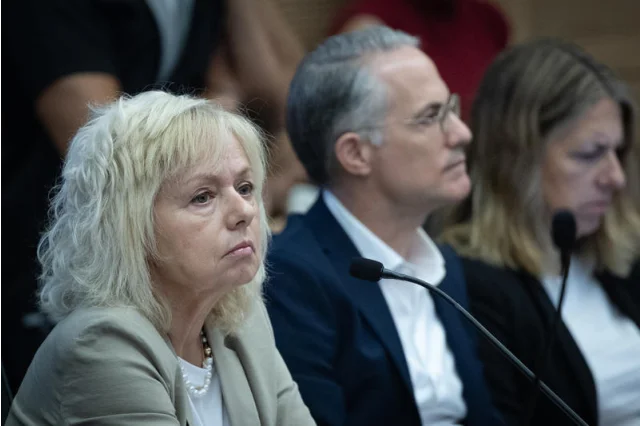
Attorney General Gali Baharav-Miara accused the government of harming the rule of law in the State of Israel in a strongly worded statement on Sunday evening, blasting the decision to disregard a recent High Court ruling.
Baharav-Miara's statement came after the government declared it would not honor the High Court's decision allowing the Second Authority Council for Television and Radio to continue operating despite lacking the legally required number of members needed to make decisions.
“The government's decision, which declares the lack of legal validity of the actions of the 'outgoing' Council currently in office, constitutes an additional and serious attempt to thwart the judicial decisions issued by the court, and to intimidate anyone who seeks to comply with these decisions or rely on them,” the AG's office stated.
“This undermines fundamental principles of the rule of law in a democratic state.”
In a letter to the High Court, Baharav-Miara said the decision is “a direct continuation of the actions taken by the Minister of Communications in the current proceeding, which led to the resignation of the ‘outgoing’ Council members and whose purpose was to thwart the Honorable Court’s decision of May 15, 2026.”
On Monday, Culture and Sports Minister Miki Zohar (Likud) denied claims that the government’s resolution to disregard the High Court’s ruling represents an actual declaration of intent to disobey the ruling, potentially triggering a constitutional crisis.
“As I know him, the prime minister will comply with the High Court’s decision; there won’t be a constitutional crisis here,” Zohar told public broadcaster Kan News. “In my opinion, a constitutional crisis is the beginning of a slippery slope.”
Zohar also claimed that the government was actually trying to prevent a constitutional crisis.
The declaration "told the High Court that its behavior was against the law,” Zohar insisted. “We must obey the High Court’s decisions, but we’ll say that we are on the verge of a constitutional crisis.”
Zohar’s comments appear to be the latest attempt by the government to walk back its declaration, after Cabinet Secretary Yossi Fuchs said the statement “does not contain a single word calling for noncompliance… Rather, it expresses sharp criticism of a ruling that contradicts the explicit wording of the law.”
The coalition's decision to disregard the High Court ruling represents the latest development in its fight against what its members call systemic judicial overreach. The coalition government brought several bills to the Knesset in the period before the October 7 Gaza War, which it billed as judicial reforms, aimed at reining in the judiciary.
These bills were criticized by the opposition as attempts to undermine the rule of law and led to significant protests in the months before the war.
Retired Supreme Court justice Hanan Melcer said on Monday that the government’s actions are “reminiscent of the eve of October 7,” when protests against the judicial reforms were a weekly occurrence, often drawing tens of thousands of protesters.
He said the government’s declaration “states that they don’t recognize the decisions of the High Court of Justice.”
“This is an attack on democracy,” he warned.
One of the groups that helped lead the protests is the Movement for Quality Government (MQG), which has frequently petitioned the High Court against various aspects of the judicial reform bills.
Following the announcement by the coalition government that it would not abide by the High Court’s ruling, the MQG hosted a protest rally in Tel Aviv.
“This government operates like a bunch of anarchists in suits,” MQG chairman Eliad Shraga said. “This is a government that behaves as if the law is a recommendation. Anarchists in suits, sitting around the cabinet table, cannot decide that the court binds the citizens but not them.”
The MQG said it would push for court sanctions against the ministers involved in the declaration.
The confrontation indicated that the coalition may be gearing up to resume its plans for judicial reforms even before the start of elections this fall.
In a recent interview with Channel 14, Israeli Prime Minister Benjamin Netanyahu indicated that he plans to continue the judicial reform plan both before and after the upcoming elections.
You might also like to read this: