Netanyahu won't rule out Gaza settlements, addresses US aid, Iran threats & Turkey
'I think Erdogan forgot that the rule of the Ottoman Empire ended'




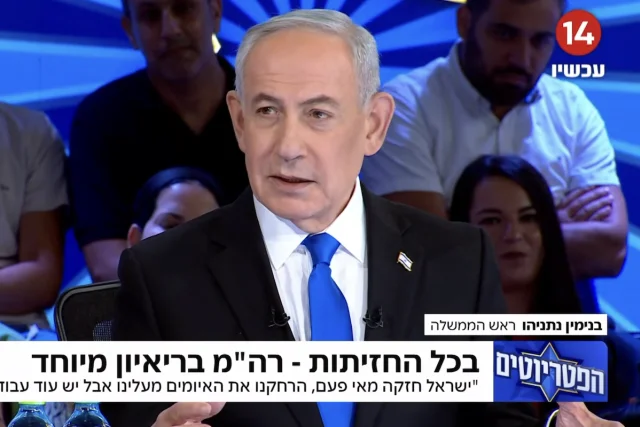
Israeli Prime Minister Benjamin Netanyahu on Tuesday night declined to rule out plans for what he described as “voluntary emigration” of residents from Gaza, during a wide-reaching interview on Israel’s Channel 14 News that touched on Gaza, Lebanon, Iran, Turkey and relations with the U.S.
The interview aired on “The Patriots,” a political TV program hosted by Yinon Magal and widely seen as being among Netanyahu’s political base.
When Netanyahu was asked about whether Israel could re-establish Jewish communities in the Gaza Strip, he declined to offer a direct response.
“The question is whether you prefer to do or to talk,” he said. “And yes, I prefer not to address it.”
His remarks came a day after Finance Minister Bezalel Smotrich said plans for three new settlements in Gaza were waiting for Netanyahu’s approval. Smotrich said the Defense Ministry Settlement Administration, which he oversees, “has completed the groundwork to establish three settlements in the north Gaza area.”
During the interview, Netanyahu addressed a wide range of issues, including U.S. aid, saying “yes” when asked whether he wants to end American assistance. He said he envisions a 10-year “slope” that would gradually reduce Israel’s reliance on U.S. support.
He added that while Israel values the aid, its economy – approaching $1 trillion – will be able to sustain itself, beginning “already in the coming year.”
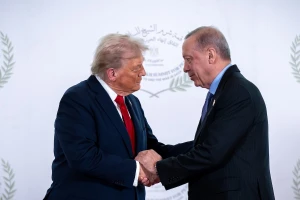
Netanyahu also responded to concerns over Turkey’s regional role and President Recep Tayyip Erdoğan's rhetoric toward Israel.
“The things Erdoğan says about wanting to destroy Israel, to retake Jerusalem, I think he forgot that the rule of the Ottoman Empire ended,” Netanyahu said. “There is the State of Israel here, the Israel Defense Forces, and the people of Israel. We will not allow anyone to threaten us.”
He took a hard line on the broader regional outlook, emphasizing the need for continued military strength in what he described as an enduring conflict environment.
“The war will never end,” Netanyahu said. “You want to live in the Middle East? Be strong.”
At the same time, he indicated that further normalization agreements may still be in play, while declining to provide details.
“There is more on the table,” he noted. “I will not name names in order to bring results.”
Netanyahu described his diplomatic approach as a balance of firmness and flexibility.
“Choose exactly the places where you must stand up to the world,” Netanyahu said. “Where you can say yes, say yes, and where you need to stand on interests, say no. We need to navigate our policy with responsiveness and also with force. I promised that we would change the Middle East, and we did.”
He said Israel needs a broad national government to navigate current challenges, adding, “I want a broad national government because we are facing great opportunities and great challenges,” and “This is not spin.”
He stressed, however, that his current coalition partners would remain in place. “That is not even a question,” Netanyahu said. “I am expanding the national camp.”
He also said the government will continue with its judicial reform agenda and attributed delays in advancing the ultra-Orthodox IDF draft law to late handling of the issue, saying, “We did not manage to pass the draft law because we got to it late,” and adding, “It is hard to prevent desertions.”
He also reiterated his position on Iran, saying, “As long as I am prime minister, Iran will not have nuclear weapons,” he said.
You might also like to read this: