Amb. Leiter says Israel-Lebanon deal supersedes US-Iran MOU, military option remains



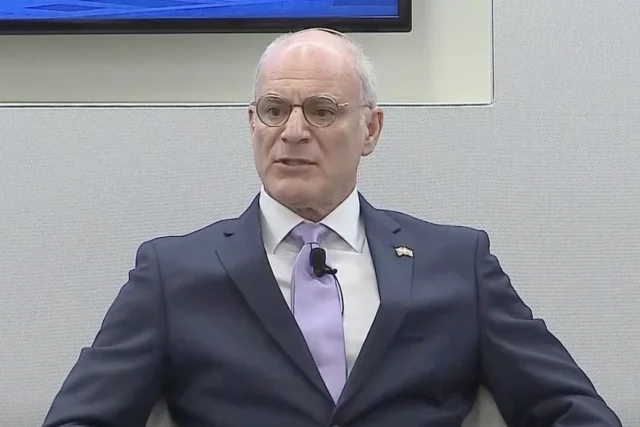
Israeli Ambassador to the United States Yechiel Leiter said on Monday that Israel views its newly signed agreement with Lebanon – not the recent U.S.-Iran memorandum of understanding – as the framework for future relations with Beirut. He also signaled that military action against Iran remains an option if diplomacy fails.
Speaking during an interview at the Council on Foreign Relations in Washington, D.C., Leiter addressed a wide range of issues, including negotiations with Lebanon, the future of U.S.-Iran diplomacy, reported tensions between Prime Minister Benjamin Netanyahu and President Donald Trump, and Israel's relationship with Vice President JD Vance.
Asked about the relationship between the Israel-Lebanon agreement and the US-Iran memorandum signed earlier this month, Leiter dismissed the idea that the MOU's ceasefire provision would define Israel's policy.
Although the first of the MOU's 14 points calls for a ceasefire between Israel and Hezbollah, neither Israel, Hezbollah nor Lebanon's internationally recognized government signed the agreement.
“Both Israel and Lebanon clearly see our trilateral agreement superseding the first clause of the MOU,” Leiter said. “Whether or not the United States does, you’ll have to ask an administration spokesman.”
Iran, along with Pakistani and Qatari mediators, may regard the MOU as the more significant agreement, Leiter explained, but Israel does not. He added that the memorandum is primarily intended to reopen the Strait of Hormuz to maritime traffic and “is not a closure of the operation against Iran and its nuclear pursuits.”
His remarks echoed Israel's longstanding position that military action against Iran's nuclear program remains possible if negotiations fail to produce an agreement acceptable to Jerusalem.
Leiter also argued that sanctions relief should not be granted to Tehran, warning that Iran's rulers would use the funds they receive “for nefarious purposes.”
At the same time, he acknowledged that the final decision rests with Washington.
“All we can do is weigh in… We can’t be part of that decision-making process. That’s too big for us. We know our size.”
Despite concerns expressed by many in Israel over the MOU, Leiter said he remains “sanguine” that negotiations could ultimately produce an agreement aligned with Israel's long-term security interests, particularly by limiting Iran's ballistic missile program.
“Whether that’s in 60 days or 90 days or after the midterms… I’m quite sure that the administration didn’t go to war to go back into a situation where Iran has a pathway to once again try and produce nuclear weapons,” he said, adding that he “can’t imagine that any ultimate agreement with Iran would be absent a clause limiting the development of ballistic missiles.”
He also expressed optimism that any final agreement would address Iran's support for regional proxy groups, including Hezbollah, Hamas, the Houthis in Yemen and Shi'ite militias operating in Iraq and elsewhere.
Turning to Israel's negotiations with Lebanon, Leiter said talks would continue later this month.
“Next week, we’re going to be sitting in Rome on the 14th and 15th, bringing teams for each issue.”
He reiterated Israel's longstanding position that it has no territorial ambitions in Lebanon but said the Israel Defense Forces would remain deployed in southern Lebanon until the Lebanese Armed Forces could fully secure the area and prevent Hezbollah from reestablishing a military presence.
Concerns over Hezbollah sympathizers within the LAF and Israel's willingness to assist both the Lebanese military and government in addressing those challenges were also discussed.
Addressing reports of friction between Netanyahu and the Trump administration, Leiter dismissed suggestions that the relationship had deteriorated.
“The media loves drama. So, if the president and the prime minister have 100 conversations that are pleasant, and then there are two conversations in which the president is having a bad day or is a little irritable and makes that known – that becomes the tenor of the relationship between the two men. The relationship is good and solid. There are differences along the way, and they are legitimate.”
Later in the discussion, Leiter also pushed back on a recent comment by Vice President JD Vance that President Trump was the only world leader who still had sympathy for Israel.
Leiter pointed to Israel's close ties with countries including India, the United Arab Emirates and Azerbaijan, adding that after several public and private meetings with Vance, he had never detected “a scintilla of antipathy toward Israel."
Please take a moment to join believers worldwide praying for Israel right now. Add your light to the live prayer map—and show the world one more watchman praying for the peace of Jerusalem.

You might also like to read this: