Gaza at a crossroads: What Israel's ancient prophets say about the region’s future
Joel and Lynn Rosenberg of The Joshua Fund turn to the prophets Zephaniah and Isaiah to examine what scripture reveals about judgment, restoration, God's promises




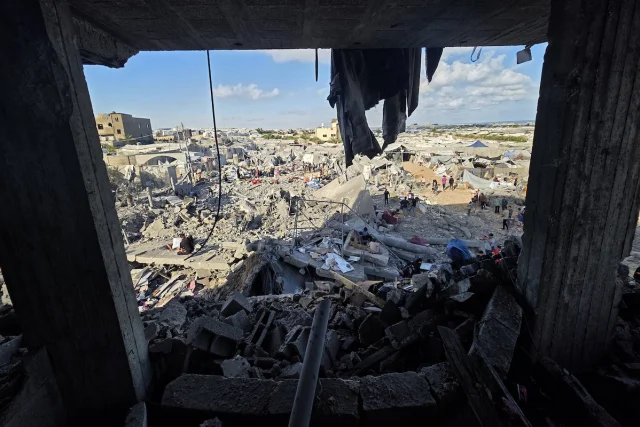
As international debate over Gaza’s future continues, with questions of governance, displacement, and rebuilding still unresolved, ALL ISRAEL NEWS Editor-in-Chief Joel Rosenberg is looking beyond diplomatic proposals to Scripture.
Joined by his wife, Lynn Rosenberg, the co-founders of The Joshua Fund examine what the Bible says about Gaza’s prophetic role, drawing on the books of Zephaniah and Isaiah to explore themes of judgment, restoration, and God’s promises to Israel and her neighbors.
Their discussion also considers how believers can respond with wisdom, compassion, and hope as the region stands at a pivotal moment in history.
Speaking with the directness that has defined his work as a journalist and author, Rosenberg walks through Zephaniah chapter 2, a compact but weighty text that addresses Gaza’s fate before the final days of history. Three times in a single verse, the prophet repeats the word “before.” Before the decree takes effect. Before the burning anger of the Lord comes. Before the tribulation closes. Something, the text insists, will happen first.
What follows is striking. The prophet declares that Gaza will be abandoned, that no inhabitants will remain, and that the coastal land will become the possession of a remnant of the house of Judah. “The coast will be a remnant of the house of Judah,” Rosenberg notes. “They will pasture on it, and their God will care for them.” Whether today’s events represent the beginning of that fulfillment, he is careful not to overstate. “Could God be using these events to fulfill it? Yes. Do we know that for sure? No. But I think we need to be praying.”
That prayerful posture, neither triumphalist nor despairing, runs through his analysis. “The governments aren’t going to bring hope,” he says, “but we can be the agents of hope and light in this darkness.”
The second prophetic thread that Rosenberg unpacks is Isaiah 19, one of Scripture’s most arresting passages concerning Egypt. The chapter opens with hard news: spiritual deception, political tyranny under a cruel master, environmental and economic collapse. But in verse 20, the text turns: “He will send them a savior and a champion, and he will deliver them.” For Rosenberg, the identity of that savior requires no interpretation. “What other savior does God send? This is Jesus.”
The chapter’s close is nothing short of breathtaking. A highway will stretch from Egypt to Assyria. Former enemies will worship together. Israel will stand at the center as “a blessing in the midst of the earth,” with God declaring, “Blessed is Egypt, my people, and Assyria, the work of my hands, and Israel, my inheritance.”
For Rosenberg, that vision frames everything. “These scriptures give us hope,” he said. “Not just for Israel. For the Egyptians, the Lebanese, the Syrians, the Jordanians, the Palestinians.”
Lynn Rosenberg gave listeners a clear place to begin. She called for prayer covering the practical needs of Gaza’s people alongside the spiritual, asking that God would open pathways for food, water, and medical care, and that Scripture would take root across the region.
“Pray for God’s hope to spread and to grow across the whole epicenter region,” she says.
Whatever the next chapter of Gaza’s story holds, the Rosenbergs are convinced the final chapter has already been written.
Click below to listen to the full Inside the Epicenter podcast.
You might also like to read this: