Who keeps Israel? A Christian answer to a presidential boast
“He that keepeth Israel shall neither slumber nor sleep.” — Psalm 121:4


When President Donald Trump stood beside the Emir of Qatar at the Group of Seven summit in Evian this week — a new understanding on Iran only days from signing, and a public rebuke for Jerusalem already delivered — he made a claim that ought to give every Bible-believing friend of Israel pause. “Without the United States, there would be no Israel,” he said. “Without me, there would be no Israel, because no other president was willing to do what I did.”
As Christians who have spent years defending this president’s record toward the Jewish state, we are precisely the people who should be willing to say, plainly and without rancor, that the second half of that sentence cannot stand. Not because we are ungrateful — but because we know who actually keeps Israel, and His name is not Trump.
Let me first say what I am not saying. I am not enlisting in the ranks of those who oppose this President out of habit, and I am not waving away what American friendship has meant to Israel in our generation. The embassy moved to Jerusalem. The city was recognized as Israel’s capital. Iran’s ambitions were confronted rather than appeased. The reflexive courting of Israel’s enemies in the international forums was, for a season, abandoned. These were real and good things, and to thank God for a leader who did them is not flattery; it is simple honesty, and the Scriptures everywhere commend gratitude to those who do us good.
But there is a world of difference between thanking a friend and crediting him with your existence. A guest may thank his host for the meal; he does not thank him for the harvest, the rain, and the sun. When a man says that without him there would be no Israel, he has quietly stepped out of the role of friend and into a role that belongs to God alone. And here the believer, of all people, must not nod along.
Begin with the plainest question the Bible answers about this people: who keeps them? The psalmist does not leave us guessing. “Behold, he that keepeth Israel shall neither slumber nor sleep” (Psalm 121:4). Not a coalition, not a treaty, not an army, not a benefactor in Washington — the LORD Himself is the watchman over Israel, and He has never once nodded off at His post.
Look at the long witness of history and the claim collapses under its own weight. Pharaoh thought Israel was his to keep, and Egypt buried its firstborn. Assyria carried the northern tribes away and is itself a ruin. Babylon torched the Temple and passed into the dust of the museums. Persia, Greece, Rome — every power that ever imagined it held the Jewish people in its fist is gone, and the people they meant to break are still here, still opening the same Scriptures, still turning their faces toward the same Jerusalem. A leader who holds office for four years, perhaps eight, cannot be the reason a nation has survived for four thousand. As Israel sang after one narrow deliverance, “If it had not been the LORD who was on our side... when men rose up against us: then they had swallowed us up quick” (Psalm 124:1–3).
None of this means God does not use the nations and their leaders. He does — constantly, and often grandly. But Scripture is careful to mark the line between being used by God and imagining oneself to be God’s substitute, and that is exactly the line Evian crossed.
Consider how the prophets speak of it. When the LORD raised up Assyria to discipline His wayward people, He called that empire “the rod of mine anger” (Isaiah 10:5) — a tool in the hand of a Workman. Assyria’s downfall came not because it acted, but because it boasted: “By the strength of my hand I have done it, and by my wisdom; for I am prudent” (Isaiah 10:13). To which heaven replied with a question that should be read slowly by every powerful man: “Shall the axe boast itself against him that heweth therewith? or shall the saw magnify itself against him that shaketh it?” (Isaiah 10:15). The axe does not keep the woodsman. It is held.
Set beside that the gentler example of Cyrus. God called the Persian king “his anointed” and went before him to subdue nations, all so that the exiles could go home and rebuild — and yet the LORD adds, “I have surnamed thee, though thou hast not known me” (Isaiah 45:1, 4). Cyrus served God’s purpose for Israel without ever knowing the God he served. He received an empire; he did not receive the glory. For the LORD had already settled that question: “I am the LORD: that is my name: and my glory will I not give to another” (Isaiah 42:8).
Here is a word worth offering the President directly. If he wishes to be remembered as a modern Cyrus — a gentile ruler whom God used for the good of the Jewish people — that is a high and honorable thing, and many of us would gladly say so. But Cyrus never stood before the nations and announced that without him there would be no Israel. The instrument that boasts against the hand has forgotten what it is. The moment a man claims the glory of Israel’s survival for himself, he reaches for something God has expressly refused to share.
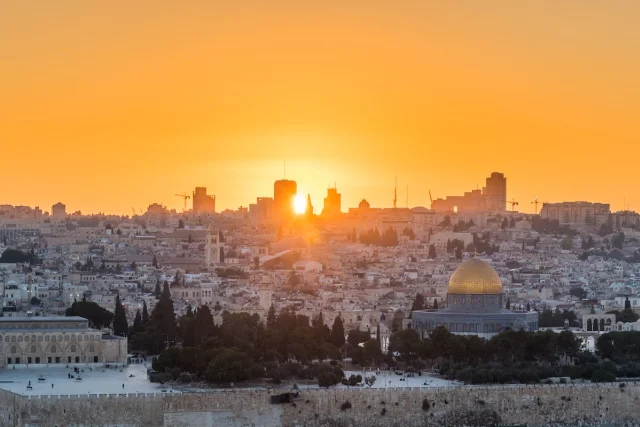
And why is Israel’s survival not finally in human hands? Because it rests on a covenant that no ballot can repeal and no summit can renegotiate. To Abraham God said, “I will bless them that bless thee, and curse him that curseth thee” (Genesis 12:3) — notice the direction of it: the nations are weighed by how they treat Israel, not Israel by how the nations treat her. Through Jeremiah He bound the survival of the Jewish people to the fixed order of creation itself: “If those ordinances” — the sun by day, the moon and stars by night — “depart from before me, saith the LORD, then the seed of Israel also shall cease from being a nation before me for ever” (Jeremiah 31:36). The sun rose this morning over Evian as it rose over Sinai; the covenant is just as steady. He calls this people the very “apple of his eye” (Zechariah 2:8), and guards them as a man guards his own sight.
For my fellow Christians the point is sharper still, because the New Testament forecloses the escape route some have tried to take. Paul, writing of Israel, declares that “the gifts and calling of God are without repentance” (Romans 11:29) — God does not take back what He has promised. If the Almighty Himself will not revoke His call on this people, no president can be the thread by which their existence hangs. To suggest otherwise is not merely poor history; it is poor theology.
There is a mercy in saying all this clearly, because the Bible is also a record of what becomes of rulers who forget it. Nebuchadnezzar, the most powerful man of his age, walked the roof of his palace and admired his handiwork: “Is not this great Babylon, that I have built... by the might of my power, and for the honour of my majesty?” (Daniel 4:30). The sentence was scarcely finished before God drove him out to live like a beast among the fields, until he learned the lesson all proud rulers must learn — “that the most High ruleth in the kingdom of men” (Daniel 4:17). Moses had warned Israel of the very same temptation in their own hearts: never to say “My power and the might of mine hand hath gotten me this wealth” (Deuteronomy 8:17). The danger is not unique to Babylon, or to Washington. It is the perennial temptation of the strong.
And there is a warning here for us as well, who love both Israel and the leaders who befriend her. The psalmist’s counsel is blunt: “Put not your trust in princes, nor in the son of man, in whom there is no help” (Psalm 146:3). Princes are worth thanking. They are not worth trusting. The moment our confidence in Israel’s future rests on who occupies the Oval Office, we have made the same error as the boast we are criticizing — only quieter.
So let the record show our gratitude. Thank God for every nation and every leader who has stood with the Jewish people, and thank the President for the good he has done. But the survival of Israel is not the achievement of any administration, and it never was. It is the steady work of the One who has kept this people through Pharaoh and Caesar and the furnaces of the last century, and who keeps them still.
He that keepeth Israel shall neither slumber nor sleep. He did not begin in 2017, and He will not finish when any president leaves office.
You might also like to read this: