Eisenkot’s Yashar party soars in the polls as Israel's parties prepare for October elections
Several significant leaders, potential party mergers could still change the picture




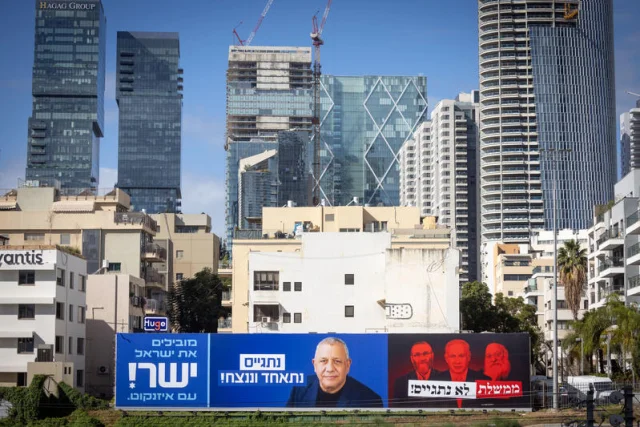
Among all Israeli politicians, Gadi Eisenkot has seen the most momentum in recent weeks.
His Yashar! party has rocketed up recent polls, overtaking Naftali Bennett and Yair Lapid’s Together party, and even come into striking distance of Benjamin Netanyahu’s Likud party, which is mired in internal discussions over its slate of candidates while suffering from general dissatisfaction with the security situation, particularly the U.S.-Iran deal.
Meanwhile, the elections currently appear most likely to be held on their scheduled date at the end of October, after initiatives to move them up have been averted for now.
Channel 13’s most recent poll sees Yashar as the largest opposition party with 20 seats, beating out Together, which fell to 17 seats. The Likud would still be the largest party with 22 seats, though Netanyahu’s bloc would only receive 51 mandates, ten short of the necessary majority.
In this poll, The Democrats and Yisrael Beytenu received eleven seats, the ultra-Orthodox Shas nine, far-right Jewish Power and ultra-Orthodox United Torah Judaism eight each, the three-party Arab alliance six, and the Islamist Ra’am and Religious Zionism four, respectively.
Knesset Seat Poll
— Israel Elects (@israel_elects) June 17, 2026
🔵Likud: 22
🔴Yashar: 20
🔴Together: 17
🔴Democrats: 11
🔴Yisrael Beteinu: 11
🔵Shas: 9
🔵Otzma: 8
🔵UTJ: 8
🟢Hadash-Ta'a'l: 6
🟢Ra'am: 4
🔵RZP: 4
via Hamadad/Chan13, June 17 pic.twitter.com/sDk5nSEtH1
This would give the opposition 59 seats, with ten seats going to the two Arab parties.
Eisenkot’s momentum was also confirmed by public broadcaster KAN News’ most recent poll, which gave Likud 23, Yashar 21, and Together 17 seats.
The race for leadership of the opposition bloc is currently drawing the most attention, though there are myriad open questions ahead of the elections and the candidate lists are far from being finalized.
Bennett and Lapid soared up the polls after announcing their joint slate several weeks ago, but Eisenkot has benefited from declining their invitation to join, and now looks like the most likely candidate to challenge Netanyahu.
Asked by 103FM radio whether he would agree to join Eisenkot and become his number two, Bennett highlighted his past experience and achievements as prime minister, before adding that he “will do anything in the world to replace this very bad government. I will not let ego be a factor.”
Who do undecided voters trust most on key issues?
— Israel Elects (@israel_elects) June 17, 2026
Iran
🔵Netanyahu: 43%
🔴Eisenkot: 17%
🔴Bennett: 15%
Cost of living
🔴Bennett: 36%
🔴Eisenkot: 17%
🔵Netanyahu: 15%
Social schism
🔴Eisenkot: 31%
🔴Bennett: 26%
🔵Netanyahu: 11%
via Hamadad/Chan13, June 17
Maybe the most important factor when analyzing the upcoming elections is the fact that the picture of which parties are running, and how their respective lists will look, is still far from clear.
Several parties that are under the threshold could still either join together or add significant figures to their list to rise up the ranks.
While the leadership of Netanyahu in the Likud is unquestioned, a quarrel has broken out over the candidate list, as the prime minister and some leading figures seek to cancel the intra-party primary election to give Netanyahu the right to nominate nine candidates.
Sources told Ynet News that Netanyahu sees this as a way to ensure that candidates with national popularity and recognition are included, rather than having to battle for votes.
היום כולם כבר יודעים: לאייזנקוט אין ממשלה בלי המפלגות הערביות. pic.twitter.com/NI0ciibEHN
— Benjamin Netanyahu - בנימין נתניהו (@netanyahu) June 18, 2026
Within his coalition, the debate over support for enlisting ultra-Orthodox men has remained a central bone of contention, as several Likud lawmakers have prevented bills supported by the Haredi parties from advancing.
Shas leader Aryeh Deri and UTJ’s Moshe Gafni also attacked Jewish Power’s Itamar Ben Gvir this week, slamming the response of the police force, which is under Ben Gvir’s National Security Ministry, against ultra-Orthodox protesters as overly violent.
Haredi leaders have ramped up their calls for demonstrations recently, which they hope will also help drive out voters during the upcoming elections.
Meanwhile, Finance Minister Bezalel Smotrich’s Religious Zionism party continues to teeter on the brink of the election threshold. Ben Gvir has reportedly rejected calls by Netanyahu to repeat his joint run with Smotrich, who tried to appeal to his base of national-religious settlers this week by claiming that the Hebron agreement with the Palestinian Authority had been canceled, which was quickly contradicted by the Foreign Ministry.
💛 Watch the moment Eitan Mor reunites with his parents: pic.twitter.com/mKajWRBumU
— Israel Defense Forces (@IDF) October 13, 2025
Smotrich’s new addition, Tzvika Mor, father of returned hostage Eitan Mor, doubled down on this appeal in an interview with Ynet News, calling for Palestinians in the Gaza Strip to be offered money to make them “leave,” while deriding reports of settler violence as “a campaign whose purpose is to make liberals within Religious Zionism become alienated from their roots.”
In the political center, the most critical question is whether Benny Gantz’s Blue and White party will manage to claw back above the threshold – and if it does, which bloc it will support.
Israeli media reported that Gantz is close to finalizing the addition of two well-known, right-leaning candidates: Brig.-Gen. (res.) Dedi Simchi, the former Fire and Rescue Commissioner whose son was killed fighting on Oct. 7, and popular economist Yaron Zelicha.
In addition, there are persistent reports that Gantz has been discussing a merger with Yoaz Hendel, leader of the Reservists Party, which hasn’t been projected to pass the threshold in any poll so far.
The party has also positioned itself on the center-right but strongly supports the enlistment of Haredi men in the army, making a coalition with the Haredi parties unlikely. Hendel served as Communications Minister in the Netanyahu-Gantz and Bennett-Lapid governments before rejoining the IDF and leading a commando unit as a reserve officer over the past years.
On the opposite side of the spectrum, the far-left Democrats, composed of the Labor and Meretz parties, proudly announced a new membership record of over 75,000 members ahead of primaries planned for next month.
The party has recently gathered several well-known activists and leaders of the anti-government protest movement, like Yaya Fink, Moshe Radman, and others.
Meanwhile, the Arab parties Hadash, Ta’al and Balad have reportedly agreed to establish a joint list without the Islamist Ra’am Party, after months of fruitless negotiations.
However, the Arab parties as well as The Democrats were joined by a new potential rival on the far left wing this week, as the leaders of the Standing Together movement announced the creation of a “truly” Jewish-Arab party, to be called “A Place For Us All” (Makom LeKulanu).
The socialist-communist Hadash-Tal party has a reserved slot for a Jewish candidate on its list, while other parties have reserved slots for minorities, which are often filled by Druze politicians.
Co-chairs Rula Daood and Alon-Lee Green emphasized that their party will aim to give equal representation to Jewish and Arab Israelis who want to “work toward peace, equality, social justice, and the fight against violence and crime.”
You might also like to read this: