Can talking prevent Israel’s next election from tearing the country further apart?
.jpg "Maayan Hoffman")




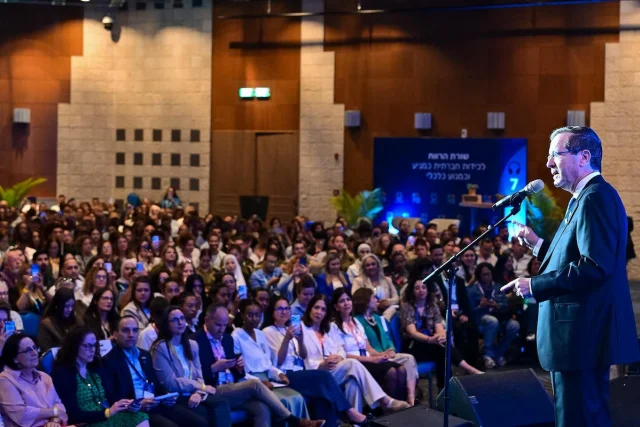
As Israel appears headed toward another election, President Isaac Herzog is trying to prevent an already fractured society from tearing itself further apart.
Against the backdrop of deep political and social polarization, Herzog convened the President’s Conference for a Shared Israeli Future at the International Convention Center in Jerusalem last week in what many participants described as an effort to lower the temperature ahead of an expected election campaign.
The divisions existed long before the Oct. 7, 2023, Hamas attack and the ongoing war, but many Israelis believe the national trauma and prolonged conflict have only intensified them.
The understanding that in a pre-election period “the public discourse normally gets much hotter,” according to Prof. Tamar Hermann, a senior research fellow at the Israel Democracy Institute, was part of what prompted Herzog to host the “Time to Talk” conference.
Herzog opened the “Time to Talk” conference with a stark message: Israeli society is becoming dangerously polarized.
But is that really the case, and if so, can talking solve it?
Herzog said polarization in Israel had reached a “very advanced stage” and posed a national risk. He cited a study by the Agam Institute at Tel Aviv University that measured Israel’s level of polarization at 8.3 out of 10.
A December 2025 poll by the Jewish People Policy Institute (JPPI) found that most Israelis viewed social polarization as the country’s greatest danger, even more serious than the Iranian threat.
With tensions already running high, Dr. Shuki Friedman, director-general of the JPPI, told All Israel News that while Herzog’s conference was an important step toward encouraging dialogue, conversation alone would not be enough.
“We are going to an election now and naturally through this we might see more division, both sides sharpening their messages against the other side,” Friedman said, warning that the campaign season could deepen existing rifts at a time when Israel still faces major external threats.
Israel held five elections between 2019 and 2022.
Last week, Likud introduced a bill to dissolve the Knesset and trigger another election. Israeli media reported that the bill could come to a vote on May 20 and, if passed, elections could be held as early as the third week of August, roughly two months before the current legislative term is set to end on Oct. 27.
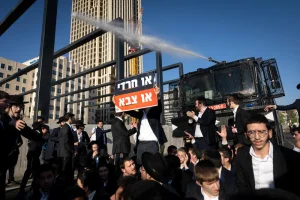
Prime Minister Benjamin Netanyahu’s Likud Party moved to dissolve the Knesset amid mounting pressure from the ultra-Orthodox parties over a draft bill that would require more Haredi men to serve in the army or national service. Under Israeli law, if the bill passes, elections would be triggered within 90 days.
Herzog’s conference had been planned before the dissolution bill was introduced, though organizers already knew elections would likely take place before the end of the year. The event featured speakers, panels, and dialogue forums focused on Herzog’s vision for rebuilding Israeli society and helping the country move from crisis toward repair ahead of Israel’s 80th anniversary. Israel recently marked its 78th Independence Day.
The conference was held in cooperation with the Jewish Federations of North America, the Combined Jewish Philanthropies, the Maimonides Fund, and Maala.
“When there are fuel fumes in the air, and we are entering elections, the answer is here in this tremendous movement of ‘Time to Talk,’” Herzog told the audience. “A movement that comes and says: I am coming to talk to you. I want to hear your pain. I want to understand that there is a tremendous social evolution in Israeli society.”
He added, “We are sick of the hatred, the division, the labeling, the curses, the violence and the shaming.”
Hermann told All Israel News that three of the four major divisions in Israeli society are domestic issues that will likely determine the election's outcome.
The first, she said, centers on leadership and who should govern the country, including whether Prime Minister Benjamin Netanyahu and his current circle should continue to lead Israel, or whether the country should move away from what some supporters describe as the “deep state” and old elites.
The second issue involves the role of Israeli Arabs in the next government and in Israeli society more broadly.
“Should they be equal in terms of legitimacy of their participation in all walks of life, or are they suspected and therefore we should keep them away from certain realms because we don't trust them?” Hermann explained.
The third major issue relates to the ultra-Orthodox community, including military enlistment and broader questions surrounding its integration into Israeli society.
By contrast, Hermann said that on issues such as the Israeli-Palestinian conflict, Iran, and even the economy, most Israelis hold relatively similar views.
Like Friedman, Hermann said that “talking will not do the trick.”
Instead, she argued that Israel needs leadership capable of bringing together different parts of society.
“You need a unifying leader, someone who has enough public authority that would not talk in terms of divisions but in terms of cooperation,” she said.
JPPI is currently developing, as its website describes, “a thin constitution that prioritizes stability, fairness, and compromise, ensuring democratic governance amid internal divisions.”
Friedman explained that the initiative is meant to establish basic agreements on how political disagreements should be managed within the legislative system and the broader public sphere to reduce the risk of a continuing societal rupture.
Hermann said that the makeup of the next government would also play a major role in determining whether Israel can ease internal tensions.
If the next coalition is numerically stable, she explained, it would be less vulnerable to smaller factions threatening to collapse the government. A coalition with around 70 seats, she said, would have enough political strength to address contentious issues while still maintaining broad public backing.
“Fifty-nine or sixty seats is totally different from 70 or 75,” Hermann said. “The size of the majority is critical here,” as is the number of parties making up that coalition.
At the same time, Hermann cautioned against allowing public discourse to become consumed by negativity. She said the opposition, in particular, should avoid rhetoric focused on emigration or despair and instead motivate voters and present a path forward.
“The opposition should concentrate its energies in order to be very effective when the real campaign starts,” she said. “How do you mobilize people who think that everything stinks here?”
Despite the divisions, Hermann said she believes “the state is actually functioning very well.”
“We are all aware of the division and all concerned about it, and partly because everyone is involved in the Israeli debate and so forth,” Friedman added. “But if everyone takes some responsibility and presses their message or opinion with respect to the other, this might reduce tensions.”
You might also like to read this: