Why Trump’s suggestion that Syria should ‘handle’ Hezbollah sent shockwaves through the region
Syrian intervention could benefit Hezbollah by galvanizing its base, uniting Lebanon against invaders





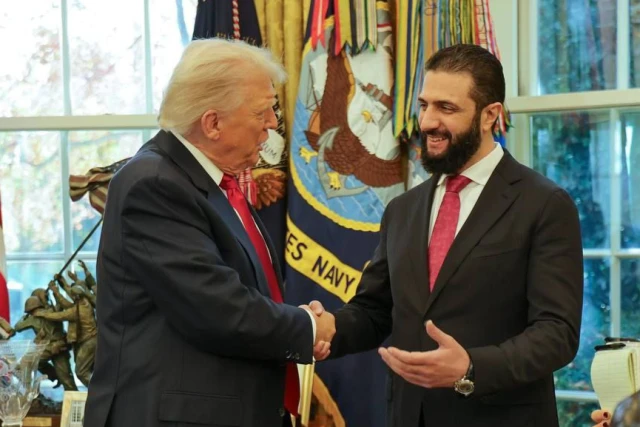
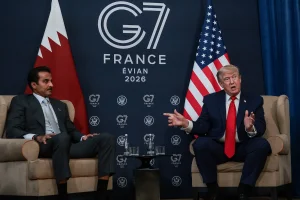
Sitting next to Qatar’s Emir on Tuesday, U.S. President Donald Trump casually raised a suggestion that could tip the entire region over the edge.
“I suggested to Israel to let Syria take care of Hezbollah,” Trump stated. “To be honest with you, I think they’d do a better job.”
What the president mentioned in his typically nonchalant manner could risk a new intra-Muslim sectarian civil war, a direct clash between a newly legitimized Sunni Islamist government supported by Turkey and the West, and a Shiite Islamist terror militia supported by Iran.
Even worse, this new Syrian invasion of Lebanon (the first ended just over 20 years ago) would probably trigger a new Lebanese civil war, endangering the bare existence of this failed state, while also destabilizing Syria, which is still recovering from a decade of civil war.
Ultimately, it might accomplish the opposite of its goal.
But before we explore the subtleties of Trump’s idea, it is, of course, crucial to state clearly that, for a variety of reasons, there is no chance this will actually happen, not the least because Syrian President Ahmad al-Sharaa repeatedly denied any interest in it.
Nevertheless, a detailed look at the idea is instructive to understand the regional dynamics.
The thing is, if Syria sincerely wanted to deal with Hezbollah, they really would do (would be allowed to do) a better job than Israel. Israel would be hit with Rhodesia-level sanctions if it did 1% of what Syria would do there. https://t.co/HiKWgzoT8C
— Rafi DeMogge רפי דמוג (@HeTows) June 16, 2026
So how did we get here?
The background to Trump’s suggestion is his frustration with what he apparently sees as Israel’s failure to “take care” of Hezbollah. The first question is, of course, what this means.
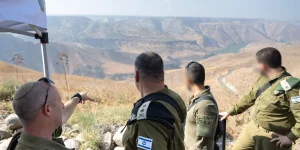
Israeli officials have stated that in order to root out Hezbollah, one would need to take over the entirety of the state – a highly unrealistic endeavor. Without this, all Israel could do is take over a security zone next to its border and demolish Hezbollah’s infrastructure there.
This, let’s remember, was only necessary because the Lebanese state failed to do so, despite claiming to have accomplished this back in January.
But the U.S. not only declined to criticize the Lebanese government for this failure but instead increasingly tied Israel’s hands by limiting its ability to strike Hezbollah outside of southern Lebanon due to concern for the Iran deal – allowing Iran to connect the two fronts.
When an Israeli strike in the Lebanese capital threatened to trigger another Iranian missile barrage last week, Trump, behind the scenes, reportedly incentivized the Iranians not to respond but publicly pummeled Netanyahu, charging he had no “f*cking judgement” and then suggesting a former archterrorist would be able to “handle” Hezbollah better than he has.
At this, Israeli author Rafi DeMogge quipped sarcastically that “The thing is, if Syria sincerely wanted to deal with Hezbollah, they really would do (would be allowed to do) a better job than Israel. Israel would be hit with Rhodesia-level sanctions if it did 1% of what Syria would do there.”
“What’s being rumored regarding #Syria entering #Lebanon is totally baseless… the demarcation of borders isn’t a priority at this time, especially in light of the crisis #Lebanon is facing.”
— Charles Lister (@Charles_Lister) June 13, 2026
- #Syria’s President al-Sharaa, speaking 36hrs ago. pic.twitter.com/7eV1TvdTIT
Unwanted outcomes
But several experts were appalled at the idea of using the Islamist troops of President al-Sharaa against Hezbollah.
This idea has been floated by the Trump administration several times already. Last week, Trump told NBC’s “Meet The Press” that he wants “a more surgical attack on Hezbollah… we can recommend Syria… They have a leader that’s really done a good job in a short period of time. And he would love to help.”
While it is unclear where Trump got the idea that the Syrians would be more “surgical” than the Israeli Air Force's precision weapons, the Syrian government has accumulated a certain track record of achievements against Hezbollah.
Responding to Trump, Foreign Policy published an op-ed by Ahmad Sharawi, a research analyst at the Foundation for Defense of Democracies, who urged, “Don’t Invite Syria Back Into Lebanon.”
Sharawi noted that “Syria’s new rulers have incentives to curb Hezbollah: The group backed the former Assad regime, relied on Syrian territory for weapons transfers, and has offered protection for Assad-era officials in Lebanon. In this light, Syrian officials have expressed frustration that Lebanon has not done more to halt the group’s activities.”
Many Syrians harbor intense resentment against Hezbollah for its support of the Assad regime. At a basketball game between the Syrian and Lebanese national teams in April, originally meant to promote reconciliation, the Damascus crowd broke into chants of “God curse your soul, Nasrallah,” with al-Sharaa in attendance.
But in addition to reigniting sectarian clashes in Syria, the potential intervention would “reopen traumatic memories from the 1975-90 Lebanese Civil War... [and] place Syria’s armed forces in a combustible environment, potentially weakening them when they are needed most to maintain Syria’s territorial integrity at home.”
Lina Khatib, a visiting scholar at Harvard University’s Kennedy School, told Al-Monitor that such a move would give loyalists of the Assad regime and its allies, Hezbollah and Iran, a golden opportunity to intensify their operations against the regime.
More violence has struck tonight across #Syria, particularly in #Palmyra, Taybat Imam & on the Barzeh/Ash Warwar line in #Damascus.
— Charles Lister (@Charles_Lister) June 15, 2026
While large numbers of MOI forces have deployed to contain protests & detain some, the gov't needs to do a lot more to prevent this from spiraling. https://t.co/GbuZr40XvM
This would leave Syria “fighting both a domestic and foreign war,” she warned.
Sharawi concluded, “Damascus is a useful partner against Hezbollah—but only on its own side of the border.”
Without ignoring its role in the intensely violent attacks on Syrian minorities – the government has indeed been a useful partner for Israel by curbing Hezbollah’s use of smuggling routes through Syrian territory, effectively depriving the terror group of its ability to use Syria as a second front on Israel’s northern border.
Al-Sharaa is the only Arab leader to have openly declared his support for the disarmament of the Iranian proxy, and his government has been actively working to thwart Hezbollah’s activities, repeatedly announcing successful operations.
At the beginning of May, it foiled a major terror attack aiming to assassinate Syrian officials through a series of arrests across the country.
In March and April, Syrian authorities announced several operations that seized 6,000 explosive detonators for IEDs, anti-tank missiles, RPGs, and explosives that were meant to bolster Hezbollah’s troops, which were actively fighting the IDF at the time.
Already last year, IDF sources told The Jerusalem Post that they gave Syria “very high marks” for its efforts to prevent Iran and Hezbollah’s ability to smuggle weapons through Syria.
But maybe the strongest argument against Syrian intervention is the fact that it “would allow Hezbollah to recast its arsenal not as a challenge to the Lebanese state but as a shield against foreign intervention,” Sharawi argued.
“Syrian intervention would likely galvanize Hezbollah's base,” Hanin Ghaddar, senior fellow at the Washington Institute of Near East Studies, told Al-Monitor.
“Hezbollah may even welcome a Syrian offensive, if only rhetorically,” she cautioned.
In the internal discussions in Lebanon, Hezbollah has consistently characterized itself as the protector of Lebanon against Israeli aggression.
Its (now much diminished but still existent) arsenal of weapons, which was on par if not superior to most regular militaries in the region, is meant to defend the country against the technologically superior Israeli army, the terror group has always argued.
An invasion from Syria would bolster Hezbollah’s argument of being the only effective protector of the country and potentially unite even its opponents behind the defense of the homeland, Khatib explained.
“They all agree that they do not want to see Syrian troops enter Lebanon under any pretext,” Ghaddar said.
The Syrian troops are still dominated by former Islamist terrorists, who by now have participated in violent attacks against Syria’s Druze, Alawites, Kurds and Christians.
“Lebanon has been scarred by decades of Syrian military and political interference in the country. And whether Lebanese politicians and the public support Hezbollah or not, they all agree they do not want Syria to intervene in domestic Lebanese affairs again,” Ghaddar explained.
By Wednesday, Trump had backpedaled already, arguing all he wants is for Israel “to use good judgment” in its war against Hezbollah.
Over the past year, the president has repeatedly floated ideas that did not amount to much of anything in the end. However, his repeated mentioning of the Syrian intervention plan indicates the idea still appeals to him, despite the obvious risks and unclear benefits.
For Israel, this highlights the fact that no one will seriously confront Hezbollah but the IDF.
Please take a moment to join believers worldwide praying for Israel right now. Add your light to the live prayer map—and show the world one more watchman praying for the peace of Jerusalem.

You might also like to read this: