‘Academies of Hope’ expands support network for Gazan children with Israeli backing




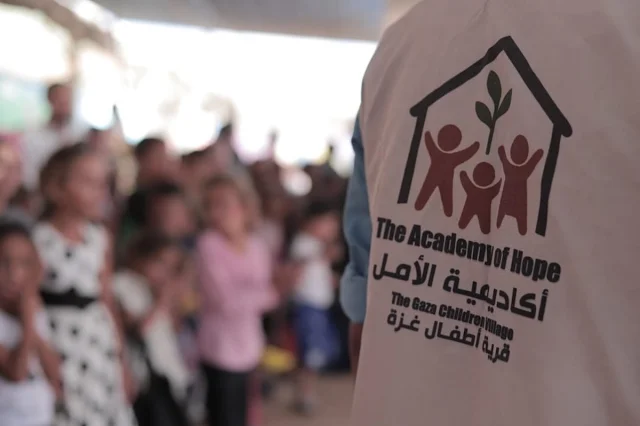
An American-Palestinian doctor is drawing attention because of his dual advocacy: supporting civilians in Gaza while publicly opposing Hamas, an approach that has led several Israeli charities to partner with him.
Dr. David Hasan was born in Kuwait to a family from the West Bank, and went on to train as a neurosurgeon at Duke University in North Carolina. When he saw the events unfolding in Gaza after Oct. 7 and the horrendous conditions so many innocent people were enduring, he was moved that December to join a World Health Organisation medical mission and do what he could.
In an interview with NBC, he described traumatic scenes inside Gaza’s medical system, including surgeries performed without anesthesia, widespread severe malnutrition, amputations, and cesarean sections conducted without pain relief. However, rather than focusing solely on his own medical field, Hasan said he has worked to build a broader support network for the growing number of orphans and destitute children in Gaza and the surrounding communities.
Founded just last year, Gaza Children’s Village (GCV) now has a whole network of operations with six “Academies of Hope” in locations including Deir al-Balah, Khan Younis, Zawaidah across central and southern Gaza, and plans to develop a large “Educational City” in the North Al Mawasi Humanitarian Zone to serve 10,000 children every day. This “Mega Academy,” as GCV calls it, will be one of the largest non-residential campuses for children in the Middle East.
“We are outrageously ambitious,” he told the Times of Israel. “We will try to expand the academy and reach to mothers and fathers too, to provide them with training. We will use the Israel-friendly curriculum to reach them, too. Our goal is not just today and tomorrow, but five years, 10 years down the road – to create a culture of hope, love, peace, tolerance, and understanding of the other side.”
Beyond meeting educational needs, Hasan believes their work can be a cornerstone in building a more peaceful and stable Middle East.
“There are many innocent people in Gaza who want peace with their neighbors and who do not support Hamas,” he said. “I know this for a fact, because I heard it firsthand.”
When they set up their first academy in a tented area, they were prepared to serve 200 children, but to their surprise, 500 turned up. More than that, they arrived hungry and some had not slept properly for days. He soon turned to World Central Kitchen to coordinate the provision of food and education to the children, some of whom had gone four or five days without food, according to Hasan.
“Our focus has always been, and continues to be, the most vulnerable children – orphans, unaccompanied kids, or injured children who cannot get proper medical treatment. It’s very challenging, but we’re doing our best,” Hasan said.
Their goal is to establish long-term community stability by providing children with safety, dignity, and predictable routines amid the insecurity and chaos of Gaza, as well as “peace-aligned education.”
Their curriculum is based on the Palestinian Authority framework but revised to remove all violent or hateful content. According to their website, it promotes literacy, numeracy, emotional intelligence, coexistence, and respect. They aim to provide academic continuity for children who have been out of school for months or even years, and also create a path for those in higher education.
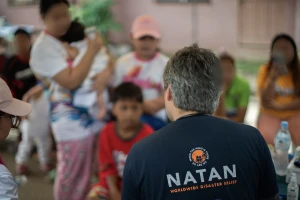
Together with the Israeli non-profit NATAN Worldwide Disaster Relief, they also provide clinical services and medical help.
CEO of NATAN, Alice Miller, had been searching for a way to serve the people of Gaza and told ALL ISRAEL NEWS that they had found the “perfect partner” in Hasan.
“If you need a pediatric neurologist, it's not easy to find in Gaza,” she said. “So we can help them. We have many volunteers, Arabic-speaking volunteers, who can support the doctors inside Gaza. We're sending in medicine, we're sending in equipment, we're putting up a dental clinic, where we're going to employ volunteer dentists, without an Israeli passport.”
Miller and her team have coordinated with Israel’s humanitarian aid facilitation unit, COGAT, and have received their approval.
“We are doing everything in the clear, you know, nothing under the table in any way… when you work in the clear, things happen. Doors open up,” she said.
Hasan agrees and is transparent about partnering with Israeli organizations.
“You have to be honest with everybody,” he said. “If the people in Gaza found out later, they would say, ‘You’re up to no good.’”
But why is this 50-year-old Palestinian doctor so willing to work with Israelis? Hasan told Jewish News that he was raised with a single narrative about Jews in the Middle East, but became exposed to Jewish culture and to Christianity through his studies in the US, an experience that changed his perceptions.
“I came to appreciate all the different religions and world views, which kind of helped shape the way I am,” he explained.
The impact these studies had on Hasan is evident in the curriculum of his Academies of Hope.
“We created a course where we actually teach the kids about love, peace, tolerance, critical thinking,” he told Jewish News. “We teach the kids about neighbours, the major religions… the differences and similarities,” he said, explaining how they are fostering values not just of tolerance but of appreciation and care.
“For the first time, you walk in, and you see kids have drawn Palestinian and Israeli flags together,” he said.
More than just bringing the flags together, Hasan shared plans to bring Israeli children who lost their parents in the Oct. 7 attacks together with orphans from Gaza.
“These kids are the most affected of the whole war,” Hasan said. “We failed them before, and now we’re trying to make it better.”
“If change is possible in Gaza – one of the most difficult places in the region – imagine what impact that could have elsewhere,” he said.
You might also like to read this: