'America’s support for Israel was never about money': David Friedman backs Netanyahu’s aid phase-out plan



For decades, American financial aid to Israel has been viewed in Washington as a key staple of the U.S.-Israel alliance. It has survived Republican administrations, Democratic administrations, wars in the Middle East, peace negotiations and countless political battles on Capitol Hill.
So, when Israeli Prime Minister Benjamin Netanyahu recently stated that Israel should begin phasing out American financial aid, it caused quite a stir, both politically and strategically.
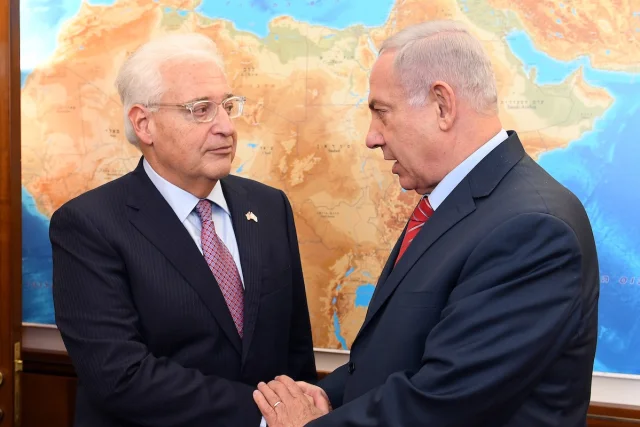
Former U.S. Ambassador to Israel David Friedman told ALL ISRAEL NEWS that the comments by Netanyahu are a positive development. “America’s support for Israel was never about money,” he says. “Its financial backing is a strategic commitment much more akin to an investment than a gift. As Israel grows into a regional superpower with its own defense capabilities, the Prime Minister is correctly seeking to modify the relationship to reflect current realities.”
The comments by Netanyahu are significant because the prime minister is touching what has long been considered politically untouchable territory in Washington. For generations, military aid to Israel has represented more than dollars and cents. It has symbolized the extraordinarily close alliance between the United States and the Jewish state.
But Netanyahu now appears to believe the relationship may need to evolve. “I want to draw down to zero the American financial support, the financial component of the military cooperation that we have,” Netanyahu told CBS correspondent Major Garrett. “Because we receive $3.8 billion a year. And I think that it’s time that we weaned ourselves from the remaining military support.”
Netanyahu then took it a step further. When asked how quickly he wanted the process to happen, Netanyahu replied, “Let’s start now and do it over the next decade, over the next ten years, but I want to start now. I don’t want to wait for the next Congress. I want to start now.”
And he made it clear this wasn’t just a passing thought. “Absolutely,” Netanyahu said when asked whether Israel should “reexamine and possibly reset its financial relationship to the United States.” He added that he had already discussed the issue with President Trump and Israeli officials.
Missouri Congressman Mark Alford, a strong supporter of Israel, said that Netanyahu’s comments are evidence of Israel’s growing maturity and self-sufficiency as a nation. But either way, Alford will have Israel’s back:
“I’m proud to represent the state of Missouri, home of President Harry S. Truman, who helped launch the State of Israel in 1948. While I believe we are inextricably linked as nations, defending freedom and democracy, Israel has made great strides in growing into a sustainable force for those objectives. We will always stand with Israel and the independent decisions it makes to further strengthen its sufficiency,” he said.
Meanwhile, influential conservative podcaster and author Josh Hammer argued that this move would ultimately benefit both nations. “I’ve been calling for this for my entire adult lifetime. It’s the best policy for both countries. It’s best for the American taxpayer and it’s best for the integrity of Zionism itself,” he asserted.
To understand why Benjamin Netanyahu’s comments matter so much, you really have to look back at the financial and strategic relationship between the United States and Israel since 1948.
When President Harry S. Truman recognized Israel moments after independence was declared, America’s support was initially more diplomatic and political than military. Israel was a tiny, vulnerable country fighting for survival in a hostile region. They have beaten back every enemy that has attacked them since 1948.
But over time, especially following the 1967 Six-Day War and the 1973 Yom Kippur War, the relationship fundamentally changed.
Israel increasingly came to be viewed by Washington as a crucial democratic ally in the Middle East and an important strategic partner during the Cold War. American military assistance began to grow significantly in the 1970s and 1980s as the two countries developed deep intelligence, military and technological ties.
Aid to Israel was no longer viewed simply as foreign assistance. It became deeply tied to America’s own national security interests.
Successive administrations from both political parties saw Israel as a stabilizing force in the Middle East, a trusted intelligence ally and a key military partner in a volatile region.
Today, Israel receives approximately $3.8 billion annually in military aid under a 10-year memorandum of understanding, negotiated during the Obama administration, and which runs through 2028.
That funding supports missile defense systems like Iron Dome, advanced weapons systems, joint military projects and defense cooperation programs. Supporters of the arrangement also point out that much of the money ultimately flows back into the American economy through defense contracts and weapons purchases from U.S. manufacturers.
Still, the political environment surrounding Israel has changed dramatically in recent years, and thus, the financial shift we may see in the future.
You might also like to read this: