AI-generated Holocaust content sparks debate among experts



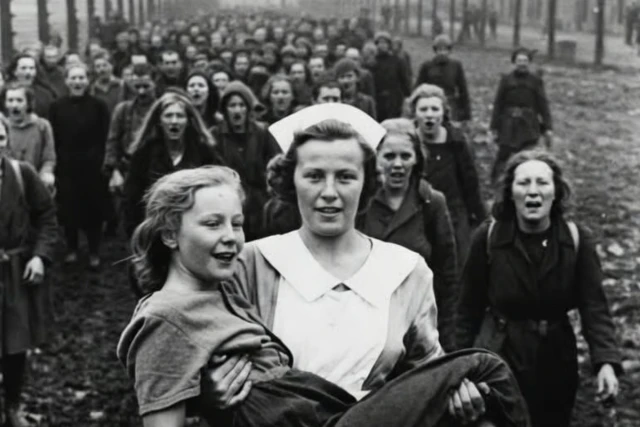
As the number of living Holocaust survivors rapidly declines, educators and historians are increasingly debating whether artificial intelligence can help preserve Holocaust memory – or distort it. The debate intensified after the World Jewish Congress released an AI-generated video of Anne Frank as part of an educational campaign, drawing both praise and criticism online.
“For decades and decades, we’ve seen her photos. Say what you will about AI, it stirs me to see her in ‘real life,’” one online commentator wrote.
“Disgusting AI,” another commentator wrote. “Anne Frank deserves better.”
The controversy reflects a broader discussion unfolding across Holocaust education institutions as experts weigh whether emerging AI technologies can responsibly preserve survivor testimony and historical memory at a time when firsthand witnesses are disappearing. While some educators argue AI can help younger audiences engage with Holocaust history, others warn the technology risks blurring the line between authentic documentation and digital fabrication.
Cory Weiss, the World Jewish Congress’s executive director of communications strategy, explained why the organization decided to use AI-generated content featuring Anne Frank.
“For us, it was about getting social media users to pause, in an era when people are very quick to scroll through,” he explained.
“Our goal is to try to use it responsibly when we do use it and not go over the top in using it,” Weiss added.
Proponents argue that AI can preserve Holocaust memory and make testimony more accessible to younger generations, while critics contend that it risks cheapening – or even distorting – the memory of the six million Jews murdered during the Holocaust.
Yfat Barak-Cheney, executive director of the World Jewish Congress Institute of Technology and Human Rights, said AI offers both opportunities and dangers. She described the technology as simultaneously useful and “a convenient tool for Holocaust distortion.”
“There’s a huge ethical question here,” Barak-Cheney said, while arguing that AI may eventually become a necessary educational tool.
“If we’re not going to use any of these tools, we’re going to remain way behind,” she assessed.
Robert Williams, CEO and Finci-Viterbi Chair of the USC Shoah Foundation, said caution is essential when incorporating AI into Holocaust education.
“You have to be extraordinarily careful,” Williams warned.
“You want to look at the source in whole, in order to try to understand that these are not just moments in time [and] that there’s a context in which these things appear,” he explained.
Williams argued that hologram interviews with Holocaust survivors demonstrate how AI can be used responsibly.
“A hologram interview with a Holocaust survivor is one way that you can use AI responsibly to get people to engage with the testimony of Holocaust survivors in a way different from just plunking somebody down in front of a computer and saying, ‘Watch,’” he said.
Despite acknowledging some potential benefits of AI, the Auschwitz-Birkenau Memorial and Museum warned last year against using artificial intelligence to generate fictional images of Auschwitz victims.
“The use of artificial intelligence to generate fictional images of Auschwitz victims … is not a tribute,” the museum stated. “It is a profound act of disrespect to the memory of those who suffered and were murdered in Auschwitz. It undermines the integrity of historical truth,” it added.
Yves Kugelmann, a board member of the Switzerland-based Anne Frank Fonds and who co-produced a 2021 animated film based on Frank’s diary, argued that AI-generated Holocaust content could create long-term confusion about historical authenticity.
“This ‘footage’ of Anne Frank, and anybody else, is going to stay in the ‘net,’” Kugelmann said. “And in 10 years, you won’t know what is true, what is not true, what footage is correct or which one is an invention."
At the same time, AI is becoming an increasingly important research tool for Holocaust institutions. Yad Vashem announced in 2024 that it had begun using AI technology to help identify the names of Holocaust victims.
While experts remain divided over how AI should be used, there is a broad consensus that preserving Holocaust memory is becoming increasingly urgent. A 2025 report predicted that 70% of living Holocaust survivors will die within the next decade because of their advanced age.