8-year-old Israeli boy searching for treasure discovers ancient artifact in Ramon Crater





This may be surprising, but some of the most significant archaeological discoveries in the Holy Land have been made by children simply exploring their immediate surroundings and stumbling upon an ancient treasure.
The Dead Sea Scrolls and the Ketef Hinnom scrolls, which contain biblical writings dating to approximately 650 BC, were both discovered this way.
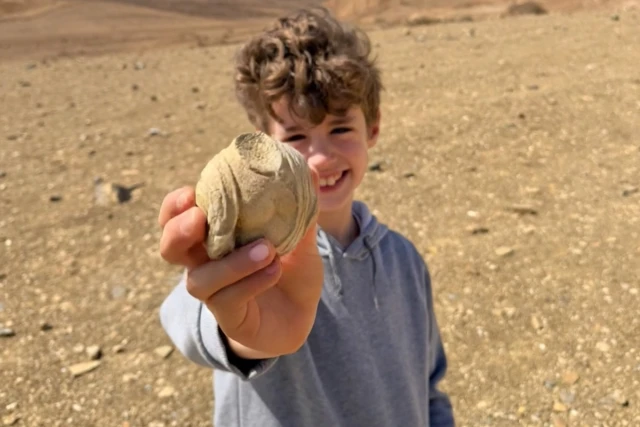
Then this week, the Israel Antiquities Authority announced that an 8-year-old boy had found a fragment of an ancient statuette.
While at a picnic in the Ramon Crater area in the Negev Desert region of southern Israel, Dor Wolynitz, of Rehovot, made his own archaeological discovery while looking for something special he could show in class.
“Suddenly, I noticed an interesting stone with stripes lying on the ground, and picked it up,” he said. “It seemed like an unusual object to me, so I showed it to Akiva, an archaeologist and my Dad’s friend, who was with us on our trip.”
Akiva Goldenhersh, a supervisor for the theft prevention unit at the Israel Antiquities Authority, said he initially thought it was a fossil.
“But then I noticed the sculpted folds of the garment and I was very excited,” he said.
Upon examination of the 6 by 6 centimeter fragment, archaeologists determined that it dates to the 3rd century AD. Geologist Dr. Nimrod Wieler said it is composed of a light mineral of the phosphorite type, which is common in the Negev region.
“Being made of local material reasonably indicates the statuette was made in Israel and not imported,” Goldenhersh said. “The style of clothing and sculpture is appropriate for the Roman period. The figure is depicted wearing a type of heavy mantle called a himation, with no visible chiton, or undergarment.”
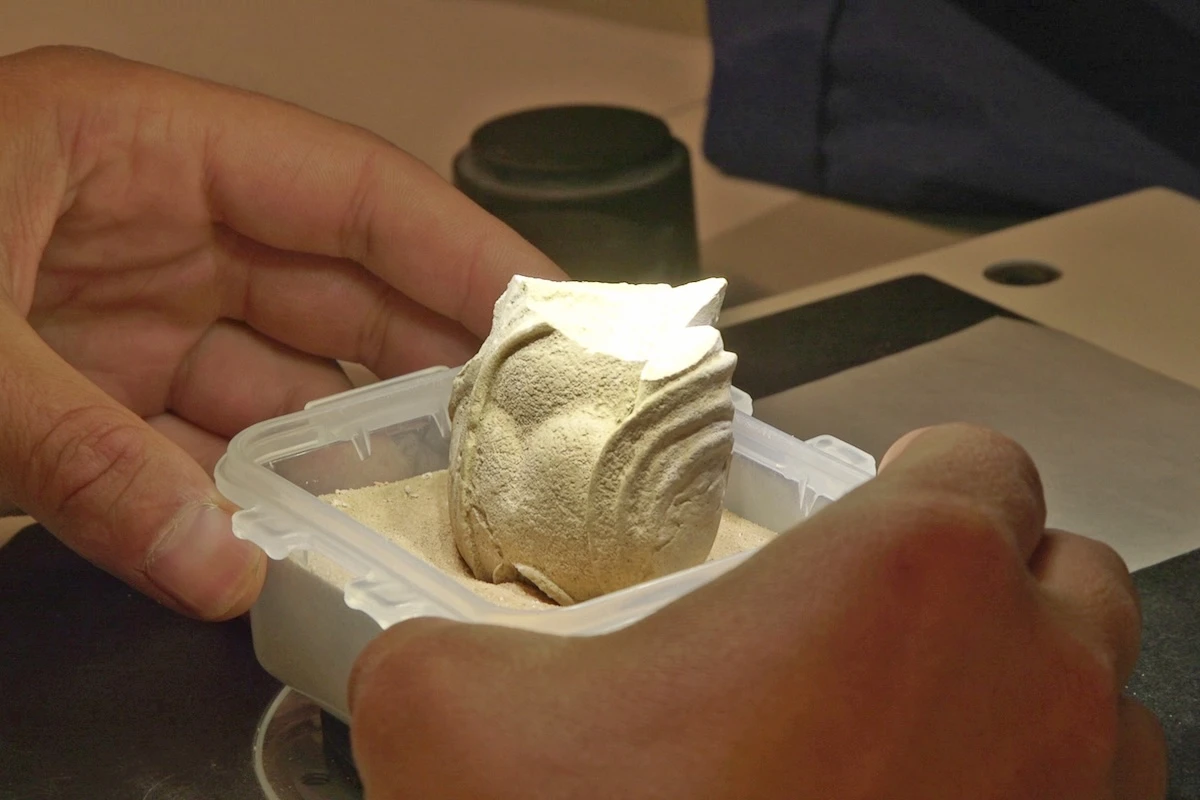
Goldenhersh said the manner in which the folds are sculpted, and the choice of such a delicate material, indicate a very high level of skill on the part of the artist.
“The absence of characteristic markings on the fragment makes identification difficult, but stylistically, it might be of the god Jupiter, or Zeus-Dushara – a Nabatean god who was identified and merged with Zeus in the context of the encounter between the Nabatean culture that was widespread in the Negev region, and the Hellenistic-Roman world,” he continued.
Such styles could also be found in Petra. “This tiny find thus reflects the combination of local traditions with influences from the classical world,” he said.
Goldenhersh praised Dor for handing over the fragment to the National Treasures Department. The boy received a certificate of appreciation from the Israel Antiquities Authority.
“Every archaeological find is part of our joint heritage in this land. Handing it over to the National Treasures allows us to study it, preserve it, and make the knowledge accessible to the general public,” Goldenhersh said. “The responsible conduct of Dor and his family is an example of proper civic responsibility and the preservation of our country’s cultural assets. Dor is a role model for us all.”
Israeli Minister of Heritage Rabbi Amichai Eliyahu said the discovery “illustrates how much history is right under our feet.”
“I congratulate Dor for his vigilance and responsibility – thanks to him, the find was discovered, will be preserved and will be able to tell us all the story of the people and cultures that passed through here thousands of years ago,” he said.
The Ramon Crater is a unique geological structure that draws many tourists from all over the world. In ancient times, it was a station on the overland trade routes linking India and China with the Mediterranean. Many layers of archaeological records have been excavated in the region over the decades.
You might also like to read this: