Israeli artists face growing cultural boycott abroad after Oct 7



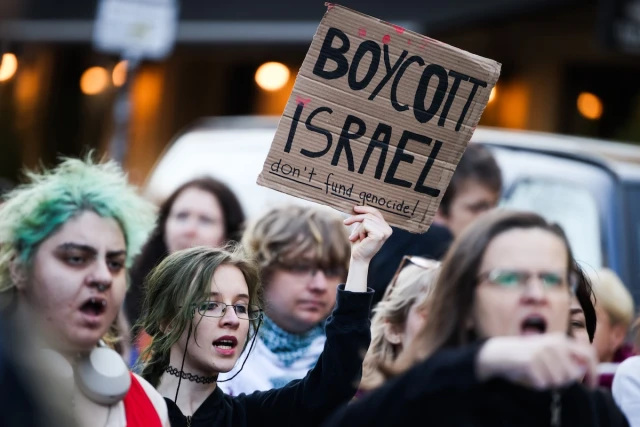
Before Hamas’ Oct. 7, 2023, attack on Israel, the Israeli dance company Mayumana regularly partnered with performers around the world. Since then, founder Boaz Berman says international collaborations have dried up as Israeli artists face growing cultural boycotts abroad.
“After Oct. 7, we had groups that didn’t want to work with us anymore,” Berman said. “We used to work in Spain a lot. Everyone knew us. We formed a partnership with a Spanish cast and production. Suddenly, they refused to continue working with anything that connects them with Israel."
“They asked us to publish that we support Palestine, and when we answered that we don’t mix politics – we do art – they dissolved the affiliation. They said they cannot work with us anymore,” Berman recalled.
“This was a big blow,” he admitted. “We have been working with people from all over the world – Spain, South America, and Australia. Political opinions should not be a part of the show."
Mayumana’s post-Oct. 7 boycott challenges are far from unique among Israeli artists and cultural groups.
“Israel is a damaged product, persona non grata. Fewer and fewer people are invited to European events and affiliations,” assessed one academic who spoke on condition of anonymity.
“Researchers refuse to publish with us. Submissions from Israelis are rejected in the arts and humanities, even in the sciences. We are at the lowest point in these vicious boycotts if the war continues,” the academic said.
“Art used to be what brought us together,” Berman recalled, adding, “but now they use the art platform to air their extreme political opinions. Now, if you have something that connects you to Israel, you are not considered a human being. Prior to Oct. 7, people were sending us offers. When they hear we are based in Tel Aviv, they refuse to talk to us anymore.”
Demonization and delegitimization are the traditional components of antisemitism, whether directed against Jews as individuals or against the Jewish state.
Dov Maimon, a senior fellow at the Jewish People Policy Institute, placed the current Israel hatred in the context of Jewish diaspora history.
“Jews want to be loved in the eyes of the other,” Maimon argued. “People don’t love us. It’s like a girlfriend who is just not that into you."
Looking ahead, Maimon proposes that Israel cut its losses and focus on strengthening its ties with hundreds of millions of pro-Israel evangelical Christians worldwide.
“We don’t need them. We must stop looking for love. It’s a big sickness of the Diaspora. Some 800 million evangelists [sic], Argentina, Panama – we have allies; we just must find a strategy to reach out to all our allies. The strength lies with us,” he assessed.
Bar-Asher Siegal, the Vice President of Global Engagement at Ben-Gurion University, believes that Israel is no longer perceived as part of Europe’s cultural values.
“It’s about liberal and democratic views. Laws and proclamations made by this government go against these values,” she argued, referring to the current, more conservative government in Israel.
Siegel also believes that Europe and Israel drew opposite conclusions about the Holocaust.
“Europe and Israel drew opposite lessons from the Holocaust. Europeans concluded that collective identities – nations, borders, religion – are dangerous. Their answer was to move beyond all that: fewer borders, post-national ideals, universal individual rights,” she explained.
“Jews concluded the opposite: Minorities can’t trust superpowers to defend them. A people without a state, an army, and sovereignty is defenseless. Israel was built on that lesson,” Siegal assessed.
Entertainment attorney and music manager Ari Ingel explained that artists are often “soft targets” in international political disputes that can lead to boycotts.
“We can’t change every mind, but we can change the people who are willing to learn, engage, and make changes,” he argued.
“There are actually only a small minority of activists who are very loud,” Ingel said.
Despite the challenges, he believes that there is a silent majority that is not hostile towards Israel and Jews.
“The large, silent majority doesn’t harbor ill will toward Israel. Activists obsessively post. As for the anti-Zionist Jewish community – they make it seem like there’s a 50/50 divide, but over 88% support Israel’s right to exist as a Jewish state. The anti-Zionist Jewish community is less than 10%,” he concluded.
Last month, over 1,000 entertainment leaders signed a joint letter supporting the Jewish state’s participation in the Eurovision Song Contest, which will be held in Vienna later this month.
You might also like to read this: