Netanyahu: Iran War is not over; Responsibility for Oct 7 is on everyone ‘from the PM down’
US military aid should end, relations should move from aid to partnership, Netanyahu tells CBS





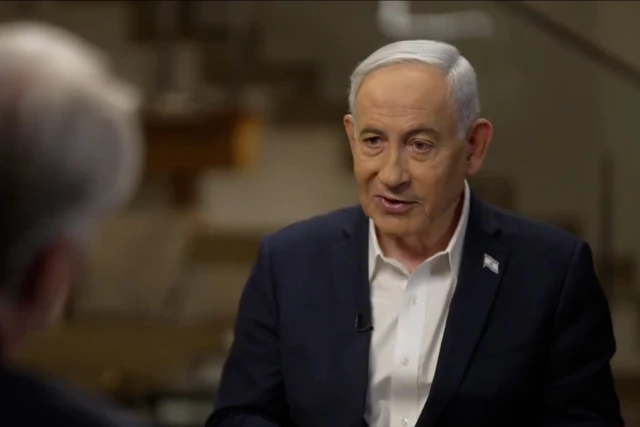
Israeli Prime Minister Benjamin Netanyahu warned that the war with Iran is not finished, noting that the regime’s enriched uranium would have to be extracted, in a wide-ranging interview with CBS News published on Sunday evening.
Israeli media outlets have sharply criticized Netanyahu over his limited engagement with the local press during the war, accusing him of favoring supportive outlets while giving multiple sit-down interviews to American media.
Speaking to Major Garrett on the CBS program 60 Minutes, the prime minister warned that “there's work to be done” before the Iran war can be declared over, while also acknowledging some responsibility for failures on Oct. 7 but touting his government’s response in the aftermath of the catastrophe.
The United States and Israel agree that fighting against Iran will resume if all goals can’t be achieved in a negotiated agreement brought about by the U.S. blockade and economic pressure, Netanyahu said.
“I think it accomplished a great deal, but it’s not over,” Israeli Prime Minister Benjamin Netanyahu tells 60 Minutes about the war in Iran. Netanyahu says highly enriched uranium must be removed from Iran and believes “it can be done physically.” pic.twitter.com/N5XbvzpYa0
— 60 Minutes (@60Minutes) May 10, 2026
Shortly after the interview aired, U.S. President Donald Trump said he had received a response from Tehran to the latest U.S. proposal, writing on Truth Social: “I don’t like it – TOTALLY UNACCEPTABLE!”
Listing the goals that would have to be achieved in any case, Netanyahu explained, “Certainly, we want to get the nuclear material out. We certainly want to get the enrichment sites dismantled. We've curbed a lot. We've degraded a lot of the missile production sites. But the agreement should cover all these areas, including the proxies.”
Regarding the enriched uranium, Netanyahu said, “You go in, and you take it out,” without revealing details of a potential military operation. “I think it can be done physically. That's not the problem. If you have an agreement, and you go in, and you take it out, why not? That's the best way.“
Netanyahu noted, “the problem of the Hormuz Strait was understood as the fighting went on,” hinting that Israeli and U.S. leadership had not expected the weakened regime to be able to maintain a blockade on the strategic waterway.
While the Iranian regime has proven resilient during the month-long war that resulted in the elimination of most of its senior leaders, Netanyahu stressed that it is at its “weakest point” since grabbing power in 1979.
According to a Pew survey published last month, 60% of U.S. adults viewed Israel unfavorably, up nearly 20 points in four years. Israeli Prime Minister Benjamin Netanyahu says the rise of social media is a major reason for this decline. https://t.co/QP4ESNtjGq pic.twitter.com/miCEwFYLX3
— 60 Minutes (@60Minutes) May 10, 2026
“There are fissures in the regime. There are cracks in it because they've been hit very hard by our joint efforts, our joint military efforts.”
Asked about the condition of Supreme Leader Mojtaba Khamenei, who was reportedly seriously injured in the strike that killed his father and predecessor, Netanyahu replied, “I think he is alive. What his condition is, it's hard to say, you know? He's holed up in some bunker or in some secret place. And I think he's trying to exert his authority.”
Asked whether he believed it is possible to topple the regime, Netanyahu responded, “You can't predict when that [might] happen. Is it possible? Yes. Is it guaranteed? No. But I can tell you, it's like bankruptcy, you know? It proceeds gradually, and then it falls – like that. You couldn't predict the fall of the Soviet Union… what precedes it? There has to be a weakening of the regime. The regime has been weakened. But it's not guaranteed.“
The end of the regime would mean “the end of Hezbollah, it's the end of Hamas, it's probably the end of the Houthis, because the whole scaffolding of the terrorist proxy network that Iran built collapses if the regime in Iran collapses,” the prime minister added.
Netanyahu also dismissed suggestions that he is “hungry” for conflict: “That's funny because for years, I was considered, before the October 7th, I was considered perhaps the most restrained prime minister in Israel's history,” he told Garrett.
“I was conceived as being politically tough but militarily very restrained. Obviously, it changed on October 7th, because they were gonna annihilate us. I didn't think it was just an attack by Hamas. I saw it as it was, an attack by the Iran axis to try to annihilate us through a noose of death,” he explained.
Asked about his level of responsibility for the surprise attack, given that nearly all senior security officials have now been replaced, Netanyahu said “everybody bears some responsibility. From the top, from the prime minister down,” before quickly pivoting to his call for an “independent, bipartisan” commission of inquiry, rather than the traditional one.
“What about since October 7th? It was clearly my responsibility to get Israel out of this horrible noose of death that the Iranians put on us,” Netanyahu continued, “and we did, systematically, very resolutely go from each one of these seven fronts, one after the other, and roll back the tide of terror.”
Netanyahu announces he wants American financial aid reduced to zero within ten years pic.twitter.com/yYA5ST6iyz
— Will Chamberlain (@willchamberlain) May 10, 2026
The prime minister reiterated that he intends to phase out the American military aid to Israel in the near future.
“I want to draw down to zero the American financial support, the financial component of the military cooperation that we have… We've come of age. We have a booming economy,” he noted.
The current 10-year U.S.-Israeli Memorandum of Understanding is set to expire next year, meaning the next agreement could potentially be the last of its kind.
“I think that it's time that we weaned ourselves from the remaining military support and go from aid to partnership. So I want to draw down, and then I want to suggest projects, joint projects for intel, for weapons, for missile defense… I said, let's start now and do it over the next decade, over the next ten years, but I want to start now.”
“I think it's time that we end it, over time, an agreed schedule, [end] American military aid and move from aid to partnership,” he concluded.
You might also like to read this: