The next Mossad Director: Maj-Gen Roman Gofman, military secretary to PM Netanyahu
Controversial nomination approved by advisory committee on senior appointments after months-long deliberation




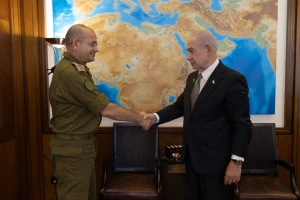
Major-General Roman Gofman, currently serving as military secretary to the prime minister, was approved to become the next director of the Mossad foreign intelligence agency on Sunday.
Prime Minister Benjamin Netanyahu’s office stated that, after receiving the approval from the advisory committee on senior appointments, he “signed the document appointing Maj.-Gen. Gofman as the next Director of the Mossad, effective 2 July 2026, for five years.”
The nomination of Gofman, seen as a close confidant of Netanyahu who trusted him with sensitive tasks over the past two years, has been subject to criticism and his appointment is still expected to be fought against in the Supreme Court.
Netanyahu praised the decision of the committee, saying Gofman “is an outstanding, bold, and creative officer who has demonstrated out-of-the-box thinking and impressive ingenuity throughout the war. I wish Major General Gofman great success in his next role as head of the Mossad, and I am confident he will do much for the security of Israel.”
לאחר שאושר על ידי ועדת גרוניס, חתמתי הערב על מינויו של האלוף רומן גופמן לתפקיד ראש המוסד הבא.
— Benjamin Netanyahu - בנימין נתניהו (@netanyahu) April 12, 2026
האלוף גופמן משמש בשנתיים האחרונות כמזכירי הצבאי. מדובר בקצין מצטיין, נועז ויצירתי, שהפגין לאורך המלחמה ראייה מחוץ לקופסה ותחבולנות מרשימה.
אני מאחל הצלחה רבה לאלוף גופמן בתפקידו הבא… pic.twitter.com/Ie1xQreZ7N
Retired Supreme Court President Asher Grunis, who headed the advisory committee, was the only one of its four members to oppose the nomination, citing the affair surrounding the use of a minor for intelligence operations during Gofman’s tenure as an IDF division commander in 2020.
In addition, some critics have noted that Gofman doesn’t have relevant intelligence experience, having served in and commanded tank units in the IDF. Others have highlighted Gofman’s lack of high-level English skills. However, Gofman is a native Russian speaker, having been born in today’s Belarus in the former Soviet Union.
IDF Chief of Staff Lt.-Gen. Eyal Zamir testified that he doesn’t oppose Gofman’s appointment. “I believe that if he had not been designated for this role, he would certainly have been fit to advance to significant positions in the IDF and to the very top leadership – and perhaps in the future even to Chief of Staff,” he said.
Incoming Mossad chief Major General Roman Gofman was filmed fighting Hamas terrorists during the October 7 massacre, showing remarkable bravery as he engaged the attackers at the Shaar Hanegev junction before being wounded. Chosen by Prime Minister Benjamin Netanyahu, Gofman is… pic.twitter.com/2VTW23lepU
— ILTV Israel News (@ILTVNews) December 7, 2025
However, the current Mossad director, David (Dadi) Barnea, expressed his reservations over the issue, arguing that “When a commander decides to violate army procedures and military law and take matters into his own hands, this has many implications. Any command remark disqualifies promotion, certainly an appointment as head of the Mossad.”
Deliberations over the intelligence affair, as well as Grunis' falling ill, have delayed the nomination process since last December, despite pressure from Netanyahu.
In his written decision, Grunis hinted that he opposed the nomination because he suspected that Gofman had lied about not knowing the age of Ori Elmakayes, who was only 17 when the division used him for a covert, unauthorized social media influence campaign. Elmakayes was later detained on suspicion of possessing classified information before the charges were dropped.
Grunis wrote, “The use of a minor Israeli civilian is an extremely serious flaw from an ethical and moral standpoint. It is a flaw in terms of integrity that should be attributed to Brig.-Gen. [at the time] Gofman. The division and Brig.-Gen. Gofman did not provide an accurate answer to IDF authorities who asked whether Elmakayes was being operated by them, and that is a mild description. It is clear and simple that this is a significant flaw in terms of integrity regarding Maj.-Gen. Gofman.”
Prime Minister Benjamin Netanyahu at a reading of the Book of Esther, last night, together with National Security Minister Itamar Ben-Gvir; Government Secretary Yossi Fuchs; his Military Secretary, Maj.-Gen. Roman Gofman; and his staff. pic.twitter.com/37pdERGsk7
— Prime Minister of Israel (@IsraeliPM) March 4, 2026
Speaking to the committee, Gofman said, “I did not lie in the IDF debriefing; I did not know he was a minor. I only learned about the boy’s arrest when the affair was published in the media. I considered going to meet Elmakayes, but I received a call from the Chief of Staff’s office advising me not to meet him.”
Committee member Prof. Daniel Hershkowitz, who, like Grunis, was exposed to the classified materials in the incident, was convinced by Gofman’s testimony, writing, “I did not find in these materials anything that would impair the integrity of Major General Roman Gofman.”
Responding to the committee’s decision, Elmakayes wrote on 𝕏 that it was “A ridiculous decision – someone who abandoned a 17-year-old will also abandon Mossad agents. I will fight to disqualify Gofman’s appointment.”
Most opposition leaders in Israel did not immediately comment on the nomination, which is still expected to face petitions to the Supreme Court citing opposition to Grunis, as well as that of Attorney General Gali Baharav-Miara.
Yair Golan, chairman of the far-left "The Democrats" party, accused Netanyahu of nominating loyalists to key security posts.
“The appointment of Roman Gofman as head of the Mossad, together with the appointment of David Zini, is not a professional decision but the construction of a personal protective layer. Netanyahu is surrounding himself with loyalists in order to evade responsibility for the October 7 debacle and to thwart the exposure of the QatarGate affair,” he wrote on 𝕏.
You might also like to read this: