Israeli experimental lab launched to International Space Station



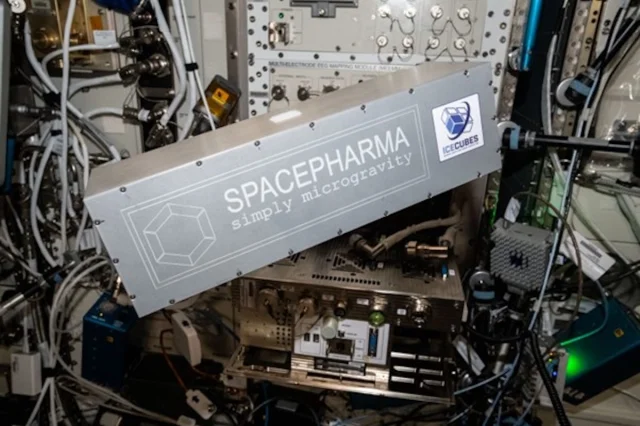
Israeli company SpacePharma launched a shoebox-sized experimental laboratory to the International Space Station last weekend aboard a SpaceX Dragon cargo spacecraft, marking another step in Israel’s growing role in space-based medical and scientific research.
The autonomous mini-laboratory is conducting biological experiments from several European research groups, including a project to identify biomarkers for brain cancers using brain-tissue organoids. Researchers hope the findings could eventually improve diagnosis and treatment options for patients.
Headquartered in the Israeli coastal city of Herzliya, SpacePharma specializes in miniaturized laboratories designed to operate autonomously in space. The company’s technology enables biological and chemical experiments to be conducted in microgravity conditions aboard orbiting spacecraft.
One of the flagship experiments aboard the mission is being led by a hospital team in the French city of Grenoble with financial backing from the European Space Agency (ESA). Researchers are using chips containing brain-tissue organoids to map biomarkers associated with brain tumors.
“Developing this method could improve the diagnosis of these types of cancer. The researchers are creating a kind of biomarker atlas, which could make it possible to identify the type of tumor already during the biopsy procedure and deliver the appropriate treatment directly to the brain, without the need for another operation,” Yossi Yamin, founder and CEO of SpacePharma, said in an interview with the Davidson Institute.
The latest launch follows another recent SpacePharma mission. Last month, a separate company laboratory was sent into orbit aboard a Northrop Grumman resupply mission carrying an experiment focused on identifying genes linked to longevity. The study is being led by Prof. Gil Atzmon of the University of Haifa’s School of Medicine.
Yamin also revealed that he recently briefed senior officials at the U.S. National Institutes of Health (NIH) on the company’s space-manufacturing research.
“I presented our work on producing monoclonal antibodies – identical antibodies – and organoids in space. If all goes well, perhaps the NIH will support us in future clinical trials based on our space-manufacturing technology,” he assessed.
The experiments are funded by the Ramon Foundation, named after Israel’s first astronaut, the late Ilan Ramon, as well as his wife Rona and son Asaf. The foundation also sponsors student-led experiments through its Ramon SpaceLab educational initiative.
“To me, the launch of the student experiments from the Ramon SpaceLab program captures exactly why we do what we do,” Gil Doron, CEO of the Ramon Foundation, explained.
“When teenagers realize that an idea of theirs can leave the classroom and reach space, something profound changes in them. Science stops being theoretical and becomes alive, real, and meaningful. They are not just learning about research; they become researchers. They are not just hearing about innovation; they are creating it,” he continued.
Israel’s expanding space sector is also seeking partnerships beyond Europe and the United States. Israeli space-tech company Harel Space Agency is currently working with Israel’s Foreign Ministry to establish the first space academy in Juba, the capital of South Sudan.
“Even in the capital, Juba, there are still mud houses, and some roads are little more than dirt tracks. We are trying to help them develop the ability to use space science for basic needs, such as water management and improving agriculture,” the company’s founder and director, Harel Ben-Ami, said.
“The Ministry of Foreign Affairs and Israel’s ambassador to South Sudan, Gershon Kedar, brought us in to help establish it. We are bringing lecturers from Israel and around the world, have created the first curriculum for training high school teachers in space science, and are trying to teach them how space science can be used to improve life on Earth,” he continued.
“Our vision is to later establish a nanosatellite laboratory there with Israeli suppliers, and to help South Sudan place its own nanosatellite in space as part of a structured space studies program,” Ben-Ami added.
Israel has also pursued regional cooperation in space exploration. In 2021, Israel and the United Arab Emirates signed a landmark agreement to cooperate on space missions and the future landing of miniature spacecraft on the moon.
“If we combine the capabilities of the Israeli side and the Emirati side, we can do a very interesting and successful mission,” Shimon Sarid, CEO of SpaceIL, predicted at the time.
You might also like to read this: