What Israel’s Eurovision triumph says about the Jewish state’s unbreakable spirit
.jpg "Maayan Hoffman")



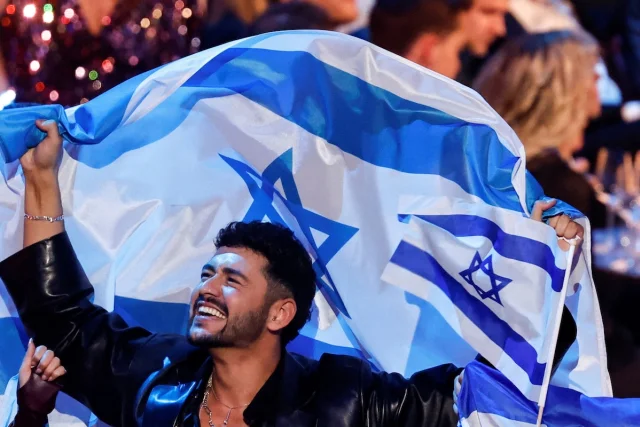
Israel’s second-place finish at Eurovision over the weekend was not just about a catchy song or a charismatic singer. It was another reminder that even when the odds seem stacked against the Jewish people, whether in ancient times or today, on the battlefield, in politics, or in the arena of culture, resilience, creativity, determination, and faith continue to carry them forward.
Twenty-eight-year-old Noam Bettan was not expected to place so highly.
He received 123 points from the juries and 220 from the public televote, bringing his total score to 343 points and earning him second place overall, behind Bulgaria. The result came in a year when Israel faced what many viewed as an unprecedented campaign to ban it from the competition, while protesters demonstrated outside the venue and audience members booed during his performance.
This was the third Eurovision since the Oct. 7, 2023, Hamas massacre against Israel and the first time since that the Israeli entry was not directly tied to war, loss, or survival. Instead, Bettan performed a song about romance and love, signaling that even as Israel continues to face existential threats, life still moves forward.
According to Hannah Brown, Jerusalem Post movie critic and culture writer, before discussing the broader symbolism surrounding the performance, Bettan deserves credit simply for being an excellent performer.
“One thing, and let’s not overlook it, is that he is a really good singer,” she told All Israel News. “He is charismatic, he has a great voice, he was poised on stage, and it was a fun-tempoed song.”
Brown said the Israeli performance featured beautiful, sexy dancers alongside impressive staging elements and visual effects.
“I think at some level, the jurists just really liked the song,” Brown said.
But she added that the result also carried a broader message.
The loudest voices are often those speaking against Israel, but they do not necessarily represent the majority. Although there was a campaign by some European governments, broadcasters, and artists to exclude Israel from Eurovision, far more people ultimately voted to hear Bettan sing.
There were also credible security concerns surrounding the Israeli delegation. Bettan’s protection was reportedly coordinated not only by Austrian police, but also by the Shin Bet, the Mossad, and the FBI. These agencies would not become involved without legitimate threats. Yet despite the pressure, Bettan appeared determined to block out the noise.
Brown recalled a similar moment from last year, when Israeli Eurovision contestant Yuval Raphael, a survivor of the Nova music festival massacre, walked the turquoise carpet, and a man approached her and mimed slitting his throat. Raphael, Brown said, simply kept walking as if nothing had happened.
“These young people handled it so well, and they are extraordinary for being able to do it,” Brown added.
Eurovision holds a unique place in Israeli culture, much like the World Cup does for soccer fans. Israel has competed in the contest since 1973. The country has won four times, in 1978, 1979, 1998, and 2018, and has consistently ranked near the top, including second-place finishes the last two years.
Brown said those victories carried particular significance in Israel’s earlier decades, when the country had not yet achieved widespread international recognition in sports, entertainment, or culture. For example, Israel did not win its first Olympic gold medal until 1992, and Israeli television series such as “Fauda” had not yet become global successes.
“Israelis love to sing and present these songs, their best singers, and being admired by the world and included in this world competition is very important to Israelis at an emotional level,” Brown said.
For many Israelis and Jews around the world, moments like Eurovision are about more than entertainment. They are reminders that despite isolation, criticism, and pressure, Israel is never entirely alone. There are always people willing to support what they believe is right rather than simply what is popular.
It may seem like Eurovision is just a song contest, and believing Bettan’s performance represented something larger could sound like a stretch. But in the eyes of many Israelis, his success fit into a broader pattern.
Just as Israel’s stock market posted one of its strongest years not long after the country suffered the deadliest attack in its modern history, and just as tiny Israel continues to stand alongside the massive United States against some of the world’s largest terror networks, Bettan’s performance became another reminder of something Israelis know well: The country may be small, but when it believes in itself, its people, and its God, it continues to defy expectations.
You might also like to read this: