Israeli archaeologists uncover evidence of biblical-era trade links with Arabia



Israeli researchers studying ancient seeds discovered in desert fortresses have uncovered new evidence suggesting the biblical Kingdom of Israel controlled key trade routes to Arabia nearly 2,800 years ago – decades earlier than scholars previously believed.
The new study by the Israel Antiquities Authority used C14 dating on organic samples recovered from one of two ancient fortresses in the Arava region of southern Israel. The findings challenge the long-held assumption that the structures were built by the Assyrian Empire after its conquest of the Kingdom of Israel around 732 BCE.
Instead, the dating results indicate the fortresses were likely constructed between 791 and 772 BCE by the Kingdom of Israel itself, potentially reshaping historians’ understanding of ancient trade between the Land of Israel and the Arabian Peninsula.
Dr. Doron Ben-Ami, a senior researcher at the IAA and the study’s lead author, said the findings demonstrate how archaeology can overturn decades of accepted scholarship.
“This is the beauty of archaeology,” Ben-Ami said in an interview with The Times of Israel.
“For years, you are captivated by a certain hypothesis, even though you do not have the smoking gun, and you try to fit everything in, and then you actually find out you were proceeding in the dark, thanks to a bunch of cereal seeds,” he explained.
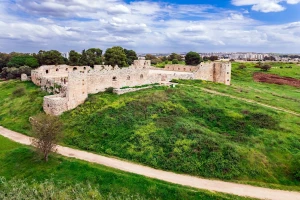
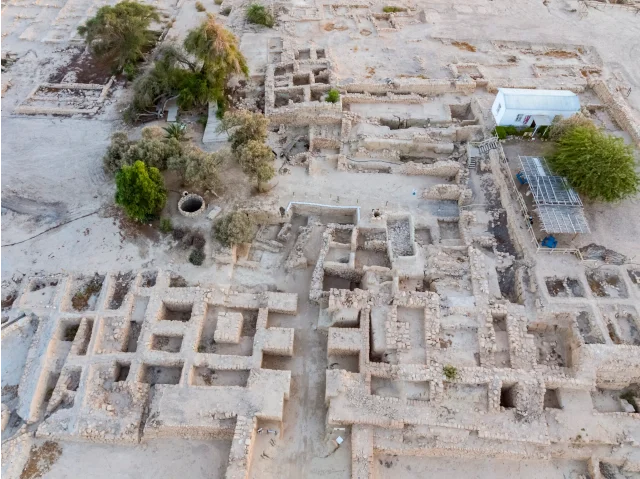
The two fortresses studied are those at Ein Hatzeva, south of the Dead Sea, and at Tell el-Kheleifeh, in modern-day Jordan, just kilometers from the Israeli border and the city of Eilat. These fortresses are located along the ancient trade route linking the Levant with modern-day Saudi Arabia.
According to Ben-Ami, the sites may reveal who controlled commerce along the strategic desert corridor.
“[Hatzeva] is an enormous fortress, the largest in the southern Levant, but, for many years, it was neglected,” he said.
Researchers also identified striking architectural similarities between the two sites.
“All scholars dealing with these [fortresses], including myself, are of the opinion that there was one architect behind the two, and they were constructed at the same time,” Ben-Ami revealed.
For years, scholars believed the southern fortress at Tel el-Kheleifeh was established by the Assyrians after their expansion into the region.
“The data from that [which] was published did not allow for clear-cut chronological conclusions,” the scholar continued. “Still, according to the well-accepted hypothesis, Kheleifeh was considered one of the fortresses established by the Assyrians.”
Ben-Ami and his team were surprised when laboratory testing dated the structures to decades before the Assyrian conquest of Israel.
“Just to be on the safer side, we sent more samples to the lab,” the lead author recalled.
The findings forced researchers to reconsider the entire historical framework surrounding the sites.
“If archeological remains could speak, they were now shouting that the establishment of the fortress had nothing to do with the Assyrians,” Ben-Ami said. “We needed to find a different story.”
That reassessment led researchers to examine which regional power could have controlled the trade route during the eighth century BCE.
“The only candidate in terms of political strength during this time period was the Kingdom of Israel, even though it is located up north, considering the other two political entities in the southern part of the region, the Kingdoms of Judah and Edom,” Ben-Ami assessed.
“Why Israel? Because most scholars are of the opinion that during this time period, Israel regained hegemony over the region, as documented also in the biblical narrative and based on archaeological evidence,” he explained.
“Our research fills in some of the void in the historical and geographical setting of this time period,” Ben-Ami argued, “The Kingdom of Israel dominated the two [directions] out of the Arava Valley with these two fortresses, Hatzeva in the northern part and Kheleifeh in the southern part.”
“It is now crystal clear that the Kingdom of Israel was present and involved along the southern border of Judah, as it is echoed also in various biblical verses,” Ben-Ami said.
Prof. Israel Finkelstein of the University of Haifa, who was not involved in the study, said the findings significantly strengthen historians’ understanding of the region during the biblical era.
“This is a very interesting study, which significantly advances the study of the south in particular and the history of ancient Israel (including biblical exegesis) in general,” Finkelstein stated.
“In the early eighth century, the Northern Kingdom (of Israel) dominated the trade routes in the south, possibly with the help of Judah as a vassal,” he assessed.
You might also like to read this: