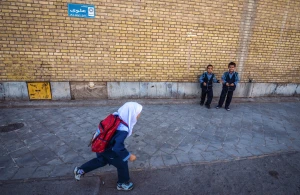
In move to strengthen social interaction and learning, Israel's Education Ministry to ban cellphone use in middle schools
Experts call for programs aimed at teaching proper use of technology, alongside ban





The Ministry of Education announced on Sunday that it will ban the use of cellphones in middle schools, starting in the 2027 school year.
A ban on the use of cellphones in elementary schools was already implemented in February of this year. Education Minister Yoav Kish said the Education Ministry will also examine whether to ban phones in high schools as well.
According to the new policy, the devices must remain turned off in students' bags or in storage compartments as determined by the schools. Use of cellphones will only be allowed in classes where the educational staff approves it for learning purposes.
The new policy was formulated after examining studies from Israel and abroad, and after discussions with educators, principals, parents, and students.
The ministry examined studies on the impact of phones on attention and concentration, sleep quality, emotional state, and the ability to maintain social relationships in adolescence.
According to the ministry, the data indicate an increased addiction to social media, loss of proper sleep habits, and a decrease in face-to-face social encounters.
Minister Kish said, “We see too many cases of children who are together in the classroom, but each one alone in front of their own screen.”
At the same time, many studies indicated improvements in school climate, academic achievement, and student engagement following restrictions on cellphone use in schools.
The ban will be implemented in a phased approach and will be accompanied by instructions for schools, education teams, and parents. As part of the decision, activities during breaks will be adopted to strengthen interpersonal interaction, social activity, and a continuous study routine.
Dr. Odette Sela, chief research scientist at the Ministry of Education, told reporters in a briefing that, “Studies in the United States are already showing good results from banning cell phones in schools, but we may initially see more violence and resistance.”
Minister Kish said, “Our responsibility is not only to understand reality - but also to act in time. The school should be a place that restores human interaction to children, the ability to truly be with each other, reduce distractions, and increase attention to learning.”
On average, Israeli children receive smartphones around age six, which is much younger than in most other developed nations.
A pilot project in Tel Aviv found that restrictions on cellphone use in secondary schools led to significant changes in the nature of breaks and the climate of classes. However, researchers studying such changes note that removing phones is not enough, saying a broader public policy is needed, including guidance for parents and children, encouragement of social activity, and regulation of technology companies.
The National Parents' Leadership Council warned that a ban by itself will likely not produce the desired results, and needs to be accompanied by practical programs that encourage responsible use of digital devices.
“When choosing to lead a move based on a ban on use during school hours, it is imperative to accompany it with a broad educational, informational and practical program that will encourage informed and responsible use of digital means even beyond school hours,” the council said.
“The challenge of using smartphones cannot be solved only through bans. If we want to create real change, we must invest in education, in social solutions during the school day, and in building correct usage habits even after school hours,” Oran Ozan, chairman of the council, said.
Dr. Asher Weller, a specialist in child and adolescent psychiatry and the academic director of the youth department at ICA, the Israeli Center for Addiction and Mental Health, told Channel 12 that the ban is a step in the right direction, but not enough.
“The ban on cellphones in middle schools starting next school year is a step in the right direction, but it cannot stand alone,” he noted. “This step should be part of a broader process that includes a discussion on the subject: about the advantages and disadvantages, about understanding the dangers of using cellphones, and about a genuine desire to understand what we will really gain from such an initiative - in the education system, as parents and as a society.”
“In addition, when making such a significant move, it is important to invest thought into alternatives that can replace mobile phones in schools - and how to utilize the time for healthier alternatives (face-to-face conversation, sports activities, bonding activities, etc.),” Dr. Weller continued. “The bottom line is, this is a step in the right direction, but it cannot stand alone and must be part of a broader and more in-depth system.”
You might also like to read this: