Hidden for decades, Holocaust survivor’s sketches go on display in New York



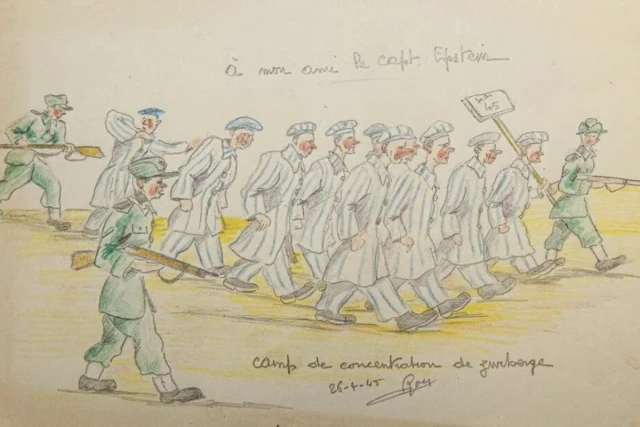
A rare collection of sketches offering a glimpse into life inside a Nazi concentration camp went on display this week at Manhattan University in New York.
The drawings were created by Marcel Roux, a member of the French Resistance who survived more than three years in captivity and was among roughly 7,000 prisoners liberated by U.S. Army forces from the Langenstein-Zwieberge camp – a subcamp of the Buchenwald complex – on April 12, 1945.
Yad Vashem Holocaust Memorial Museum in Jerusalem confirmed that Roux, who was not Jewish, survived nearly three years in Sachsenhausen before being transferred to Buchenwald and ultimately to Langenstein-Zwieberge. He was not a professional artist, and the drawings are fairly crude, but nonetheless, they provide a first-hand eyewitness account of life in the camps.
Following his liberation, Roux is believed to have given the drawings to U.S. Army Capt. William Epstein, who stored them in a leather case with postcards, photographs and other wartime memorabilia. Epstein later brought the case to his home in Westchester County, New York, where it remained until his death in 1990.
The house was sold in 1993 to Kenneth and Helen Orce, who discovered the case in a closet and recognized its historical significance. After Epstein’s widow declined to reclaim it, the couple contacted Yad Vashem to authenticate the artwork and ultimately donated the collection to the Center for Holocaust, Genocide and Interfaith Education at Manhattan University in the Bronx, Kenneth Orce’s alma mater.
Professor Mehnaz Afridi, director of the Center, said the sketches – made on graph paper with colored pencils – depict “ordinary” scenes Roux witnessed in the camps where he was imprisoned, including prisoners lining up for food, being abused by guards and enduring the daily brutality of their captors. One sketch shows starving prisoners lying on the ground, near death, as no one comes to their aid.
Afridi said the drawings were Roux’s attempt to document what he had seen, and that he dedicated them to Epstein, whom he described as a friend who may have helped him recover after his imprisonment. Little is known about Roux’s life after the war. Epstein, by contrast, went on to work as a doctor in New York City hospitals before retiring in the 1980s.
A statement on the Center’s website says its “mission is to promote Jewish-Catholic-Muslim ‘discussion and collaboration.’ Our goal is to help eradicate human suffering, prejudice, and racism through education. We condemn all violence in the name of race, religion, ethnicity and gender. The Center’s principal sphere is education and is committed to understanding and respecting differences and similarities between people of all religions, races, ethnicities and nationalities. Its focus remains the lessons of the Holocaust, which are essential to educating future generations in order to combat prejudice, genocidal ideologies, apathy, and Holocaust denial.”
Photographs from the liberation of the Langenstein camp can be viewed at the 8th Army website HERE.
You might also like to read this: