Israel honors victims, survivors ahead of Holocaust Remembrance Day



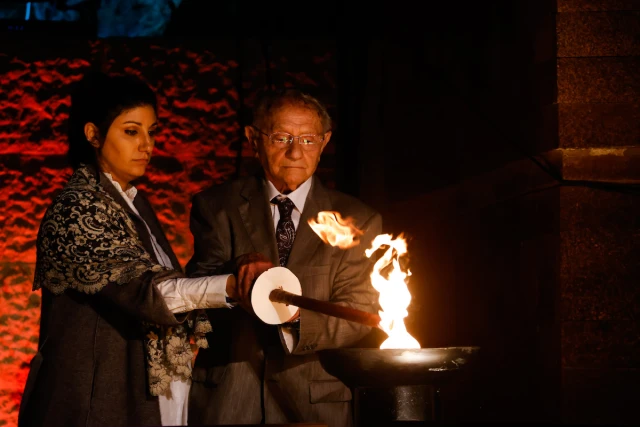
On Monday evening, Israelis will mark Yom HaShoah, or Holocaust Remembrance Day. The solemn annual observance will be commemorated nationwide with official ceremonies, alongside local events, school programs, and private moments of remembrance, as survivors and their descendants honor the Holocaust in their own ways.
According to statistics, roughly 100,000 survivors live in Israel today, representing more than half of the global survivor population.
On Monday evening, the government will broadcast a pre-recorded state ceremony from Yad Vashem in Jerusalem marking the start of Holocaust Memorial Day. Six survivors will light torches at the ceremony, symbolizing the six million Jewish victims of the Holocaust.
This year’s torchlighters are Saadia Bahat (98), Michael Sidko (90), Miriam (Daisy) Bar-Lev (90), Moshe Harari (92), Ilana-Lina Fallach (89) and Avigdor Neumann (95).
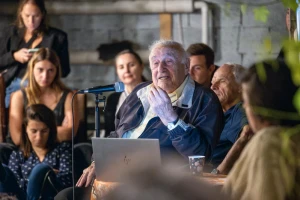
In addition, Haviva Burst, 96, who was born in Poland as Luba-Chaya Hochlerer, will deliver the survivors’ address, and Menachem Neeman, 88, will recite the “El Maleh Rahamim” memorial prayer.
These survivors have shared their stories publicly in the past and records of their testimony can be found online.
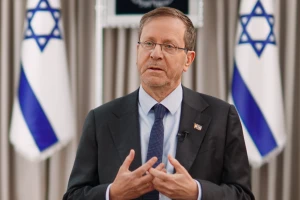
The program will also include speeches by Israeli leaders, prayers led by senior rabbis, and survivors' testimonies. The decision to pre-record the ceremony was made prior to the announcement of a ceasefire in the war with Iran.
On Tuesday at 10 a.m., sirens will sound across the country for two minutes. It is a custom, but not a law, for people to stand in silence for those two minutes. Vehicles stop on highways, and people get out to stand next to them, while the same thing occurs at workplaces, schools, and other public venues.
It is also common for schools to hold assemblies in which survivors share their stories with students, followed by in-class discussions. Most cities and municipalities host public events, while Holocaust- and WWII-related programming is broadcast on television and other media. By law, entertainment venues are closed and flags on public buildings are lowered to half-mast.
The question is sometimes asked why Israel observes its own Holocaust Remembrance Day, separate from International Holocaust Remembrance Day on Jan. 27. The latter was established by the United Nations in 2005 and coincides with the date the Soviet Army liberated the Auschwitz death camp in Poland.
In Israel, the day was established by the Knesset in 1951 to coincide with the 27th of the Hebrew month of Nisan, which falls in the spring and during the Warsaw Ghetto Uprising. Officially known as “Holocaust and Heroism Remembrance Day,” it commemorates both the victims of the Holocaust and Jewish resistance to the Nazis. The timing also creates distance from Passover and precedes Independence Day, both of which are marked by celebration.
Although the Holocaust Memorial Day is often described as a “pause from normal routine,” this year it comes after nearly six weeks of war, making the sense of disruption especially pronounced.
You might also like to read this: