What happened in the Warsaw Ghetto uprising?



Holocaust Memorial Day is commemorated internationally on Jan. 26, marking the date that Auschwitz was liberated by the Allied forces, but in Israel, Yom HaShoah (Holocaust Remembrance Day) marks the anniversary of the Warsaw Ghetto Uprising, which peaked at Passover in the Spring of 1943.
The largest Jewish community in Europe at the time of the Second World War was in Warsaw, Poland. In the city of 1.3 million inhabitants, over 380,000 were Jewish, but in 1939, the Jewish quarter was blocked off and essentially besieged as Hitler’s campaign of destruction developed.
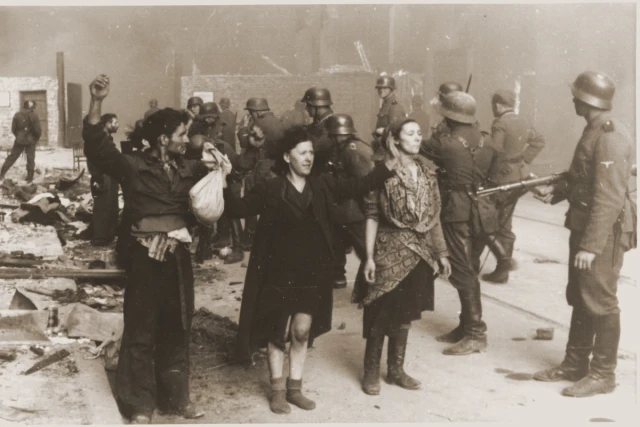
Nazi troops rounded up almost half a million people, primarily Jews and also some Roma, forcing them into an area of less than 3.5 square kilometers (1.5 square miles) where they were subjected to starvation, disease and death. On average, nine people were crammed into each available room, and many were left on the streets with no shelter at all, according to Encyclopedia Britannica.
Charles G. Roland explains in his book “Courage Under Siege: Disease, Starvation and Death in the Warsaw Ghetto,” that by 1941, the official ration provided just 184 calories for those trapped in the ghetto (between 5-10% of what most people need each day), leading to thousands of deaths. He quotes a deputy in the Ordnungsdienst municipal police as saying, “Natural death in the street from hunger, exhaustion, exposure, heart attack, or infectious disease had become the rule.” Roland describes the dead bodies strewn in the streets and skeletal survivors, barely alive and too weak to move.
Periodically, ghetto inhabitants were carted off in their thousands to concentration camps such as Treblinka, decimating the population from half a million to a few thousand by 1944. However, there were a few isolated Jewish people remaining outside the ghetto, including one Messianic Jewish believer named Rachmiel Frydland. He wrote of his experiences, saying,
“In late 1944, by hiding in cemeteries, deserted churches, and the homes of fearful friends, I was one of the few surviving Jews in Warsaw outside the ghetto. In that enclosure were 5,000 Jews, the last of Warsaw’s original 500,000. By God’s enabling, I secretly slipped into the ghetto and was able to speak comfort to a few of the Jewish believers still alive. Other Jewish brethren heard the message and believed in Messiah Jesus. My friends in the ghetto insisted that I leave. They said that if God had preserved me thus far, I would be a witness to the woes they now experienced. At the end of the war, I could tell the story of their suffering. I was probably one of the last to leave the ghetto. It was only shortly afterward that the Germans obliterated the entire Jewish area.”
In his research paper, “Heroes of the Holocaust: Poland, the Warsaw Ghetto and Yeshua,” Dr. Mitch Glaser records that there were around a quarter of a million Messianic Jews in Eastern Europe before so many were murdered in the Holocaust, and that many had been trapped in the Warsaw Ghetto.
However, before the ghetto’s destruction, there was an incredible uprising of courageous resistance, and this is what Israel’s Memorial Day chooses to focus on, rather than the international rescue that came in January 1945. For this reason, Israel’s Holocaust Memorial Day is known as “Yom HaZikaron laShoah ve-laG'vurah” (יום הזיכרון לשואה ולגבורה), which means "Day of Remembrance for the Holocaust and heroism."
Several resistance groups had been forming, but the uprising itself began after 250,000 had been forced onto trains for supposed “relocation to the east,” and the horrific news filtered through that they had been taken to their deaths. One of the resistance groups, Żydowska Organizacja Bojowa (The Jewish Fighting Organization, ŻOB), led by 23-year-old Mordecai Anielewicz, urged people to resist going to the railroad cars at all costs.
By January 1943, ŻOB led the uprising of some 700 Jewish men and women who began to bravely fight against their captors. They refused to attend assembly points and hid underground, fighting with weapons that had been smuggled into the ghetto.
The uprising began on April 19, which is Nisan 14 on the Jewish calendar, the day before Passover. Despite the odds against them, they courageously resisted the Germans for an entire month. However, the heroic resistance fighters were woefully outmatched by the Nazis. They were eventually overcome by May 16, when they were captured and killed, and the ghetto was ultimately destroyed.
Given the proximity to Passover, it was decided to mark the anniversary of the Warsaw Ghetto Uprising eight days before Independence Day, as a reminder of the critical importance of an autonomous state for Jewish people to defend themselves from the violence and annihilation attempts that never seem to stop.
Israel’s memorial day for the Holocaust and its heroes, Yom HaZikaron laShoah ve-laG'vurah, was deliberately chosen to emphasize the heroism of the Warsaw Ghetto Uprising and those who refused to die without a fight.
You might also like to read this: