Finance Ministry weighs canceling Eilat tax exemption, raising retirement age to address budget deficit - report
Finance Minister Smotrich denies reported changes, says journalists failed to contact him



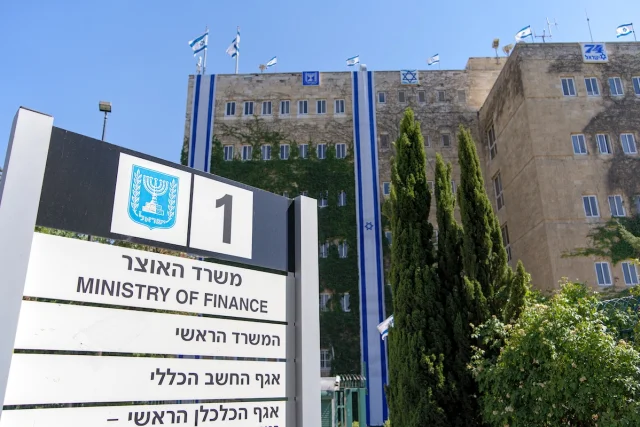
Reports in Hebrew media on Tuesday stated that the Finance Ministry was planning to implement sweeping reforms in order to reduce the budget deficit, including raising the retirement age and cancelling the exemption on the VAT in the southern port city of Eilat.
Following those reports, Finance Minister Bezalel Smotrich posted a message to social media, denying the two most prominent reforms, which featured widely in headlines of Hebrew news sites.
“I'm seeing false reports on websites,” Smotrich wrote. “Journalists haven't contacted me on the matter to ask and clarify, this isn't serious and that's how these reports look too.”
“So at least the public should know my position,” he continued. “A. The retirement age will not rise to age 70. The issue is not on the table. B. The VAT exemption for the city of Eilat will remain. Residents of the city can rest easy.”
The idea of raising the retirement age and canceling the VAT exemption for the city of Eilat, which functions as a tax-free zone, are not new ideas, as both ideas have been previously discussed in the Finance Ministry, even before Smotrich took that portfolio.
The initial reports in Hebrew media said that department heads at the Finance Ministry were formulating a plan for the years 2027-2032, which is expected to include a series of reforms aimed at reducing the deficit.
The planning was being carried out under the direction of Minister Smotrich, who asked for the long-term planning for the next term. However, recognizing the reality of upcoming elections, and a possible new government, there were no attempts to formulate a state budget.
The planning was carried out by members of the professional echelon in the Finance Ministry, meaning that several of the suggested changes will likely be proposed again, regardless of who holds the ministerial portfolio.
Among the other proposed changes are reductions to mandatory pension contributions, which can reach as high as 30% of a worker’s salary, when all contributions, taxes, and deductions are factored in.
Additionally, the Finance Ministry proposed gradually reducing certain tax exemptions, including the VAT exemption in Eilat, and VAT exemption on fruits and vegetables, as well as reducing tax benefits for new immigrants and communities affected by the 2023 Gaza War.
The Finance Ministry also proposed reducing the budget for the Defense Ministry, while excluding the NIS 350 billion ($120 billion) recently added by Prime Minister Benjamin Netanyahu.
The Finance Ministry also recommended cutting all special coalition funds, such as recent funding for ultra-Orthodox education, while also reducing the number of ministries through mergers and cuts.
The Israeli government currently has a higher number of ministers than ever before as part of a bid to give ministerial positions to coalition partners. The Finance Ministry estimates that reducing the number of ministries and ministerial salaries could save as much as NIS 10 billion ($3.4 billion) over a 4-year government term,
You might also like to read this: