The Jews God did not replace
Why Messianic Jews test whether Christian anti-replacement theology is serious


Some theological errors begin as doctrines and end as instincts.
Replacement theology is one of them. At its crudest, it says that the Church has inherited Israel’s promises while Israel has been left only with judgment. But its deeper danger is not merely doctrinal. It teaches a way of seeing. It trains Christians to look at living Jews and see a remainder, a people whose covenantal purpose has supposedly expired. It turns Israel from a people into a symbol, from a covenant into a metaphor, from a living wound into a completed argument.
Cookie Schwaeber-Issan recently warned Christians against precisely this danger in an All Israel News column. Her argument was direct and necessary: God knew Israel’s failures before any modern critic discovered them. He judged Israel, scattered Israel, disciplined Israel—and still promised to regather, restore, and remain faithful to Israel. Her point was not sentimental. It was covenantal. If God has not revoked His promises to Abraham, Isaac, Jacob, and their descendants, then no Christian has authority to rewrite the deed of inheritance in the name of spiritual superiority.
That warning should be received. But it should also be carried further.
Replacement is not only a doctrine. It is a habit of misrecognition. It begins whenever one community takes another community’s name, promise, suffering, vocation, or inheritance and quietly assigns it elsewhere. Sometimes this happens in theology, when the Church claims Israel’s blessings while leaving Israel only judgment. Sometimes it happens in politics, when Israel is treated merely as a strategic asset, prophetic clock, geopolitical nuisance, or moral abstraction rather than as a living people. And sometimes it happens in law and communal life, when actual Jewish persons are made invisible because they do not fit the categories by which institutions prefer to see them.
That last form of replacement is where Messianic Jews in Israel become the stress test.
If Christians are right to reject the claim that the Church has replaced Israel, then Christians must also reject the subtler claim that a Jew who believes in Yeshua has somehow been replaced by a non-Jew. One need not accept Messianic Jewish theology to see the moral problem. A Jewish person’s ancestry, memory, family, peoplehood, and covenantal history do not disappear because a legal, religious, or social institution finds his confession inconvenient.
The question is not whether Israel’s rabbinate must recognize Messianic Judaism as Judaism. That is a separate theological and communal question. The more basic question is whether a Jewish state, built to protect Jewish continuity after centuries of exile and attempted annihilation, can also protect Jewish conscience when that conscience takes a form many Jews find painful, alien, or wrong.
That distinction matters, especially now.
Since the October 7 massacre and the war that followed, public language about Jews, Israel, Zionism, Christians, Palestinians, and religious belonging has become combustible. In the United States, the ADL 2024 audit recorded 9,354 antisemitic incidents, the highest number in the organization’s tracking history. In Israel itself, Christians remain a small but significant minority: the Israel Central Bureau of Statistics reported approximately 184,200 Christians on the eve of Christmas 2025, about 1.9 percent of the population. Meanwhile, the Rossing Center 2024 report on attacks against Christians in Israel and East Jerusalem documented harassment, physical attacks, vandalism, desecration, and growing concerns among Christian communities about the erosion of spaces they have inhabited for centuries.
In such an atmosphere, Christians must be doubly careful. We must not use Jewish suffering as raw material for our systems. We must not use Israel merely as a prophetic timetable. And we must not use Messianic Jews as trophies in an argument against Judaism. They are not symbols first. They are persons first.
The biblical argument against replacement theology begins where Scripture’s covenantal architecture begins: with Abraham. God promises land, seed, nationhood, and blessing. The Abrahamic covenant is not a vague spiritual mood; it has concrete shape. It concerns a people, a land, and a blessing that will reach the nations. A Messianic teaching outline on Zionism and Israel summarizes the covenant’s central provisions as the land promise, the national promise, and the spiritual blessing promise, confirmed through Isaac, Jacob, and the twelve tribes.
Genesis 15 sharpens the matter. In the covenant ceremony, God alone passes between the pieces. The meaning is stark: the covenant is binding upon God Himself. The promise does not finally rest on Israel’s later moral performance, but on God’s own faithfulness.
That does not make Israel immune from discipline. Scripture never says that. Israel’s disobedience brings judgment, exile, and suffering. But discipline is not cancellation. Exile is not replacement. The Land Covenant anticipates worldwide dispersion followed by regathering; Israel’s failure under the Mosaic Covenant does not nullify the Abrahamic Covenant.
This is the theological center of the matter: God does not confuse punishment with abandonment. He does not confuse exile with divorce. He does not confuse Israel’s failure with His own forgetfulness.
Jeremiah 31 presses the point with almost cosmic force: Israel’s national standing is tied not to its perfection, but to the fixed order of sun, moon, and stars. Ezekiel 36 makes the same scandalous promise from another angle: Israel is disciplined for profaning the land and the Name, yet God still pledges to gather, cleanse, restore, and renew. Romans 11 then warns Gentile believers not to boast over the natural branches. The gifts and calling of God are irrevocable not because Israel is sinless, but because God is faithful.
Eugene Merrill makes this covenantal logic plain in scholarly form. In his essay on the Abrahamic covenant, Merrill argues that the covenant is foundational to God’s dealings with a fallen world. The Mosaic covenant did not make Israel God’s people; rather, it called Israel, already Abraham’s seed, to serve as witness-bearers to God’s redemptive plan articulated in the Abrahamic covenant.
That is why Romans 11 is not a decorative proof-text. It is a warning label on Gentile theology. The Gentile Church does not become holy by confiscating the root; it lives by being grafted into a story it did not author.
Messianic Jews stand precisely at this difficult intersection.
They remind Christians that the Jesus movement did not begin as a Gentile religion. It began among Jews. Its first arguments were Jewish arguments. Its first Scriptures were Israel’s Scriptures. Its first confession was not a rejection of Israel, but a claim about Israel’s Messiah.
Arnold Fruchtenbaum’s study of First Peter presses that point exegetically. He argues that Peter wrote to Jewish believers of the Dispersion, that “Dispersion” was a technical Jewish term for Jews living outside the Land, and that Peter distinguished those Jewish believers from the Gentiles among whom they lived. Fruchtenbaum further frames Jewish believers in Yeshua as the present remnant of Israel and argues that First Peter’s language should not be flattened into a generic replacement of Israel by the Church.
Scholars differ over whether First Peter’s audience was primarily Jewish or mixed. But the debate itself reveals the central point: the early Jesus movement cannot be honestly understood by erasing Jewish believers from the frame. Jewish belief in Yeshua is not a late embarrassment to Christian history. It stands at the beginning of Christian history. Before there was a Gentile Church debating its relationship to Israel, there were Jews proclaiming that Israel’s Messiah had come.
Modern Messianic Jews are not a large community, but they are not imaginary. The Caspari Center survey reported that the Israeli Messianic movement had more than tripled over twenty years and placed the number of Israeli Messianic believers in 2020 at 15,323. A St Andrews Encyclopaedia of Theology overview describes Messianic Jews as Jews who accept Jesus—Yeshua—as Messiah and Lord and estimates the number of Messianic Jews in Israel somewhere between 8,125 and upward of 30,000, depending on definition and source. These numbers are small in national terms. But small communities often reveal the deepest tensions in a society’s moral architecture. A minority can expose the weakness of a category precisely because it cannot be comfortably absorbed into it.
That is what makes Messianic Jews so difficult for settled systems. To many Christians, they are a reminder that salvation did not begin in Rome, Geneva, Canterbury, Wittenberg, Nashville, or Dallas, but in Jerusalem. To many Jews, they evoke the long and bitter history of Christian coercion, contempt, forced conversion, social pressure, and missionary triumphalism. Both reactions have history behind them. Christian memory should be humble enough to admit why Jewish fear of Christian mission exists.
But fear should not become erasure.
Israel’s legal history shows why this issue is delicate. The Law of Return amendment rightly expresses the Zionist conviction that the Jewish people need a homeland open to Jews from the countries of their dispersion. But the law also contains limiting language. It extends rights to certain family members of Jews, while excluding “a person who has been a Jew and has voluntarily changed his religion.” It defines a Jew, for purposes of the law, as one born of a Jewish mother or converted to Judaism “and who is not a member of another religion.”
That language has had consequences. In the Brother Daniel/Rufeisen case, a Polish Jew who had become a Carmelite monk was not treated as a Jew for purposes of the Law of Return. Later, after the Shalit case, the phrase “and who is not a member of another religion” became central to the legal definition. Messianic Jews fell directly into this fault line. In the Beresford litigation, Gary and Shirley Beresford were denied relief on the ground that their faith in Yeshua placed them in a religious category incompatible with Judaism, even though the State did not recognize Messianic Judaism as a separate religion.
Here the matter becomes legally precise and spiritually haunting. A person may remain Jewish by ancestry, memory, family, and peoplehood, yet become difficult for a legal category to see. The person has not vanished. The category has failed.
This is the kind of error modern institutions often commit. They mistake the map for the land. They mistake the label for the person. They mistake administrative clarity for truth.
Replacement theology is a theological category error. But legal and social systems can commit category errors too. They can turn living people into contradictions. They can decide that because a person’s faith is unacceptable to a community, the person’s identity must therefore be treated as unstable, suspicious, or unreal.
A Jew who believes in Yeshua may be theologically unacceptable to many Jews. But that does not mean his Jewish story has been metaphysically erased. It does not mean his grandparents disappear. It does not mean exile and memory disappear. It does not mean the Shoah, the synagogue, Hebrew prayer, family history, Jewish suffering, Jewish hope, or love for Israel vanish into a bureaucratic checkbox marked “another religion.”
Nor should Christians respond with triumphalism. Christians must not say, “See, Israel rejects its own.” That is another form of misuse. It turns Messianic Jews into weapons. It exploits their vulnerability for apologetic advantage.
The better response is covenantal humility.
Christians should say: we were grafted in; we did not replace the root.
Israel should be able to say: we need not accept your Christology to protect your conscience.
And Messianic Jews should be allowed to say: our faith in Yeshua does not make us props in someone else’s story.
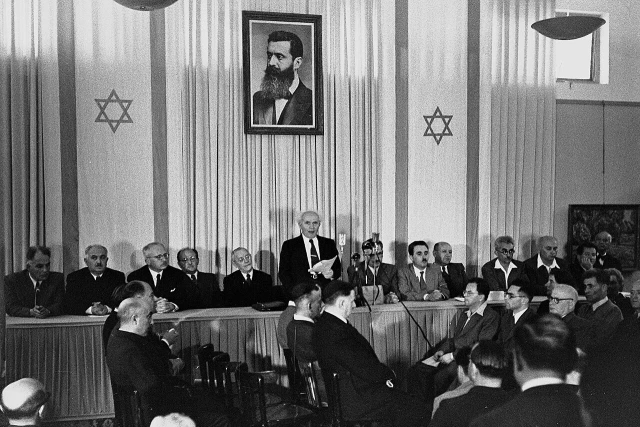
This is where Israel’s own founding language matters. The Declaration of Independence describes the Land of Israel as the birthplace of the Jewish people, where their spiritual, religious, and political identity was shaped. It declares that Israel will be open for Jewish immigration and the ingathering of the exiles. But the same declaration also promises complete equality of social and political rights irrespective of religion, race, or sex, and guarantees freedom of religion, conscience, language, education, and culture.
That is not a foreign standard imposed upon Israel from outside. It is Israel’s own noblest self-description.
A Jewish state secure enough to defend Jewish continuity should also be secure enough to protect Jewish conscience. That does not mean the rabbinate must affirm Messianic theology. It does not mean Israeli law must dissolve the distinction between Judaism and Christianity. It does not mean the Church may ignore the historical wounds created by Christian coercion. It means the State can distinguish between theological disagreement and civic dignity. It can say: we do not accept your claim that Yeshua is Messiah, but we will not pretend that your ancestry, conscience, dignity, or lived Jewishness have become nothing.
This is especially important because harassment of Christians and Messianic believers is not merely theoretical. The 2008 bombing that severely injured Ami Ortiz, the teenage son of a Messianic pastor in Ariel, remains a brutal reminder of what can happen when religious hostility mutates into dehumanization. The same class materials recount that the package bomb exploded when Ami opened what appeared to be a Purim gift basket, and they describe broader harassment of Messianic leaders and congregational members, including fliers with names and addresses.
The present moment requires moral clarity on two fronts at once. Antisemitism is real, rising, and dangerous. Anti-Christian harassment in Israel is also real, documented, and corrosive. One truth does not cancel the other. Indeed, the biblical mind should be capable of holding both. To defend Jews against antisemitism is not to ignore Christian vulnerability. To defend Christian and Messianic Jewish conscience is not to deny Jewish trauma. Moral seriousness refuses the cheap comfort of one-sided seeing.
That is why the anti-replacement argument must mature.
It must reject crude Christian supersessionism, yes. But it must also reject the pious misuse of Israel. Christians must not turn every headline into a prophecy chart, every war into a proof-text, every Jewish tragedy into confirmation of their interpretive system. That is not love. That is consumption.
The same Zionism notes warn against “newspaper exegesis,” the habit of forcing events into prophetic speculation in ways that can shift blame onto Israel and the Jewish people. That warning is wise. A biblical defense of Israel should not become superstition. It should produce prayer, repentance, practical love, evangelistic seriousness, historical humility, and moral steadiness—not sensationalism.
A Christian who truly rejects replacement theology should become less arrogant, not more. Less eager to decode every headline. Less willing to instrumentalize Jews. Less tempted to treat Israel as a theological possession. Less likely to use Messianic Jews as proof that his system is right.
The Bible teaches a better measurement.
Election is not entitlement. Discipline is not abandonment. Fulfillment is not confiscation. Inclusion is not erasure. Gentile blessing does not require Jewish displacement. Christian faithfulness does not require Jewish invisibility. And the confession that Yeshua is Messiah does not authorize anyone to despise the people through whom the Messiah came.
This is the deeper point Schwaeber-Issan’s warning opens for us. Christians who say the Jews have been replaced are not merely making an exegetical mistake. They are assuming authority over a covenant they did not make. They are revising God’s faithfulness downward to fit their system. They are saying, in effect, that Israel’s failures are stronger than God’s promises.
But the warning presses further. If the Jews have not been replaced, then Jewish believers in Yeshua must not be replaced either—not by Christian triumphalism, not by Jewish communal fear, not by legal categories, not by media caricature, not by institutional discomfort.
No one needs to agree with Messianic Judaism to defend Messianic Jews from erasure. No one needs to accept their Christology to recognize their dignity. No one needs to resolve every theological dispute between synagogue and Church before saying that a living Jewish person should not be reduced to a bureaucratic contradiction.
Messianic Jews are not a problem to be filed away. They are a wound in our categories. And perhaps, by God’s mercy, they are also a witness against them.
To the Church, they say: remember where you came from.
To Israel, they say: Jewish identity is deeper than administrative neatness.
To both, they say: the covenant is larger than your categories.
God did not replace the Jews. Christians must not replace them with the Church. Nations must not replace them with abstractions. And no one should replace living Jewish persons—including those who confess Yeshua—with a label that makes them disappear.
The promise is older than our polemics. The covenant is deeper than our categories. And mercy is more exact than our definitions.
You might also like to read this: