42 lost pages of early New Testament manuscript recovered through technology and careful research
The recovered pages come from one of the oldest manuscripts of Pauline letters





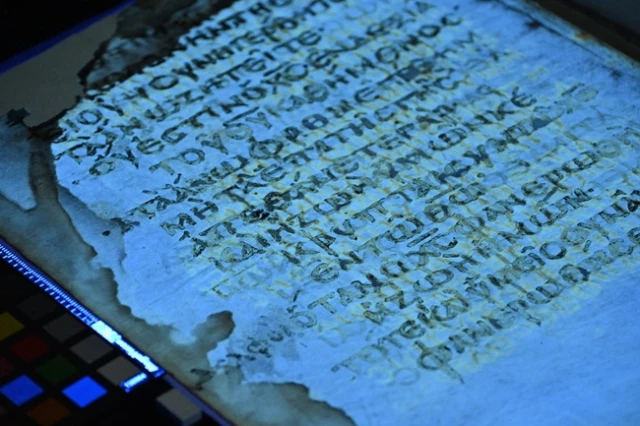
A team of academics at the University of Glasgow has successfully recovered 42 lost pages from one of the most important early New Testament manuscripts, called Codex H, the university announced in late April.
The manuscript, a 6th-century copy of the Letters of Paul, is considered important, not only because it contained one of the oldest collections of the Pauline epistles, but also it was the earliest manuscript to contain the “Euthalian Apparatus,” a collection of reader aids for understanding the book of Acts and the Pauline letters.
Designed as an aid to understanding the Pauline corpus of texts, as well as the book of Acts, the “Euthalian Apparatus” contains editorial material, including some of the earliest chapter divisions, a chronology of Paul’s journeys and letter writing, a list of locations where each epistle was believed to have been written, as well as a list of quotations and citations from the Old Testament which appear in the Pauline writings.
Traditionally, the “Euthalian Apparatus” is attributed to Euthalius, a bishop of either Sulci in Sardinia, Sulca in Egypt, or Sulce, near Syene, also in Egypt. The apparatus dates to the 4th or 5th century, appearing in Armenian and Syriac texts in the late 5th century.
According to Daniel B. Wallace, founder and executive director of the Center for the Study of New Testament Manuscripts, and Senior Research Professor Emeritus of New Testament Studies at Dallas Theological Seminary, the apparatus contained in these pages “is the oldest one we have.”
The 42 rediscovered pages of Codex H were considered lost to history when they were removed from that codex in the 13th century. Due to the effects of aging, the pages were scraped clean, re-inked, and then reused as binding material and flyleaves for other manuscripts at the Great Lavra Monastery on Mount Athos, Greece. Due to the high cost of creating parchment, this reuse was common practice in the Middle Ages.
Today, the surviving fragments of the codex are contained in these manuscripts, scattered across libraries in Italy, Greece, Russia, Ukraine, and France.
“The breakthrough came from an important starting point,” Professor Garrick Allen related. “We knew that at one point, the manuscript was re-inked.”
“The chemicals in the new ink caused ‘offset’ damage to facing pages, essentially creating a mirror image of the text on the opposite leaf – sometimes leaving traces several pages deep, barely visible to the naked eye but very clear with latest imaging techniques,” Professor Allen explained.
“In partnership with the Early Manuscripts Electronic Library (EMEL), researchers used multispectral imaging to process images of the extant pages, in order to recover ‘ghost’ text that no longer physically exists, effectively retrieving multiple pages of information from every single physical page,” he continued. “To ensure historical accuracy, the team also collaborated with experts in Paris to perform radiocarbon dating, confirming the parchment’s 6th-century origin.”
Multispectral imaging uses light outside the visible spectrum, such as ultraviolet and infrared, to reveal details invisible to the naked eye.
Technology is changing how we see, count, and understand pages of documents long lost or even completely unknown.
— Wes Huff (@WesleyLHuff) April 29, 2026
42 pages from the 6th century Codex H (015) were revealed via the use of multispectral imaging. MSI deciphered the letter tracings of the palimpsest showing the…
Speaking to CBN News’ Raj Nair, Dr. Wallace clarified, “We don't actually have 42 new pages. What we have is the residue of ink left over from those 42 pages that was pressed against the following page.”
Dr. Wallace also clarified that the discovery does not involve any new material to the New Testament. Saying that the recovered pages contain about 130 verses of Paul’s letters, he explained, “it's something like 130 more verses are found in Paul's letters than what we had known before previously for this manuscript. But it's not 130 verses more that we didn't know about at all. It's just for this particular manuscript.”
While the recovered text contains no “new” material from Paul’s letters, the discovery provides a unique insight into how the New Testament was transmitted and understood through the centuries. For example, the chapter and section divisions in Paul’s letters and the Book of Acts contained in these pages are different to the modern groupings and divisions. In some older codices, the order of books in the New Testament differs from that found in modern Bibles.
Dr. Wallace clarified, however, that the verse order in all Pauline letters is the same as in modern Bibles.
“Given that Codex H is such an important witness to our understanding of Christian scripture, to have discovered any new evidence – let alone this quantity - of what it originally looked like is nothing short of monumental,” Professor Allen added.
Key findings from the recovered pages include: ancient chapter and division lists, which differ from those used today; insights into scribal practices; further evidence of how sacred texts were reused and repurposed once they began to show signs of wear.
You might also like to read this: