From the Nile to the Euphrates? What the Bible really says about Israel’s border





During the recent conversation between Tucker Carlson and Mike Huckabee, their exchange on the issue of Israel’s biblical borders quickly became surreal. Carlson seemed eager to push Huckabee into agreeing that the Bible gives the Jews a mandate to rule territory stretching across much of the Middle East. And once Huckabee acknowledged that the Bible does speak about the Euphrates as one of the borders, Carlson treated it as a kind of “gotcha” moment.
The idea that the Bible commands Israel to conquer land “from the Nile to the Euphrates” has become a common talking point and a staple of anti-Semitic conspiracy theories since the dawn of Zionism. But both the biblical text and Israel’s modern history tell a very different story. Let’s look at the facts.
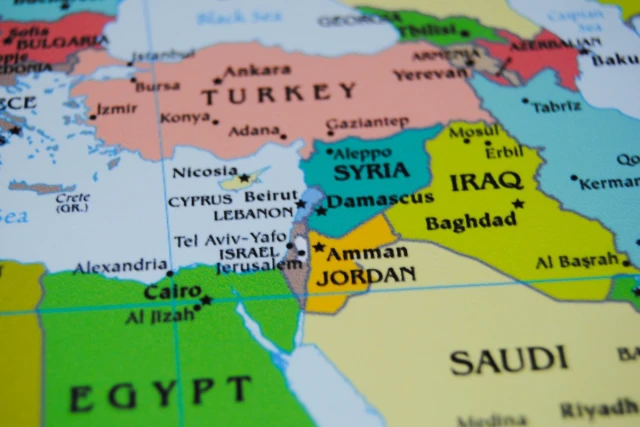
Fact 1: Yes, God promised the land all the way to the Euphrates. In Genesis 15:18, God said, “From the river of Egypt to the great river, the Euphrates.” There is similar language, mentioning the Euphrates, in Exodus 23:31, Deuteronomy 1:7 and 11:24. Some interpret the “River of Egypt” as the Nile, but most biblical geographers identify it with a seasonal wadi on Egypt’s frontier, often associated with Wadi el-Arish or the nearby Besor/Gaza drainage system.
Fact 2: The biblical narrative repeatedly treats the Jordan River, not the Euphrates, as the real eastern boundary of Israel’s heartland. At the end of Deuteronomy, Moses is standing on Mount Nebo, in what is today the Kingdom of Jordan, and God tells him explicitly that he is not allowed to enter the land. If the Euphrates were truly the eastern border of the Promised Land, Moses would already have been standing inside it. Up there, just before he dies, God shows Moses the land west of the Jordan River, and the scripture says:
Then the Lord said to him, “This is the land I promised on oath to Abraham, Isaac and Jacob when I said, ‘I will give it to your descendants.’ I have let you see it with your eyes, but you will not cross over into it.”
Deuteronomy 34:4
In Joshua 22, the few tribes who received allotments on the eastern side of the Jordan River felt disconnected from the others and were worried that their descendants might be pushed away. The detailed border descriptions in the tribal allotments in Joshua cover the areas of Modern Israel and the West Bank only, besides those few eastern tribes. The overwhelming majority of biblical events in Israelite territory take place west of the Jordan River. We know from both biblical stories and from archaeology that the eastern side of the Jordan was inhabited by Ammonites, Moabites, and Edomites, not Israelites.
The promise about the Euphrates, therefore, must be understood carefully. Biblical scholars and interpreters have proposed several ways to understand these verses. Three major explanations are often discussed:
1) Imperial reach rather than settlement. Some scholars believe the promise refers to Israel’s sphere of influence rather than its permanent borders. Under King David and Solomon, Israel briefly dominated territories reaching toward the Euphrates (1 Chronicles 18:3; 1 Kings 4:21), even though the Israelites did not settle those lands.
2) Future or messianic fulfillment. Some interpreters believe the full promise will only be realized in the messianic age or millennial kingdom, when Israel’s borders will expand beyond their historical limits.
3) A conditional promise. Others argue that the full extent of the land promise depended on Israel’s obedience. If the people had fully followed God’s law, their kingdom might have expanded much further than it historically did.
Fact 3: Historical Israel never permanently ruled that territory. What are the actual biblical borders? As we saw, for the east-west borders, a good measure is “From the River to the Sea,” meaning from the Jordan River to the Mediterranean Sea. As for the northern and southern borders, a common biblical shorthand for the country is “from Dan to Beer Sheva,” which is used as a description of the entire country.
These definitions are not entirely clear, as they don’t necessarily correspond to the borders defined in the tribal allotments in the book of Joshua. What do we do with the Negev Desert south of Beer Sheva, for example? Moses visited Eilat, according to Deuteronomy 2:8, and he wasn’t allowed in the Promised Land. What about the northern border? If we go straight west to the Mediterranean Sea from Dan, and say that all that land belongs to Israel, then the Phoenician city of Tyre should be in Israel – but it never was. Not now, and not historically.
If we say “ancient Israel in biblical times,” we also run into trouble, since these borders went back and forth, depending on military conquests and setbacks. We mentioned the Negev Desert before. Only twice in biblical times did Israelite kings extend their territory all the way to Eilat (Solomon and Uzziah in 1 Kings 9:26 and 2 Kings 14:22) and that seems to have been extremely temporary.
So the exact borders are blurry, but it’s extremely clear what the heartland is. None of these definitions excludes Jerusalem, the Sharon Plain, the Mountains of Samaria, the Jezreel Valley, the Galilee, or the Judean Desert. In fact, the entire area today known as the West Bank is within biblical Israel, no matter how we look at it. And for some reason, known only to Him, this is the land God chose for His people. Deuteronomy 11:12 says, “It is a land the Lord your God cares for; the eyes of the Lord your God are continually on it from the beginning of the year to its end.”
Fact 4: The modern State of Israel has consistently surrendered territory rather than expanding, with 1967 being the only exception. The original secular Zionism cared about historic connections and natural indigenous rights, not vague religious promises. Theodor Herzl, the father of modern political Zionism, was originally even open to the Uganda idea. Israeli founding father David Ben-Gurion accepted the 1949 armistice lines that left numerous Jewish holy sites outside of Israel, and no one was seriously talking about conquering Judea and Samaria (West Bank) until 1967.
Only when Jordan attacked Israel in 1967 did the army capture the West Bank, and even then, the government originally tried to prevent settlements and instead reach a peace agreement and give it back. Those attempts failed, but ever since, Israel has repeatedly tried to leave problematic territories, not conquer more.
There were serious talks about giving the Golan back to Syria in the 90s (and thank God it didn’t happen); we gave back Sinai to Egypt; we left South Lebanon, and we left the Gaza Strip. Yet, people keep pointing to these promises of the Euphrates as some sort of “proof” that Israel wants to conquer the entire Middle East. As if Israel doesn’t have enough trouble with the Palestinians as it is.
No Israelis outside a few fringe groups want Israel to reach all the way to the Euphrates. It would only add another few million Arabs to our already complex demographic and political challenges.
This is often how projection works. Accusations that Israel seeks to dominate the Middle East often say more about the fears, assumptions, and ambitions of its critics than about Israel itself. The Nazis said the Jews wanted world domination and then themselves tried to achieve world domination. The Soviets called us capitalists while they bathed in stolen wealth. Iran says we try to dominate the Middle East while they try to do that.
When commentators claim Israel wants to conquer the Middle East, they are not describing what the Bible says, nor what Israel has ever attempted to do. They are misunderstanding the Bible and projecting their own biases. The “Nile to the Euphrates” claim is a persistent myth that misunderstands both the Bible and Israel’s actual history.
So perhaps the next time a television host tries to turn that claim into a “gotcha” moment, it might be worth remembering that the Bible itself paints a much more restrained picture of Israel’s borders.
You might also like to read this: