Iran’s Christian revival: A fast-growing movement with ancient roots




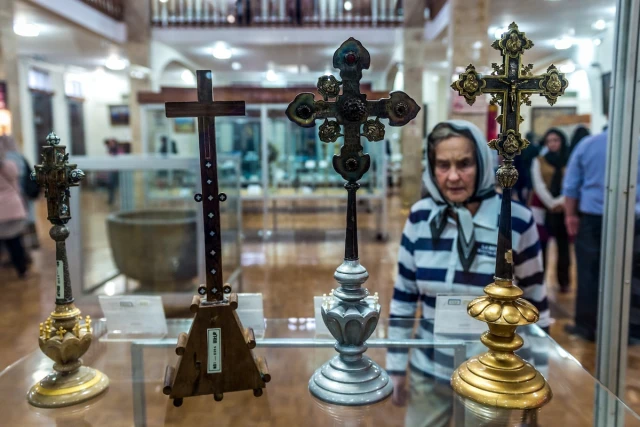
Iran has been home to one of the fastest-growing Christian movements in the world in recent years, but this revival did not begin from scratch. People have been following Jesus there since the time of the first apostles.
In Acts 2, we learn of the Holy Spirit being poured out at Pentecost upon the gathered pilgrims in Jerusalem. Jews had come from far and wide for the Feast of Shavuot, as commanded in the Bible.
Among that number were people speaking Persian: Parthians, Medes, and Elamites: “How is it that we hear, each of us in his own native language? Parthians and Medes and Elamites and residents of Mesopotamia, Judea and Cappadocia, Pontus and Asia, Phrygia and Pamphylia, Egypt and the parts of Libya belonging to Cyrene, and visitors from Rome, both Jews and proselytes, Cretans and Arabians—we hear them telling in our own tongues the mighty works of God” (Acts 2:8-11).
Soon after that dramatic event, the gospel spread far and wide as the persecuted church scattered, taking the good news with them wherever they went. It is documented that Thomas, the one who doubted, took the gospel all the way over to India, but he also had a strong influence in Iran.
Going east, the Silk Road enabled travel, and there was far less resistance to the gospel. Rome was considered an enemy empire by the Persians, and so the disciples of Jesus had a warm reception as the enemy of their enemy. For this reason, the Persian church embraced Nestorian, the Bishop of Constantinople, who was expelled by the Roman church in 431 largely for political reasons, and was able to assure their Zoroastrian rulers that their faith was not connected to Rome.
By AD 225, the Syrian church had carried the gospel east as far as India and even China. Missiologist and theologian David Bosch writes that Iranian Christians carried the Gospel to Yemen, India, and Sri Lanka, and along the Silk Road to China, and were wholly "missionary-minded."
The “Back to Jerusalem” ministry, which serves in closed countries in the East, concurs and goes further: “These ambitious missionaries were planting churches throughout Central Asia, Tibet, Korea, India, Vietnam, Japan, and China,” they added, “Iran sent missionaries out just as the early church sent missionaries to it. One of the twelve disciples, Simon the Zealot, is said to have made his way there and was martyred by being sawed in half in Suanir, Iran,” they inform. “Two monasteries in the northern part of Iran, Saint Thaddeus and Saint Stephanos Monasteries, are said to be related to the history of the apostles Jude and Bartholomew bringing the Gospel to Iran.”
They emphasize that the ancient trade routes between China and Iran would have played a key role in the development of Christianity in the East: “Interestingly, the oldest surviving Christian church in China is claimed to have been built by Nestorian missionaries from Iran, and the oldest surviving church in Iran was rebuilt by the Chinese!”
Iran is not, and never has been, a monoculture, but Zoroastrianism has long been a feature of the region, brought in by Zarathushtra (Zoroaster in Greek) sometime between about 1,200 and 600 BC, according to Encyclopedia Britannica. Christians remained in the minority, without any official endorsement. In contrast to the church, which became part of the political establishment in the Christianized Roman Empire, this lack of connection to the authorities made the faith they proclaimed all the more credible. Despite facing persecution, the Iranian church did not break, and for 200 years, Christianity became part of Iranian society, according to Transform Iran.
The seventh century saw the Islamification of Iran, which began in 637 AD. Initially, Christians had protected status as “people of the Book” and were not persecuted, even though they had second-class status as “dhimmis.” Transform Iran states that between the seventh and thirteenth centuries, the Patriarch of the Nestorian Church oversaw about 12 million believers, nearly a quarter of all Christians at that time.
Nestorians, as they became known, cherished the three values of monasticism, theology, and mission, and continued to carry out the Great Commission even during the Dark Ages.
“Persia was one of Christianity's greatest eastern powerhouses,” says Catholic educator Fr. Jason Charron. “ It was the launch pad for missionary activity, from the Tigris to the Silk Road to China, to Malaysia, into deep Mongolia. Now, this is not a romantic legend; this is documented,” he stated. “The biggest part people miss is that those Christians in the Persian world, they were not like the Christians in in the Latin West or the Middle Ages who were established, the majority. No. People have to understand this. They were a minority, they were persecuted, but they lived under suspicion. But in that pressure, in that minority position, they helped transform the religious map of Asia, and people do not appreciate this.”
Persian Christians also had an impact on the Mongol tribes during Genghis Khan's invasion of Iran. While cities in northern Iran were being destroyed, Nestorian evangelists reached the Keraits. Even some among the emperors’ families had also [been] reached [at] that time. However, in the fourteenth century, another Mongol emperor, Tamerlane, wrought havoc and destruction across the region, decimating the Nestorian church, which had faithfully stood as a witness in Iran for over 1,000 years. It was almost completely destroyed, but still a remnant remained.
The Nestorians later became known as the Assyrian church, and were joined by Armenians from the sixteenth century who were deported from Ottoman areas into Iranian cities. By the nineteenth century, some 100,000 Armenians had settled in Iran, according to Transform Iran, and together these groups constituted the church in Iran until the Islamic revolution in 1979.
The 1800s saw the arrival of Western missionaries and progress in Bible translation, with Henry Martyn coming in 1811 to complete his Persian New Testament and Dr. William Glenn completing the Bible in 1847. Later in 1870, Robert Bruce came to Isfahan, and Anglicans and other believers established hospitals and schools. However, Transform Iran states that there was a cultural clash between Western missionaries and the Eastern Assyrian Church, resulting in the growth of the predominantly Assyrian and Armenian Presbyterian Church of Iran, which grew to 6,000 members across 25 congregations.
In the 1950s, before the revolution, there was an extended time of earnest prayer and fasting among Armenian Christians in Isfahan, asking for an outpouring of the Holy Spirit. What followed was profoundly powerful and an increase in courage among the believers, including a greater desire to share with their Muslim neighbors. In the years that followed, as persecution increased, many of those involved were forced to flee, and others lost their lives, one of the most well-known being Haik Hovsepian, who was martyred in 1993.
Despite the suffering, a very powerful, strong movement had emerged praying for the conversion of their Muslim countrymen, who were mostly Shiite Muslims, huge numbers of whom have since come to believe in Jesus. Their prayers were joined by believers worldwide in the same timeframe, as the global initiative “Praying through the window” encouraged Christians to pray for the Muslim world, including Iran.
Michael Kerem of the Middle East ministry Derech Avraham told ALL ISRAEL NEWS that while there is no way to really measure the impact of these courageous people and their decisions, “These events laid a foundation and led to the growth of the underground church in Iran, especially among Muslim background believers.”
“Something religiously astonishing is taking place in Iran, where an Islamist government has ruled since 1979: Christianity is flourishing. The implications are potentially profound,” wrote Middle East analyst Daniel Pipes in Newsweek, back in 2021.
In a census taken a decade ago, only 117,700 were registered as Christians, 90% of whom were Assyrian or Armenian. However, there are at least a quarter of a million Armenians alone, and these figures do not include the evangelical church, which is now thought to be millions strong, with estimates ranging from a conservative one to one and a half million to seven million.
Pipes explained, “This trend results from the extreme form of Shi’ite Islam imposed by the theocratic regime.” He quoted an Iranian church leader who joked that Ayatollah Khomeini was one of the best evangelists in Iran. As conditions under the regime have grown increasingly oppressive, thousands have left Islam, leaving mosques empty. Some 50,000 of Iran’s 75,000 mosques have closed, according to a senior Iranian cleric and more have since been burned to the ground in the recent protests.
Fr. Charron describes Iran as “a civilisational corridor that once hosted a major Christian centre,” pointing out that it was a “crossroads empire” strategically situated at the intersection of the world's main trade arteries. The history of Christianity in Iran has always been severely challenged, in the minority, and often persecuted, but with an influence that has gone far and wide.
“Today, Christians in Iran are again a small minority facing serious constraints. That parallel matters because it raises a serious question: If Iran was once a nerve centre of Christian missionary activity and learning, could it become that once again? Are the conditions there?” Asks Charron. “They're a minority, they're persecuted. It's a hinge point in the story of faith in Asia, and it was a hinge point in the 600s. It's a hinge point now.”
You might also like to read this: