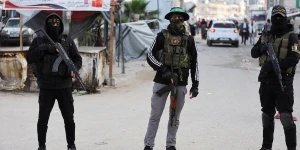
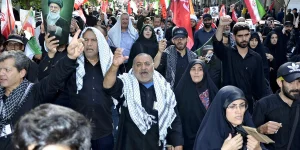
Hezbollah threatens to kidnap IDF soldiers, opposes talks ahead of historic meeting between Israeli & Lebanese ambassadors
'Negotiate as if there is no war with Hezbollah, fight Hezbollah as if there are no negotiations'




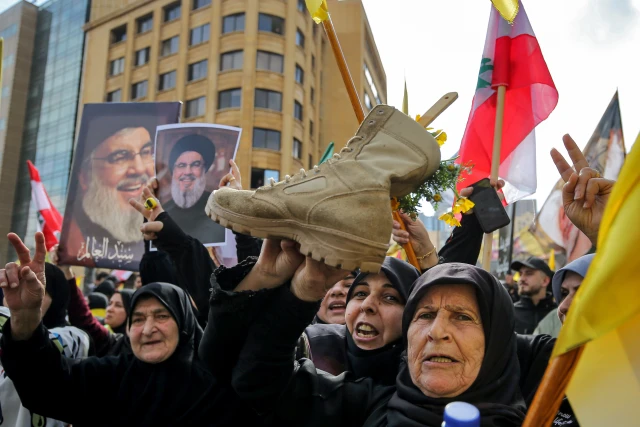
Hezbollah escalated its warnings to the Lebanese government against the first direct and high-level talks with Israel in some 30 years, ahead of a meeting between the Lebanese and Israeli ambassadors to the U.S that was set for Tuesday evening.
In a speech on Monday, Hezbollah leader Naim Qassem again hinted that the terror group would prefer a civil war rather than be disarmed, while threatening to kidnap Israeli soldiers.
After Israel continued striking Hezbollah despite the ceasefire with Iran, the government in Beirut launched a pressure campaign to bring Israel to the negotiating table in an effort to reach a ceasefire in southern Lebanon.
However, diplomatic sources told Army Radio on Tuesday that “The intention is to negotiate as if there is no war with Hezbollah, and to continue fighting Hezbollah as if there are no negotiations.”
Hezbollah’s Qassem in his speech: Lebanese government diplomacy "did not lead to anything." Claims Hezbollah's intervention in the war prevented a surprise Israeli attack on Lebanon. pic.twitter.com/vjoYKlDeMs
— Open Source Intel (@Osint613) April 13, 2026
The talks in Washington will be led by Israel’s Yechiel Leiter and Lebanon’s Nada Hamad Maawad under mediation from State Secretary Marco Rubio, the U.S. ambassador to Lebanon, Michel Issa, and other State Department officials.
Hezbollah, meanwhile, still demands an end to the Israeli military operations and generally opposes contacts with Israel. “We reject negotiations with the usurping Israeli entity,” said Qassem.
He also claimed that the goal of the Israeli operation in the south was to pave the way to a “Greater Israel,” threatening that the group had prepared itself and would use all means of resistance, including the kidnapping of Israeli soldiers.
Hinting at the group’s readiness to provoke a civil war, Qassem warned that the Lebanese Armed Forces are not capable of fighting their own citizens.
Profile of Nada Moawad, Lebanese Ambassador in Washington DC, who will be the first Lebanese civilian to attend direct talks with Israel https://t.co/6pPYUlhvo5 pic.twitter.com/5udKdJflAY
— Mustapha Hamoui (@Beirutspring) April 9, 2026
The Lebanese government last week instructed its military to enforce the state’s monopoly on weapons and establish full control over the capital, large parts of which are under the full control of Hezbollah, including zones where LAF troops are not allowed to enter.
“Our decision is not to calm down and not to surrender, we'll let the battlefield speak, and we reject the futile negotiations,” Qassem declared.
In addition, Wafiq Safa, a high-ranking member of Hezbollah's political council, told the Associated Press that “As for the outcomes of this negotiation between Lebanon and the Israeli enemy, we are not interested in or concerned with them at all.”
“We are not bound by what they agree to,” he reiterated.
According to Kan News, the Lebanese government is split between a camp closer to Hezbollah, which seeks only a ceasefire that would prevent the terror group’s destruction in the south, and an anti-Hezbollah camp which sees the disarmament of the group as the highest priority.
A political source from the anti-Hezbollah camp told Kan that it will be difficult to make progress in the talks as long as the leadership’s priority remains achieving a ceasefire.
Don’t be fooled: Hezbollah is a terrorist organization that also has a political party; it’s not a political party that also has a terrorist wing.
— Ambassador Yechiel (Michael) Leiter (@yechielleiter) April 12, 2026
Watch my full interview with @margbrennan on @FaceTheNation👇🏻https://t.co/ksjMjYo2Po
Responding to Qassem’s speech, a source in the Lebanese presidency told the newspaper Nidaa Al-Watan that the talks in Washington are an attempt to “save what remains” and stop the bloodshed, blaming Hezbollah for “the adventure of war” which provoked the new Israeli operations.
Meanwhile, a senior Lebanese political source told the newspaper that Beirut continues to insist on the declaration of a ceasefire as a first step, which Israel has rejected so far.
Despite this, a Lebanese government source told the Saudi newspaper Asharq Al-Awsat that Lebanon only agreed to the Trump administration’s request to hold the preparatory meeting on Tuesday after receiving a commitment from the U.S. to pressure Jerusalem to agree to a ceasefire in southern Lebanon.
Israel continues to insist that there will be no ceasefire, rather seeking a long-term solution. Diplomatic sources told Army Radio that for Israel, “the goal of the talks is a peace agreement with the Lebanese government that includes all components of such an agreement: land borders, maritime borders, economy, currency, etc.”
“The goal is not normalization in the narrow sense of the word, but a genuine peace agreement,” they emphasized.
However, this can only be accomplished after Hezbollah is disarmed; therefore, “The idea is that the negotiations will highlight to the Lebanese how worthwhile it is to make peace with Israel — and for that, to genuinely fight Hezbollah until it is disarmed,” a source familiar with the talks told the radio station.
According to Ynet News, Israeli assessments point to a growing discontent with Hezbollah even among the Shiite population, which is the terror group’s main support base.
Israeli officials said they believe that some citizens can be convinced Israel has no territorial claims and seeks peace, which could further erode support for Hezbollah and strengthen democratic forces in the country.
In general, Israeli officials expressed low expectations for the talks, acknowledging that the Lebanese government, which wasn’t even able to expel Iran’s ambassador from the country, is unlikely to be able to disarm Hezbollah, even if it were willing to do so.
You might also like to read this: