Netanyahu says Iran campaign ‘not over yet,' says Islamic Republic ‘seeks to annihilate the Jewish state'
Prime Minister’s speech appears to be effort to rally support ahead of upcoming election cycle




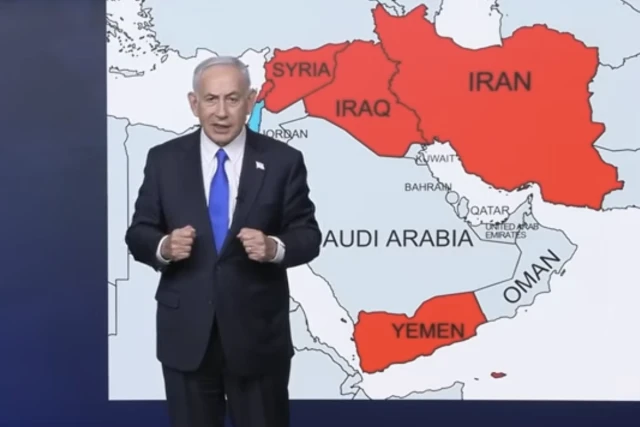
In a video message to the Israeli public on Saturday evening, Prime Minister Benjamin Netanyahu said the military campaign against Iran is “not over yet,” while highlighting achievements from the recent conflict.
“Dear citizens of Israel, my brothers and sisters, the campaign is not over yet, but even now it can be clearly stated – we have achieved historic accomplishments,” Prime Minister Netanyahu said at the start of his message.
The prime minister spoke of the Iranian-led proxy strategy, which the Islamic Republic has used to harass Israel and U.S. interests in the region for decades.
“I want you to remember where we were,” Netanyahu said. “Iran tried to squeeze us in a stranglehold; Hamas in Gaza, Hezbollah in Lebanon, the Assad regime in Syria, the militias in Iraq, the Houthis in Yemen, and Iran itself.”
Netanyahu said the recent Israeli military campaigns against Iran and its proxies have reversed the situation.
“That is to say, they wanted to choke us, and we are choking them. They threatened us with destruction, and now they are fighting to survive,” he continued. “We struck them. We still have more to do.”
Netanyahu said that his efforts to stop Iran’s nuclear program have been a major focus of his political career.
“I want to start specifically with Iran itself, specifically with the head of the octopus, because I have dedicated a significant portion of my life to preventing one thing, that this regime of terror achieves nuclear weapons, through which it seeks to annihilate the Jewish state and bring an end to Jewish history.”
That threat was what motivated Israel to strike Iran in June 2025, launching Operation Rising Lion, Netanyahu claimed, saying, “We were the first to act because we knew what was at stake.”
That action, he said, is what led the U.S. to “fight by our side shoulder to shoulder, wing to wing, for nearly 40 days against the common enemy."
“All of this happened because we initiated, we acted, we attacked,” Netanyahu claimed, saying that “Iran was very close to achieving nuclear weapons and achieving the capability to produce missiles, thousands upon thousands of missiles.”
Netanyahu echoed claims by U.S. President Donald Trump that Iran was actively seeking to develop nuclear weapons, despite denying any such program.
“If we had not launched Operation Rising Lion and later Operation Roaring Lion, Iran would already have atomic bombs, and we prevented that,” the prime minister stated.
“Before Rising Lion, I received precise intelligence, in time, and it told us that Iran was starting to act to turn enriched uranium into nuclear weapons,” Netanyahu revealed. “And the moment we received this intelligence, we went into action. We eliminated 12 of their senior nuclear scientists, we attacked their nuclear facilities together with our American friends—you remember the attack on Fordow with the B-2s. What excellent work they did. And we also attacked missile stockpiles and hundreds of launchers. And all of this removed a dual, immediate existential threat from us.”
He then claimed that “intelligence showed that [former Supreme Leader Ayatollah Ali] Khamenei had ordered the resumption and even the expansion of both the nuclear industry and the missile industry.”
“He wanted to hide both the missile production and the nuclear production deep, deep under a high mountain, in such a way that even B-2 planes could not reach them,” Netanyahu said, claiming this intelligence led to the decision to launch another campaign.
The prime minister continued by listing many of the achievements of the IDF during Operation Roaring Lion, including the elimination of most of the Iranian regime’s leadership, the heads of the Islamic Revolutionary Guard Corps, the heads of the IRGC’s Basij militia, as well as multiple military targets struck and destroyed throughout the six-week operation.
“Dozens of weapon industry factories, and there are many, many more details. I am sparing you, but we did not spare them,” Netanyahu stated.
He then spoke of the achievements against Hezbollah in Lebanon, repeating his statement that “these achievements are not yet finished.”
The prime minister also claimed that Israel’s achievements caused a diplomatic change in the Middle East.
“I want to tell you what happened here: As a result of this power we demonstrated, Lebanon turned to us in the last month, turned several times, to start direct peace talks,” he stated. “We want to reach the disarming of Hezbollah and we want a real peace agreement, a peace agreement that will last for generations.”
However, he said that other nations have also reached out to Israel more discreetly.
“It's not only Lebanon turning to us,” Netanyahu claimed. “Many other countries, both in the Middle East and outside of it, are turning to us for cooperation, for alliances. They see our power; power attracts, just as weakness repels. Power attracts, and Israel today is stronger than ever.”
In conclusion, Netanyahu highlighted the “unprecedented alliance with our great friend the President of the US, between the IDF and of course the US military, relationships that never existed before.”
Netanyahu said that the alliance would lead to further achievements in the future, and ended by quoting the verse from Numbers from which he drew the name of the June 2025 operation.
“‘Behold, a people that rises up as a lioness, and as a lion lifts himself up [Numbers 23:24]’; and with G-d's help, we will continue to act together, and we will continue to win.”
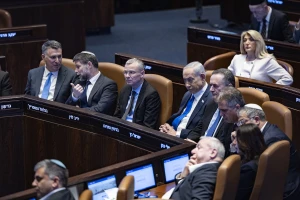
Some Israeli political analysts believe Netanyahu’s speech was an attempt to rally support ahead of the upcoming fall elections. A poll conducted last Thursday by public broadcaster Kan News showed a slight dip in support for Netanyahu’s Likud Party, primarily due to dissatisfaction with the Iran ceasefire.
The Kan poll showed that the current coalition government would win only around 50 seats in the Knesset, short of the 61 needed to secure a majority. However, Zionist opposition parties would also fall short of the majority, getting around 59 seats.
Other polls by competing news agencies showed similar results, with both groups winning nearly half the Knesset seats but failing to reach a majority. The results indicate that the upcoming elections will be tight, with the main focus being on inter-party agreements to secure a coalition.
You might also like to read this: