Serious disagreements emerge between Iranian President Pezeshkian and IRGC commander Vahidi
Pezeshkian warns without ceasefire, Iranian economy could collapse within a month





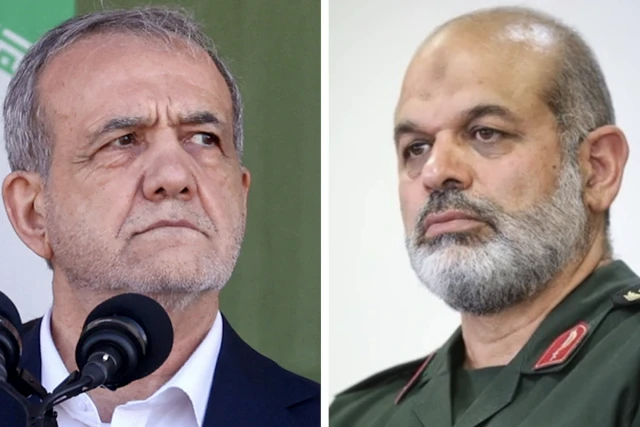
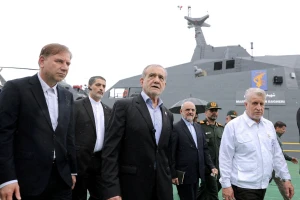
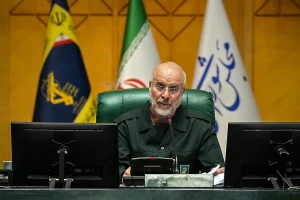
Serious disagreements have arisen between Iranian President Masoud Pezeshkian, head of the political echelon in the Islamic Republic, and Ahmad Vahidi, commander of the Islamic Revolutionary Guard Corps (IRGC), regarding the management of the war and its destructive consequences for the people and the country’s economy, opposition-linked Iran International reports.
Pezeshkian has criticized the Revolutionary Guards’ approach to the conflict by escalating tensions, continuing attacks on neighboring countries, and refusing to negotiate with the U.S., warning of drastic economic consequences from this approach.
Iran International cited “informed sources” who said that Pezeshkian has claimed that without a ceasefire, the Iranian economy faces total collapse within a month.
The Iranian president has demanded the return of executive and managerial powers to the government, a request that Vahidi has completely rejected. The London-based news site said that Vahidi blames the current situation on the government's failure to implement structural reforms before the conflict began.
The office of the president in Iran is not the seat of executive power, as it is in the United States, nor is the position directly equivalent to a prime minister, under a parliamentary system. In the Iranian regime, power is vested in the Supreme Leader, who is supported by the Islamic Revolutionary Guard Corps, which functions as a kind of private military for the Supreme Leader's interests and operates almost entirely separately from the Iranian military.
Pezeshkian has favored a more moderate approach since his inauguration in the summer of 2024. During the recent protests in Iran, he encouraged the government to listen to the protesters, saying they had legitimate concerns.
In a recent video message on March 7, Pezeshkian apologized for what he called the “fire at will” policy by Iran’s armed forces on the neighboring Gulf countries, demanding that such operations stop. Despite his request, the attacks continued shortly afterward.
In recent days, Israeli media outlets, relying on anonymous sources, have also reported signs of a rift between different branches of government in Iran.
The war, which is entering its fifth week, is beginning to reveal even deeper economic consequences on the ground inside Iran. According to the Iran International report, many ATMs are out of cash, out of service, or physically inaccessible to citizens, and online banking services for several major banks are being periodically suspended.
Several sources told the outlet that government employees have not received salaries and benefits for the past three months.
Even before the war, inflation on basic goods reached 105% and 115% in February, as the Iranian economy struggles under the weight of poor fiscal policy and restrictive sanctions imposed over its nuclear and ballistic missile programs.
Some analysts believe the disagreement between Pezeshkian and Vahidi reflects an impasse between different factions over balancing military policies and economic survival.
Meanwhile, Pezeshkian held talks with Pakistani Prime Minister Shehbaz Sharif on Saturday, in which they discussed U.S. efforts to negotiate an end to the war.
At the same time, the Washington Post reported on Saturday that the Pentagon is preparing for the possibility of weeks of ground operations in Iran, as President Donald Trump weighs sending ground troops to deal a “final blow” to the regime.
You might also like to read this: