IDF commander admits different enforcement standards for Arabs and Jews in Judea and Samaria
Bluth says government lacks resolve to confront Jewish nationalist violence in the territories




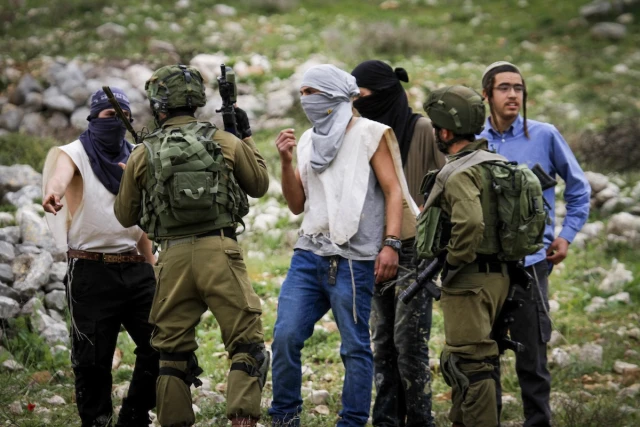
Israel’s top military commander responsible for overseeing IDF operations in Judea and Samaria (West Bank) has acknowledged differences in how rules are enforced between Arabs and Jews in the region, according to a Haaretz report.
Speaking at a recent closed forum, Maj.-Gen. Avi Bluth, head of the IDF Central Command, defended the use of live fire in response to Palestinian stone-throwing incidents, while noting that the use of live fire against Jewish settlers is problematic, saying, “soldiers’ firing on Jews has profound societal consequences.”
Bluth referred to Palestinians who throw stones at passing traffic as terrorists and said, “In 2025, we killed 42 stone-throwers on the roads.”
However, in relation to similar incidents involving Jewish settlers throwing rocks at passing Palestinian vehicles, Bluth said he did not support the use of live fire, citing potential backlash within Israeli society.
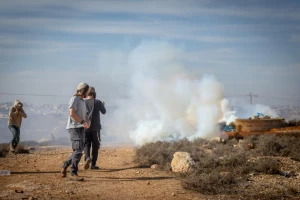
"We hit, for example, two masked Jews,” Bluth said, referring to an incident last summer in which a reservist and a Border Police officer fired at masked assailants who were throwing rocks at passing vehicles.
In that incident, the soldiers fired at the masked assailants, only finding out later that they were Jewish settlers. One of them, a teenager, was wounded by the shooting.
Bluth noted other incidents in which Jewish settlers were injured, and even one case in which a police officer, who was attacked with pepper spray by a group of right-wing activists, responded by opening fire and killed one of the attackers.
The IDF commander said he prefers soldiers to use non-lethal methods when dealing with Jewish suspects, while acknowledging that this approach results in different standards being applied to Palestinians.
"We prefer to resolve these by other means," he said. "Any such incident has very serious consequences from a societal perspective. I'm not sure we need to go there; we don't have to engage in shooting, and yes, it involves discrimination.”
Bluth also acknowledged differences in the arrest and detention of Jewish suspects. He referred to a government decision to halt the use of administrative detention against Jewish settlers accused of violence, even though the measure is still being used routinely against Palestinians.
"You know how many Arab administrative detainees there are?” Bluth asked those attending the forum. “More than 4,000. There's no administrative detention against Israelis, but there are 4,000 Palestinians in administrative detention. Start there, and then we can talk about open-fire orders. I am winning with what I have.”
According to the report, Bluth said he was proud of his decision to relax the rules of engagement when confronting Palestinians in Judea and Samaria, especially those trying to illegally cross the security barrier into Israel for work.
He noted that the current rules of engagement, approved under his command, permit soldiers to shoot a suspect in or below the knee during an arrest.
"At the [separation barrier], it is currently permitted to detain a suspect by shooting him at the knee or below to create 'barrier awareness,’" Bluth reportedly said. He noted that Palestinians working illegally in Israel can earn up to four times more per month than they would working in the Palestinian territories.
“A plasterer in Ramallah earns 1,500 shekels ($510) a month and a plasterer in Ramle earns 7,000 shekels ($2,400) a month,” Bluth explained, “so, of course, he's willing to risk being shot in the knee or a week of detention.”
However, despite acknowledging disparities in the enforcement of law between Palestinians and Jews in Judea and Samaria, Bluth also pointed to the coalition government as partly responsible for the situation.
In an open letter published in March, Maj.-Gen. Bluth urged the Israeli public to take action against the nationalist Jewish crime in Judea and Samaria.
“I call upon you – public leaders, rabbis, educators, parents, and youth – to open your eyes,” Bluth wrote. “Do not lend a hand. Do not stay silent. Do not be dragged along. Do not be swayed by smooth talk that claims to speak in the name of ideology.”
Calling it “a serious and utterly unacceptable danger,” Bluth said, “a violent group of lawbreakers operates in the areas of Judea and Samaria without restraint, in violation of the state's laws, the values of the Jewish people, and the values upon which Zionism is founded.”
He accused them of “harming the Palestinian population that is not involved in terrorism.”
“This group carries out violent actions within the villages or against uninvolved Palestinians and creates deliberate friction that sometimes results even in fatal casualties,” Bluth continued.
He noted that when security forces are required to act, “that same group does not hesitate to direct the violence also toward IDF soldiers, police officers, and commanders,” adding that “beyond the fact that these actions are neither legal nor moral, they constitute a real danger.”
Palestinian, Jewish-Israeli, and foreign activists who document and seek to prevent incidents of settler violence have said that IDF forces often arrive after incidents have already occurred and the perpetrators have left. They also claim that, even when soldiers are present, arrests are rare, with troops sometimes standing by as Palestinians or Bedouins are allegedly harassed or attacked. In some cases, activists have further alleged that soldiers themselves have taken part in the violence.
While the IDF often claims that soldiers in such incidents are “examined thoroughly and disciplinary measures are taken accordingly,” few details are typically made public regarding the outcomes of those disciplinary processes.
At the same time, the coalition government has directed funding toward some settlements established by Jewish settlers that are considered illegal under international law, including the provision of all-terrain vehicles and drones, and even subsidizing grain sales for the animals on illegal farms.
When asked, government ministers often downplay the incidents, with Prime Minister Benjamin Netanyahu recently describing them as the actions of “a handful of kids.”
Elisha Yered (25), a prominent figure associated with the Hilltop Youth settler movement, recently said in a Hebrew-language podcast that settlers often provoke confrontations with Palestinians, stating, “We provoke clashes, and we take pride in it.”
You might also like to read this: