PM Netanyahu reveals: IDF works on ‘special project’ to counter Hezbollah’s deadly FPV drones
Special munitions and sights, tactical radars, net-carrying drones: IDF scrambles to find solutions





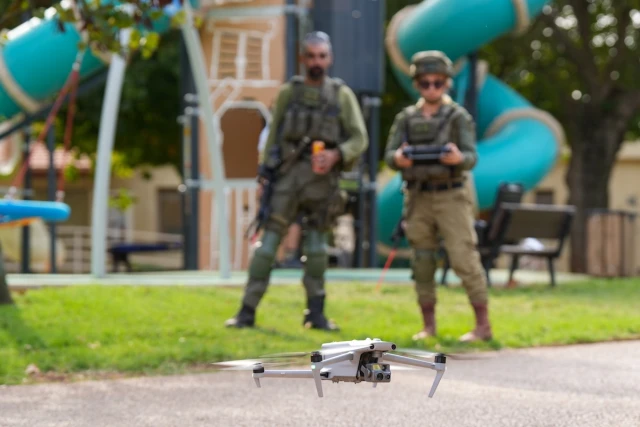
Israel’s security establishment is working on finding a solution to the constant attacks by Hezbollah’s first-person view drones that have killed several soldiers and wounded dozens more in southern Lebanon over the past weeks.
On Sunday, Prime Minister Benjamin Netanyahu stated that he “ordered the establishment of a special project to thwart the drone threat” several weeks ago. “A progress report on the matter will be presented to me today. It will take time, but we are on it. We will continue to ensure Israel's superiority in all arenas,” he added.
Over the past weeks, Hezbollah has markedly ramped up the use of cheap first-person view (FPV) drones, which are controlled via a fiber-optic cable trailing behind the aircraft, making them much harder to detect and intercept than conventional drones.
The Israeli army has scrambled to find solutions to the threat that has killed and wounded dozens of soldiers; however, Israeli media outlets reported that the threat had been known for a long time but was ignored.
A senior official told Israel Hayom that insufficient effort was invested in preparing solutions ahead of time, while the defense establishment is now scrambling to find a response as casualties are mounting.
Security officials also noted that Hezbollah remains in the early stages of operating the drones and has yet to employ the swarm tactics observed in the Ukraine war.
In addition to the lack of countermeasures, the ceasefire also limits the IDF’s ability to preempt attacks by striking Hezbollah targets deeper within Lebanese territory. The fiber-optic cables can reach about 10 kilometers (6.2 miles). The U.S. has also been pressuring Israel not to launch strikes outside the immediate vicinity of the buffer zone Israeli troops are holding in southern Lebanon.
However, with Hezbollah constantly violating the ceasefire with its drone strikes, Ynet News reported on Monday that IDF Chief of Staff Lt.-Gen. Eyal Zamir has instructed the Northern Command and the Air Force to increasingly target the production and supply chain of these drones deeper inside Lebanon, even if this draws the wrath of the Trump administration.
Meanwhile, the IDF is experimenting with tactical responses on the ground. Troops have been instructed to maintain strict operational discipline by taking cover and using improvised nets spread above vehicles to provide protection against direct drone hits.
Troops have also received special “Smart Shooter” rounds and the automatic “Dagger” sight for their rifles to improve their ability to shoot down drones on their own.
Defense Ministry sources also disclosed to Ynet that the IDF is seeking to deploy small radar systems widely across the forces to improve the detection of small drones.
According to Israel Hayom, a company called TSG is also developing a more comprehensive detection system that integrates existing sensors to create a wide-area detection field and synchronizes systems, including Iron Dome and drone-intercepting drones.
TSG is also developing a drone that carries several large nets that can be launched at FPV drones to entangle and stop them. This also has the advantage of being non-lethal during use in urban areas.
Ynet also reported the deployment of a new system using net-launching drones, though it wasn’t clear whether this was the same technology.
“The system is currently being used on a trial basis and has not yet shown significant success,” the report noted, identifying the system as the “Iron Drone Raider”.
Ynet cited military sources saying that the system had been tested previously but had not demonstrated effective detection capabilities. “We’re trying everything,” army officials explained.
You might also like to read this: