Israeli civilian contractor killed as Hezbollah continues constant drone strikes on IDF troops in Lebanon
IDF scrambles to find solutions to new threat from first-person view fiberoptic drones



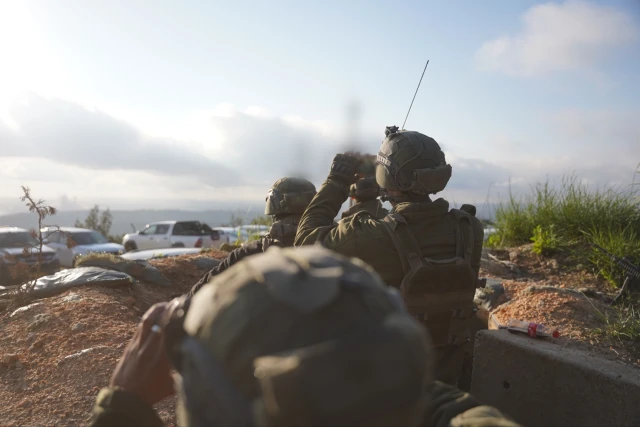
A civilian contractor of the Israeli Defense Ministry became the latest victim of Hezbollah’s incessant drone strikes on Israeli troops operating in southern Lebanon on Tuesday, as the terror group continues its attacks despite the ceasefire.
The contractor, 44-year-old Amer Hujira from the Arab town of Shfar'am, was operating heavy engineering equipment to demolish Hezbollah infrastructure near Bint Jbeil when a drone strike hit his excavator, killing him and injuring his son, who was working alongside him.
According to Army Radio, Hujira was the fourth civilian contractor with the Defense Ministry to be killed in the war, with three others killed in the Gaza Strip.
Despite the declared ceasefire, Israeli troops in southern Lebanon have remained under sustained fire, particularly from drone strikes. The deadly strike was followed on Tuesday by several additional attacks involving explosive first-person view (FPV) drones, in one of which another soldier was wounded. The following morning, another FPV drone was intercepted while targeting IDF troops.
The Defense Ministry civilian contractor who was killed in a Hezbollah explosive drone attack in southern Lebanon today is named as Amer Hujirat from the northern Arab town of Shefa-Amr.
— Emanuel (Mannie) Fabian (@manniefabian) April 28, 2026
His son, 19, who worked for the same company employed by the Defense Ministry, was lightly… pic.twitter.com/L0025u78KE
On Sunday, a drone strike killed Sgt. Idan Fooks (19) and severely injured three others. When the wounded soldiers were evacuated shortly after, an even larger catastrophe was narrowly avoided as another drone struck close to the evacuation helicopter, almost hitting it and some 20 soldiers nearby. On Monday, another soldier was severely wounded by a drone strike.
The increasing frequency of these attacks has caused an internal debate among the military and political leadership over the ineffectiveness of current countermeasures. On Tuesday, Prime Minister Benjamin Netanyahu stated on Tuesday, “A few weeks ago, I gave a directive for a special project to eliminate the drone threat. It will take time, but we will blow that up too.”
Army Radio reported that the drone issue took up significant attention in the IDF’s senior brass forum earlier this week, with several commanders expressing frustration with the limited tools available to counter the attacks.
An artillery commander currently fighting in Lebanon told the assembled commanders, “The drone threat is a significant operational challenge we are dealing with. We need to think about how to better organize ourselves against this threat.”
“There’s not much we can do about it,” said another commander. “The briefing the forces receive boils down to: ‘Stay alert, and if you identify a drone – shoot at it.’”
In a development reminiscent of Russia's war against Ukraine, IDF troops reportedly began improvising tactical solutions, such as covering positions and houses with nets.
“This is an improvised solution – we’ve started deploying it among some units, but it’s far from sufficient,” an officer told Army Radio.
One factor contributing to the challenge is Hezbollah’s increasing use of FPV drones controlled via fiber-optic cables rather than electronic signals, meaning they do not emit signals that can be jammed by electronic countermeasures.
Army Radio reported that the IDF has known about the issue for years, but warnings have gone unheeded so far.
The Israeli military even recruited a Ukrainian army officer with extensive experience countering this type of drone. He now leads a dedicated team in the IDF Planning Directorate to find solutions to the threat.
Almost one year ago, the head of the Operations Directorate instructed the relevant IDF bodies to prepare solutions to detect and neutralize fiber-optic drones, noting that they had become widespread on the Ukrainian battlefields since 2024.
Recommendations included increasing awareness of the threat, reducing movement in open areas during daylight and increasing night movement, and deploying camouflage nets.
Five months ago, IDF representatives reportedly first briefed a classified Knesset discussion on the issue and, this week, presented several proposed countermeasures in a follow-up discussion.
To assist soldiers in carrying out instructions to engage the drones with their personal weapons, the representatives recommended upgrading standard-issue firearms with specialized sights and fragmentation ammunition.
To prevent a repeat of the near catastrophe this week, they also reportedly recommended minimizing the time helicopters spend on the ground during evacuations in order to reduce the risk of detection by drones.
They also said the military will need to deploy additional radar systems within Lebanese territory to strengthen the new forward defense line.
According to Army Radio, these and other measures are now being implemented on the ground.
You might also like to read this: