Replacing Hamas with Hamas

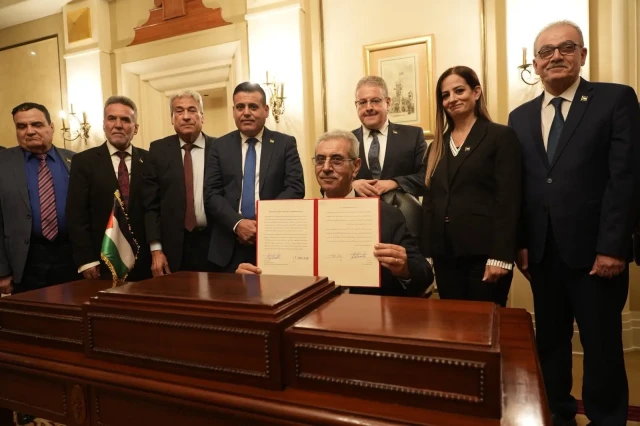
As the saying goes, “the devil is in the details.” So, although Fatah political leader, Samer Sinijlawi, says that Hamas is on the way to being replaced, there’s more to that statement than meets the eye.
Sadly, his details are so murky, that they should be taken with the proverbial grain of salt. Sinijlawi claims that Hamas is ready to transfer “the scope of its authority, hand over, not only weapons tied to internal security, but also governance of its ministries, revenues, taxation systems, administrative structures and human resources – including all authority to enforce the law.”
And who would those new Gaza overseers be? The National Committee for the Administration of Gaza (NCAG). While the name sounds official and legitimate, does anyone know anything about them?
Described as a “transitional body mandated by the U.N. to manage day-to-day operations,” what could possibly go wrong? It wasn’t that long ago that yet another U.N. organization was supposed to be doing “good work” in Gaza. That was UNRWA (United Nations Relief and Works Agency), whose local Palestinian workers were discovered to have facilitated the massacre of October 7.
In this case, the NCAG is also supposed to be comprised of independent Palestinians, supervised by the Board of Peace. Perhaps, I’m overly suspicious, but it sounds as if the U.N. just found a creative way to recycle the UNRWA workers, who were subsequently dismissed from their jobs, once the Gaza offices were closed.
But no need to worry, Sinijlawi assures us that conflict transition, similar to what happened in Northern Ireland and parts of Latin America, is a familiar and accepted process which has been met with success.
There is one small detail that he leaves out, though. Northern Ireland and Latin America were not governed by barbaric terrorists whose sole raison d’etre was to annihilate the Jewish people, first in Israel and then worldwide.
Nevertheless, you have to hand it to Sinijlawi. At least he honestly qualifies that “This is not surrender,” the title of his article. Candidly saying that “Hamas will not raise a white flag, gather every weapon in Gaza and dismantle itself in advance,” he warns that no one should have such expectations, since, doing so is “not a strategy but rather a slogan.”
Why would surrendering be a slogan? Isn’t that what happens when an enemy combatant has been defeated?
But that’s the problem. Hamas has not been completely defeated. There are still enough of them who survived, so where’s the incentive for them to relinquish their authority to others.
Who’s to say that those same terrorist survivors will not repackage themselves as members of the NCAG. In other words, they’ll just swap their old identity for a new one, becoming members of another potentially “doomed to fail” U.N. organization.
Sinijlawi cleverly tries to make the comparison between Israeli citizens, residing in the areas of Judea and Samaria, who remain armed despite having committed crimes. He states that “Israel has not succeeded in fully disarming all militant networks.” What he fails to expound upon is the identity of such criminals, who remain armed and not incarcerated. Because, to my knowledge, those involved in criminal activity are swiftly prosecuted.
Of course, this is also an unfair comparison, just from the point that those living in Judea and Samaria are not the governing forces of the state, the way Hamas was and still claims to be in Gaza.
Sinijlawi asks, “Why is Gaza expected to achieve instantly what no other context has achieved under far more stable conditions?” In answer to his question, it’s “Because Hamas exists for the sole purpose of wiping an entire people off the face of the earth.”
Samer Sinijlawi begins from a place where the events of October 7 were not significant and where Hamas is an equivalent force, similar to others. Wrong on both counts!
If that wasn’t enough, Sinijlawi tries to explain what a “profound disruption” it is to transfer power. For those whose livelihoods and careers are entrenched in Hamas, change for them, as he puts it, will come with the expected resistance.
This is where his arguments begin to take on the form of delusional thinking. Are we supposed to muster sympathy for these “working Hamas men” who will find themselves unemployed and disenfranchised?
From there, he brings up the issue of unpaid salaries and a debt totaling $6 billion owed to banks, businesses, suppliers and employees. If it wasn’t so sad, it might be laughable to think that Sinijlawi expects anyone to relieve a $6 billion debt, incurred by Hamas, when so many of their top leadership stole billions and lived in the lap of luxury in Qatar.
Whose fault is it that billions were spent on terror tunnels, over a 20-year period, when that money could have been used to lift up the people of Gaza out of poverty and deprivation?
His aspiration of starting with a clean financial slate is just too absurd to even mention, even though he does! But, again, this gives you a bit of insight into the endless well of delusion under which this man is operating.
If he were sincere and wanted to be taken seriously, he might start with the acknowledgment that Hamas is a lethal poison which mortally wounded anyone who came in contact with it. He might also take responsibility for the massacre of innocents they planned and executed, as well as the aftermath of how it devastated his own people, leaving them homeless and destitute!
Bu then he would have to start from a position of disavowing the Gazan terror government, the Gazan people who cheered on their efforts and recognize the need to start from scratch, rather than using the remains of what would amount to a seriously fractured foundation.
This is not Sinijlawi’s first attempt at sounding reasonable, in trying to come up with a workable reboot of Gaza. On February 1, 2026, I wrote an article for the Jerusalem Post called, “Is the new Gaza plan doomed to fail?” later reprinted in All Israel News.
In response, Samer Sinjilawi personally responded to me, in the Jerusalem Post with his own article, “Why dismissing Palestinian reform voices is a strategic mistake,” endeavoring to make a convincing pitch why his vision for Gaza would work.
It didn’t sound plausible then, and it still doesn’t now!
You might also like to read this: